


Trackspeed Engineering 12-tooth crank trigger wheel


Thread Starter

Joined: Nov 2006
Posts: 15,442
Total Cats: 2,106
From: Sunnyvale, CA
 Trackspeed Engineering 12-tooth crank trigger wheel
There has been some mumbling and discussion on how cool it would be to have one of these, so I decided to wait on posting this until I had them in-hand. TSE has 12-tooth OEM-location crank trigger wheels in stock. These use the OEM 99+ crank sensor and provide a significant increase in resolution over the OEM trigger wheels. Because they are equally spaced, it is now possible for MSPNP/MS1 guys to join the crank trigger club as well. The teeth are very similar to the OEM tooth profile to ensure that these are as mechanically plug-and-play as possible.
The prototype wheel is working flawlessly on an AEM-equipped car. That car went from +/- 3 degrees of timing slop to +/- <1 degree. Setup info for AEMs with and without VVT will be out shortly, MS2 following that, MS1 following that. We may offer a PnP kit for MS1/MS2 guys at some point, but if you are willing to sort it out yourself jump on this.
The wheels with spacers will retail for $49. To keep costs down, these were manufactured in two pieces - a flat wheel and a spacer. We found the spacer was necessary on some cars to keep the crank trigger clear of the harmonic balancer. They will come with every wheel - if you need it, good, if you don't need it, good.
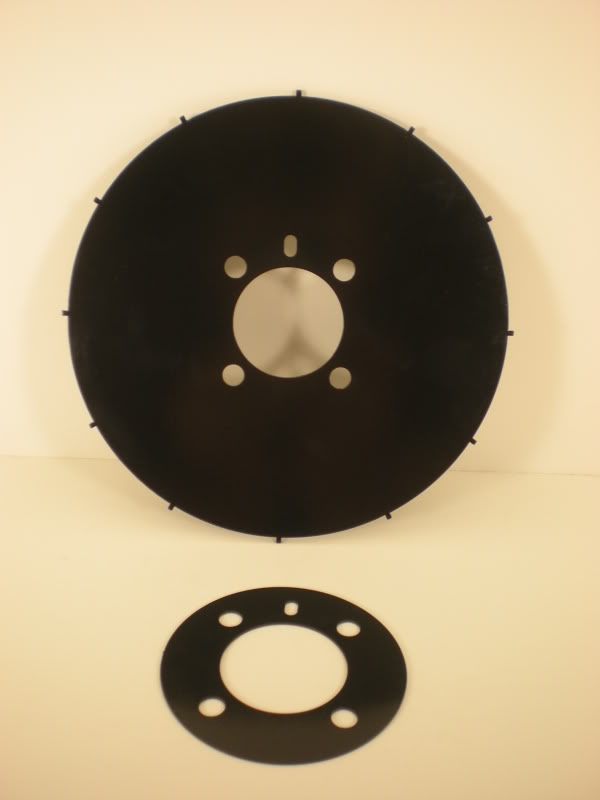
The prototype wheel is working flawlessly on an AEM-equipped car. That car went from +/- 3 degrees of timing slop to +/- <1 degree. Setup info for AEMs with and without VVT will be out shortly, MS2 following that, MS1 following that. We may offer a PnP kit for MS1/MS2 guys at some point, but if you are willing to sort it out yourself jump on this.
The wheels with spacers will retail for $49. To keep costs down, these were manufactured in two pieces - a flat wheel and a spacer. We found the spacer was necessary on some cars to keep the crank trigger clear of the harmonic balancer. They will come with every wheel - if you need it, good, if you don't need it, good.
Last edited by Savington; Jul 20, 2010 at 10:08 PM.
 0
0


Thread Starter
Joined: Nov 2006
Posts: 15,442
Total Cats: 2,106
From: Sunnyvale, CA
Bingo. It's an easy test to do - set your timing at a static 10 degrees, watch the crank pulley with a timing light, and rev the motor. It should never move from 10 degrees, but of course it does - the prototype car was seeing about 3 degrees retard while the RPMs were increasing, and 3 degrees advance while the RPMs were decreasing. The same thing happens when you are accelerating in-gear. With the high tooth count, the motor copes with changes in RPM much better, which means the 10 degrees you are watching at idle will stay at 10 degrees no matter what you do with the throttle.
0






Sav,
Is this the final version, or where there be a missing tooth wheel in the works? A 12-1 wouldn't require a cam sensor, where a 12 tooth wheel would. You could also run sequential with a 12-1 and a cam sensor.
Is this the final version, or where there be a missing tooth wheel in the works? A 12-1 wouldn't require a cam sensor, where a 12 tooth wheel would. You could also run sequential with a 12-1 and a cam sensor.
 0
0

That mostly answers the question I had: what would I need to do in order to run sequential with this wheel? Could one just carefully file/grind off one tooth? It doesn't look like a lot of mass there, but it is on the outer radius so would that affect balance enough to cause problems? Or would that not be necessary if I ran it in conjunction with the CAS?
0
IIRC you must have a number of teeth divisible by 4 (cylinders) plus the missing tooth, all evenly spaced.
so a 12-1 wheel; where there are 12 teeth plus one missing tooth evenly spaced. or a 4-2, or 36-1, etc, etc.
otherwise you use the CAS for a cam sensor for the second trigger.
so a 12-1 wheel; where there are 12 teeth plus one missing tooth evenly spaced. or a 4-2, or 36-1, etc, etc.
otherwise you use the CAS for a cam sensor for the second trigger.
0

IIRC you must have a number of teeth divisible by 4 (cylinders) plus the missing tooth, all evenly spaced.
so a 12-1 wheel; where there are 12 teeth plus one missing tooth evenly spaced. or a 4-2, or 36-1, etc, etc.
otherwise you use the CAS for a cam sensor for the second trigger.
so a 12-1 wheel; where there are 12 teeth plus one missing tooth evenly spaced. or a 4-2, or 36-1, etc, etc.
otherwise you use the CAS for a cam sensor for the second trigger.
I would suspect that you would be able to carefully remove one tooth from this wheel. However I would suggest that the wheel be fabricated without the tooth, as I can't think of an application that would not benefit.
0

Elite Member
Joined: Jul 2005
Posts: 6,420
Total Cats: 84
The AEM can be made to work with the 12 tooth wheel in NON VVT apps.
In a VVT app one tooth MUST be removed. And IIRC there is a choice of only 3 tooth locations that can be removed, and arguably 1 of them is optimal.
In a VVT app one tooth MUST be removed. And IIRC there is a choice of only 3 tooth locations that can be removed, and arguably 1 of them is optimal.
0
Does the AEM then use the 3 tooth NB cam wheel for sync (non VVT)?
MegaSquirt (and most others) can use a 12 tooth crank with a 1 tooth cam in lieu of a missing tooth on the crank wheel.
MegaSquirt (and most others) can use a 12 tooth crank with a 1 tooth cam in lieu of a missing tooth on the crank wheel.
0
Thread Starter
Joined: Nov 2006
Posts: 15,442
Total Cats: 2,106
From: Sunnyvale, CA
Designed specifically for use with the OEM 99+ crank sensor. Same tooth profile. I glanced at Nick's 1.6 SM this morning and it has the mounting boss for the OEM 99+ sensor as well. Haven't looked at the two stock '94s in the backyard but I will next week. I know my car has the mount, but it's a '99+ oil pump. I won't say that it will bolt right onto a 1.6 car since I haven't done it myself but I'll stick it on the front of Nick's car next week to check fitment with the crank pulley. We should be able to supply the sensors as well but we don't have them in stock.
As far as the missing tooth (or lack of a missing tooth), this product started as a bit of a pet project for myself and a few other folks, all of us using AEMs. We wanted a wheel to mate up with OEM NB cam/crank sensors (I think the prototype car is using a modified NA CAS), and those of us who needed a missing tooth could just shave it off. The design is with non-VVT AEM cars in mind, since we were originally going to make about 5 of these, but after looking at the manufacturing process and getting a few quotes, economically it made sense to make lots more of them. (It's the same reason there are 12 teeth instead of 36 teeth - the AEM ignores everything past 12 teeth.) It's easy to grind a tooth off wherever you need, and it's something we can do here if you tell us which tooth you want gone.
I would be stunned if there were a balance issue with grinding a tooth off, based on the way the OEM wheel is done (4 teeth unequally spaced).
As far as the missing tooth (or lack of a missing tooth), this product started as a bit of a pet project for myself and a few other folks, all of us using AEMs. We wanted a wheel to mate up with OEM NB cam/crank sensors (I think the prototype car is using a modified NA CAS), and those of us who needed a missing tooth could just shave it off. The design is with non-VVT AEM cars in mind, since we were originally going to make about 5 of these, but after looking at the manufacturing process and getting a few quotes, economically it made sense to make lots more of them. (It's the same reason there are 12 teeth instead of 36 teeth - the AEM ignores everything past 12 teeth.) It's easy to grind a tooth off wherever you need, and it's something we can do here if you tell us which tooth you want gone.
I would be stunned if there were a balance issue with grinding a tooth off, based on the way the OEM wheel is done (4 teeth unequally spaced).
0


