When you click on links to various merchants on this site and make a purchase, this can result in this site earning a commission. Affiliate programs and affiliations include, but are not limited to, the eBay Partner Network.
**Cypress Tree Knees: An Adaptation for Better Growth**
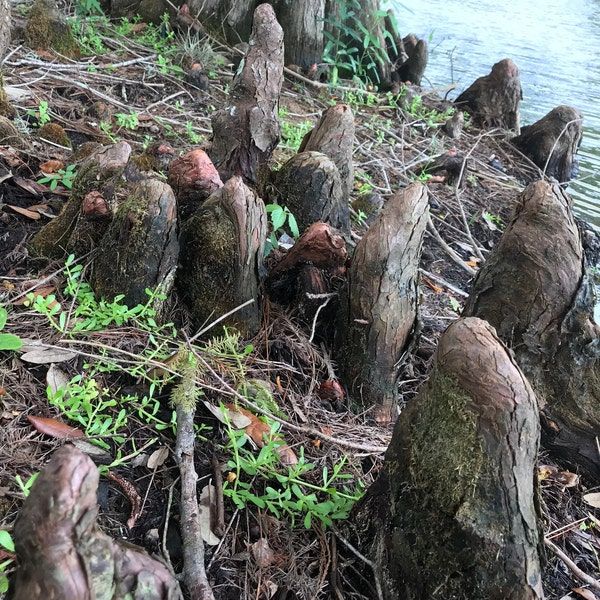
Cypress trees have unique growths called "knees" or "pneumatophores" that protrude from their roots. These growths are actually specialized roots that help the tree breathe and adapt to low-oxygen environments.
* **Why do cypress trees need to breathe?**: Cypress trees grow in wetland areas, where the water table is high and oxygen levels are low. In these conditions, traditional roots can't absorb enough oxygen to support the tree's growth.
* **How do cypress tree knees help?**: The knees act as snorkels, allowing the tree to absorb oxygen from the air. They're able to do this because they're connected to a network of aerenchyma tissue, which contains air-filled spaces that help the tree breathe.
By developing knees, cypress trees are able to thrive in environments where other trees would struggle to survive. This adaptation is a great example of how plants have evolved to cope with challenging conditions.
HOW LAVA LAMPS HELP CLOUDFLARE KEEP THE INTERNET SAFE FROM HACKERS
BY ADNAN AHMED APRIL 21, 2025 6:45 AM EST
The internet is ever-expanding, serving as a means to connect billions of people worldwide. With hosting providers and easy website builders such as WordPress doing most of the heavy lifting, just about anyone can create a website — be it for a business, portfolio, or a personal blog. However, behind the ease of creating and accessing content online lies the complex world of web security, protecting our data so it doesn't land in the wrong hands.
Cloudflare is one of the largest companies that provides network and security services on the cloud — you may have already heard of its 1.1.1.1 privacy DNS. It's used by nearly 20% of the web, meaning one in five websites on the internet is protected by Cloudflare — with your data being safeguarded through encryption. A core principle surrounding encrypting and decrypting data is the use of randomly generated cryptographic keys. There are several ways a computer can simulate randomness, but the data it generates can never be truly random.
This is where Cloudflare's "Wall of Entropy" comes in — a large display consisting of over a hundred lava lamps and a camera that periodically captures images. Instead of solely relying on computer-generated data, Cloudflare leverages an element of the physical world to aid with the encryption process. Let's take a deeper dive into how Cloudflare uses lava lamps to protect millions of websites around the globe.
Using lava lamps to generate randomness
The Wall of Entropy, as Cloudflare calls it, is situated in its headquarters in California and holds over a hundred individual lava lamps. A camera mounted across the wall snaps a picture and sends it over to Cloudflare's servers, where every pixel of this image is converted into a corresponding numerical value. Since the lava inside these lava lamps is constantly moving, rising, and falling, no two images taken by the camera will ever be the same.
It's not just the movement of the material within the lava lamps — any light or shadow leaking onto the wall affects the image captured by the camera. When you factor in how different times of the day affect the lighting on the wall, it's practically impossible to recreate the exact same image twice. This wall is located in the busy lobby of the headquarters as well, meaning any cameos by passersby actually contribute to the process of encryption.
The result is a sequence of truly random numbers, which is then used as a starting point for generating the encryption key. This unpredictability is referred to as entropy, and this forms the foundation of Cloudflare's encryption strategy.
From entropy to encryption keys
Once Cloudflare has this stream of random numbers as raw entropy, it feeds it to a tool called CSPRNG, or a cryptographically secure pseudorandom number generator. By ensuring that the numerical value obtained from the lava lamps' image, also known as the seed, is updated every so often, the output by the CSPRNG tool is always unpredictable and random.
As if the highly randomized entropy from the lava lamps wasn't enough, Cloudflare mixes the seed with data generated on two different Linux machines. The resulting cryptographic key is then used by Cloudflare to secure communications between your devices and the websites it protects.
Cloudflare also employs two other unique methods of generating truly random data. The first is a double pendulum in the company's London office — the chaotic movement of which results in the formation of unpredictable and random raw data. Cloudflare's Singapore office uses the readings of radioactive decay of a small pellet of uranium to assist with the randomness aspect of encryption.
Computers cannot generate truly random numbers, as all outputs depend on an input — and if a threat actor is able to decipher a company's encryption strategies, they could potentially predict the values of any future cryptographic keys being generated by the system and gain access to your data. Cloudflare's approach to encryption by blending qualities of the physical and digital world is how it has achieved a higher level of security against attackers.
6th grader's science experiment answers, 'Do cat buttholes touch every surface they sit on?'
A question no one knew they needed answered.
By Jacalyn Wetzel 6.28.25
Cat owners sometimes have unique questions that even Google doesn't always have the answer to. This is probably the sole reason cat forums exist, but one kid who needed a 6th grade science project decided to skip the cat forums for answers and instead use the scientific method. Kaeden Henry, a sixth grader living in Florida, bravely pondered a question few (if any one) has been brave enough to ask: do cat buttholes touch every surface they sit on?
Since cats do whatever the heck they want, training them not to jump on kitchen counters is a feat even Hercules struggles to complete. These fierce felines don't care if you're cooking dinner or trying to get comfy in bed. If they want to sit somewhere, they're going to do it. The thought of cat butts on that expensive Serta pillow designed to feel like you're sleeping on a cloud can gross people out, but thanks to Kaeden, you no longer have to wonder if the butthole itself is also making contact.
The curious sixth grader is homeschooled and well-versed in the scientific method thanks to her mother's PhD in animal behavior with a concentration in feline behavior. And, since they own cats, the science experiment was pretty straightforward (and directly impactful).
To complete the experiment, Henry and his mom, Kerry Hyde, bought non-toxic lipstick and applied it to each of their cat's anuses. Then, the cats were given commands.
"Non-toxic lipstick was applied to their bum-bums, they were then given a series of commands (sit, wait, lie down, and jump up. Side note: Both cats have been trained since kittenhood with a variety of commands, they also know how to high-five, spin around, and speak.), they were compensated with lots of praise, pets, and their favorite treats, and the lipstick was removed with a baby wipe once we collected our data in just under 10 minutes," Hyde wrote in a Facebook post.
The results? Turns out that, no, cat buttholes do not touch every surface cats sit on. Now, let's all take a collective sigh of relief while we go over the details. Kaeden's experiment covered long-haired, short-haired, and medium-haired cats (if your cat is hairless, you better stock up on Clorox wipes just in case).
"His results and general findings: Long and medium haired cat’s buttholes made NO contact with soft or hard surfaces at all. Short haired cats made NO contact on hard surfaces. But we did see evidence of a slight smear on the soft bedding surface. Conclusion, if you have a short haired cat and they may be lying on a pile of laundry, an unmade bed, or other soft uneven surface, then their butthole MAY touch those surfaces!" Hyde shares.
Now every curious cat owner can rest easy knowing that as long as their cat has hair, their bare bottom balloon knot is not touching the majority of surfaces in their home.
On July 11, I ordered some angle blocks, which I've wanted for a while, but never really needed. Lo and behold, they went on sale for half price. They were supposed to arrive today, but I don't think that's going to happen. Look at the tracking history below:
They were supposed to go North. Instead, it appears they decided on a Carribean vacation!
Every wonder about the origin of the term Mary Jane to describe marijuana?
Mary Jane Rathbun, The Medical Marijuana Activist Who Baked Hundreds Of Pot Brownies For AIDS Patients
By Amber Morgan | Edited By Kaleena Fraga
April 23, 2025
Known in the 1980s as "Brownie Mary," Mary Jane Rathbun defied the law to bring cannabis brownies to AIDS patients in San Francisco because of how marijuana could alleviate their symptoms.
At first glance, few would guess that Mary Jane Rathbun, an elderly woman with thick glasses, was one of the most well-known marijuana activists in American history. But Rathbun was famous for her “magical” marijuana brownies — and her fervent belief in the medical benefits of cannabis.
While living in San Francisco in the 1980s, Rathburn found herself in the epicenter of the AIDS epidemic. Already known for baking marijuana-infused brownies in her kitchen, Rathburn soon began distributing her baked goods to patients at San Francisco General Hospital, dubbing the AIDS patients she met as her “kids.”
Despite multiple arrests, Mary Jane Rathbun — known as “Brownie Mary” — would become one of the main driving forces behind the legalization of medical marijuana in California.
Mary Jane Rathbun was born on December 22, 1922, in Chicago, Illinois, and grew up in a strict Irish Catholic household in Minneapolis, Minnesota. According to a 1996 New York Times article, she demonstrated her ability to resist authority at a young age by fighting back against a nun who was trying to cane her. Shortly thereafter, Rathbun moved out of her family home.
As a teenager, Rathbun began working as a full-time waitress, a job she would work for most of her life. Alongside working, she also became involved in social activism, supporting causes like unions and abortion.
Then, during World War II, Rathbun moved to San Francisco and briefly married a man there. The couple would go on to have a daughter together, Peggy, who tragically died in a car accident in the 1970s.
Around the same time, Mary Jane Rathbun fatefully crossed paths with Dennis Peron, a San Francisco cannabis activist. After this meeting, Rathbun dove headfirst into the world of marijuana.
While working at the International House of Pancakes (IHOP), Rathbun began a secondary gig: selling marijuana brownies. By the 1980s, Rathbun was baking hundreds of cannabis-infused brownies a day. She advertised them on bulletin boards as “magically delicious” brownies.
Her (far-from-subtle) advertisement eventually caught the eye of authorities. On January 17, 1981, police came to her home, found more than 600 of her “magic” brownies, and arrested the 57-year-old. (Rathbun’s response to her arrest was a succinct: “Oh, ****.”).
The notoriety from Rathbun’s arrest grew her business, and earned her the nickname “Brownie Mary.” But it also did more than that.
Following her arrest and conviction, Rathbun was sentenced to 500 hours of community service — a sentence that Rathbun would complete in just 60 days. While volunteering for the Shanti Project, an organization dedicated to helping HIV/AIDS patients, Rathbun witnessed first-hand the horrific impact of the growing AIDS epidemic.
Suddenly, Brownie Mary’s business took on a new purpose.
Mary Jane Rathbun soon became a volunteer at San Francisco General Hospital — in 1982, she was arrested for the second time while carrying marijuana brownies for a friend with cancer there — and was thus on the front line of the AIDS epidemic as it ravaged San Francisco.
At the hospital, Rathbun passed out her brownies to patients struggling with the disease. Rathbun had noticed that the marijuana helped AIDS patients and cancer patients with side effects like pain and nausea, and she set out to bake a truly impressive amount of brownies each month. While most of her baking supplies were financed by her $650 social security check, people across the city also donated their cannabis.
Her impact was recognized and celebrated city-wide. In 1986, San Francisco General Hospital awarded her “Volunteer of the Year.” A decade later, Brownie Mary and Dennis Peron were both invited to be the Grand Marshals of the San Francisco Gay Pride Parade.
“Brownie Mary was providing marijuana brownies to terminally ill AIDS patients in San Francisco General Hospital, so it was an act of mercy,” Rathbun’s attorney J. Tony Serra, recalled. “Only her humanitarian conscience guided her. She never made a penny on it and she exposed herself to the full fury of the law. She couldn’t have lasted long in the state penitentiary. So she was very brave.”
Indeed, even if the city’s officials wanted to stop Rathbun, Brownie Mary was ready to be arrested as many times as necessary.
“If the narcs think I’m gonna stop baking brownies for my kids with AIDS, they can go f–k themselves in Macy’s window,” Rathbun announced in front of San Francisco City Hall during a rally in 1992.
Alongside baking her brownies, Brownie Mary continued volunteering at organizations across the city and even helped Peron open the San Francisco Cannabis Buyers Club, the first public cannabis dispensary in the United States. She and Peron also published their own cookbook, though Rathbun kept her brownie recipe a secret.
“When and if they legalize it, I’ll sell my brownie recipe to Betty Crocker or Duncan Hines,” she remarked, “and take the profits and buy an old Victorian for my kids with AIDS.”
In 1992, Brownie Mary additionally testified about the positive impacts of marijuana for medical purposes and secured the San Francisco Board of Supervisors’ resolution to make cannabis possession a lowest priority offense. In 1996, she and Peron also successfully advocated for Proposition 215, a California law that permitted the use of medical marijuana.
For her work, the board declared August 25th “Brownie Mary Day,” which is still observed to this day.
While Mary Jane Rathbun worked tirelessly to take care of the sick in San Francisco, she often neglected her own serious health issues.
In her older age, Rathbun struggled with chronic obstructive pulmonary disease and osteoarthritis. She had been diagnosed with colon cancer (and beat it). She often experienced physical pain in her knees, which had both been replaced.
Like many of her patients, Rathbun self-medicated with her cannabis brownies. She consumed half of one in the morning, and half in the afternoon, and claimed it helped her manage her physical pain.
However, by 1996, Rathbun’s condition deteriorated to the point where she could no longer walk, and consequently, no longer bake. In 1998, she moved into the Laguna Honda Hospital nursing home.
There, she passed away from a heart attack on April 10, 1999, at 76 years old. Seven days later, a crowd of over 300 people held a candlelight vigil in her honor in the Castro neighborhood where her legacy began.
Following Mary Jane Rathbun’s death, her friends, loved ones, and patients called her “Florence Nightingale of the medical marijuana movement,” in honor of her contributions to the city of San Francisco and impact on the medical marijuana movement in the United States.
Her brownie recipe, however, remains a secret to this day.
Every wonder about the origin of the term Mary Jane to describe marijuana?
...
I have a problem with the timeline for the term though, if it was indeed attributable to her brownie distribution in the 70's and 80's, as i remember the term was commonly being used clear back in the 60's.
I have a problem with the timeline for the term though, if it was indeed attributable to her brownie distribution in the 70's and 80's, as i remember the term was commonly being used clear back in the 60's.
Ok, I am 100% open to conversation on this one.
I was born in 1976, so for me, "the 70s" are my origin story, but not something which I claim as "my own," so to speak.
IDK what's to discourse; olderguy nailed it plain and simple. Being born in 1960 in the SF Bay area, I can recall making a report on the evils of drugs back in grade school as part of the public school's indoctrination backlash to the local hippie drug culture. Even to a child, the term was already so common as to be cliche'd. Sorry.
IDK what's to discourse; olderguy nailed it plain and simple. Being born in 1960 in the SF Bay area, I can recall making a report on the evils of drugs back in grade school as part of the public school's indoctrination backlash to the local hippie drug culture. Even to a child, the term was already so common as to be cliche'd. Sorry.
So, popular vote here: do I delete that post entirely, and return this thread to its natural state?
“
Mary Jane "Brownie Mary" Rathbun's famous brownie recipe was a closely guarded secret that she took to her grave in 1999
. However, some sources suggest her brownies were famously made using a boxed brownie mix and her special marijuana-infused cannabutter. A recipe for her "magically delicious" brownies, based on her reported method, was also published after her passing.
The secrecy of the "Magic Brownie" recipe
For decades, Rathbun refused to disclose her exact recipe, even co-authoring a 1993 book, Brownie Mary's Marijuana Cookbook and Dennis Peron's Recipe for Social Change, without it. When asked about it in 1996, she famously said she would only sell it to Betty Crocker or Duncan Hines once marijuana was legalized, and use the money to help her "kids with AIDS".
Her rationale was that the exact recipe wasn't the most important part—the effectiveness came from the dosage and the quality of the infused butter, which was made with marijuana donated from local growers. Rathbun also believed that the simple approach of using a boxed mix made it accessible for her patients.
A reconstructed recipe for "Brownie Mary" brownies
While the precise recipe is lost, a version of her "magically delicious" brownies has been published in tribute to her legacy. Ingredients
1 ⅛ cups cannabutter
½ cup chopped 70% dark chocolate
2 cups sugar
4 large eggs
1 teaspoon vanilla extract
1 cup all-purpose flour
⅔ cup cocoa powder
¼ teaspoon baking powder
¼ teaspoon salt
Instructions
Preheat your oven to 350°F (175°C). Grease and line a 9x9-inch baking pan with parchment paper.
In a saucepan over low heat, gently melt the cannabutter. Add the dark chocolate and stir until completely combined. Remove from the heat.
Stir the sugar into the chocolate mixture.
Beat the eggs in one at a time, then add the vanilla extract.
In a separate bowl, sift together the flour, cocoa powder, baking powder, and salt. Stir the dry ingredients into the chocolate mixture until just combined.
Pour the batter into your prepared pan and bake for approximately 40 minutes, or until a toothpick inserted into the center comes out with moist crumbs.
Let the brownies cool completely before slicing and consuming.
Note: This recipe is for historical and informational purposes. The possession, creation, and use of cannabis products may be illegal in your area. Please know the laws regarding cannabis in your state or country.”







 1
1