


Data v. Whiny Idiots (Throttle Response Edition)


Lastly, NA and supercharged cars do NOT have a 1:1 correspondence between throttle position and manifold pressure or torque. At low RPM you get full torque at something like 1/5th throttle, and at mid RPM's you get full torque at perhaps 1/2 throttle. The reason for this is that a throttle is a power-choking or constant-power device; at low RPM the power is low so the max power for that RPM is achieved at small throttle openings, which means full torque at small throttle openings.
Reply
 0
0

0


Yeah, I had not thought about it like that, but makes sense. Reminds me of driving particularly low-powered cars (like my old CRX HF w/ 62 BHP)...if you were under 3k RPM, the first inch of gas pedal travel had an effect, and the rest of the travel did nothing at all.
Reply
0
0

Junior Member
Joined: Jan 2008
Posts: 227
Total Cats: 1
From: Gainesville, Tx
Sigh. The troll wins. Make a few inane posts, pepper a few deflective comments, and watch everyone swing in the breeze from his gales of laughter 
When tracking into a decreasing radius, off camber curve that is strewn with dirt and debris, at over 100mph, worrying if my datalogging is a few nanoseconds to slow to capture the essence of the impending near death experience is akin to contemplating the embryonic cycle of a **** ant on trackout of said curve.
Just let the ******* wookie win and stop feeding him.
When tracking into a decreasing radius, off camber curve that is strewn with dirt and debris, at over 100mph, worrying if my datalogging is a few nanoseconds to slow to capture the essence of the impending near death experience is akin to contemplating the embryonic cycle of a **** ant on trackout of said curve.
Just let the ******* wookie win and stop feeding him.
Reply
0
0



You should try racing 600cc sport bikes, like a ZX-6R. They are gutless outside of the powerband, say below 8000 rpm on the one I raced. But above that... yowsa!
Reply
0
0

I'm Miserable!
Joined: Feb 2010
Posts: 583
Total Cats: -1
Here is a screen video of a some datalogs of a normally aspirated Miata.
The graph on the left shows the actual acceleration on the Y or up and down axis VS throttle position on the X axis.
The graph on the right shows MPH versus Time.
Firstly, get the graphs into your head so you can grok wassup. Then play the video. The video plays the data and shows where you are on both graphs simultaneously.
You can note a few interesting things. For one, as the throttle is applied, the resulting acceleration is pretty immediate and fairly linear with increasing throttle angle as it was applied. And two…note the hysteresis and shift as you come off the throttle. There are a few things going on there such as a slight lag from when the engine is at WOT and the engine has fully responded. As well as the engine being in a higher / more productive range at that time. The acceleration shown is from an accelerometer and so it also includes the lag and response of the various bushings, parts that twist, tire flex and so forth which also create lag and warts. It directly corresponds to what you feel in the small of your back and so is pretty realistic. There would be less lag if you just measured manifold pressure or engine rpm, however I felt that this would misrepresent matters. I mean the entire car's function is the goal for most.
If the graphs make sense to you you can get a good idea of what you'd feel if you had been there.
I can load in some Turbo charts too, any volunteers locally?
The graph on the left shows the actual acceleration on the Y or up and down axis VS throttle position on the X axis.
The graph on the right shows MPH versus Time.
Firstly, get the graphs into your head so you can grok wassup. Then play the video. The video plays the data and shows where you are on both graphs simultaneously.
You can note a few interesting things. For one, as the throttle is applied, the resulting acceleration is pretty immediate and fairly linear with increasing throttle angle as it was applied. And two…note the hysteresis and shift as you come off the throttle. There are a few things going on there such as a slight lag from when the engine is at WOT and the engine has fully responded. As well as the engine being in a higher / more productive range at that time. The acceleration shown is from an accelerometer and so it also includes the lag and response of the various bushings, parts that twist, tire flex and so forth which also create lag and warts. It directly corresponds to what you feel in the small of your back and so is pretty realistic. There would be less lag if you just measured manifold pressure or engine rpm, however I felt that this would misrepresent matters. I mean the entire car's function is the goal for most.
If the graphs make sense to you you can get a good idea of what you'd feel if you had been there.
I can load in some Turbo charts too, any volunteers locally?
Last edited by sjmarcy; Aug 26, 2011 at 01:18 AM.
Reply
0
0

I'm Miserable!
Joined: Feb 2010
Posts: 583
Total Cats: -1
Race Technology DL1 data in their analysis software screen recorded from one of my laptops. You can borrow one or a comparable unit locally if you ever have the interest and hang out with the local racers much (who would have such gadgets).
Reply
0
0
I'm Miserable!
Joined: Feb 2010
Posts: 583
Total Cats: -1
No that was just taking away my foot and then placing it back on the pedal which lead to a tap. Notice that at the same instant, on the other graph, that the rate of slowing down decreased at that time. This stuff is sensitive...
Reply
0
0

Thread Starter
Joined: Nov 2006
Posts: 15,442
Total Cats: 2,106
From: Sunnyvale, CA
Instead of posting about snapping the throttle open, why don't you share some relevant data from a real race car, like when a real race car driver properly rolls into the throttle?
Reply
0
0
I'm Miserable!
Joined: Feb 2010
Posts: 583
Total Cats: -1
The viddie shows the response of a normally aspirated Miata, just as I have stated and the conditions are shown. There are many different conditions and circumstances possible for such things. When throttle is applied at a slower rate and at performance RPM ranges the NA results improve a bit.
When you are at the cornering limit…throttle can be moved as desired. It is not always a simple roll-on from some lower but steady throttle opening. And there are also things called throttle-kicks and downshift blips.
If you'd like to show that a car is at the limit and had the throttle behaving well you don't show that using the type of graphs you have shown thus far, backed up with anecdotes.
Reply
0
0


I'm Miserable!
Joined: Feb 2010
Posts: 583
Total Cats: -1
Both Schuie and Rubens don't roll on the throttle. They use it as required. If you slow down below the car's potential then you can roll onto the throttle at every turn all the time on all occasions as you suggest. These are normally aspirated F1 engines, and so they are quite throttle responsive.
For those interested in left foot braking…you can see that Michael likes to keep some gas on much of the time, something you can't do if your right foot has to be doing one thing or the other like for Rubens.
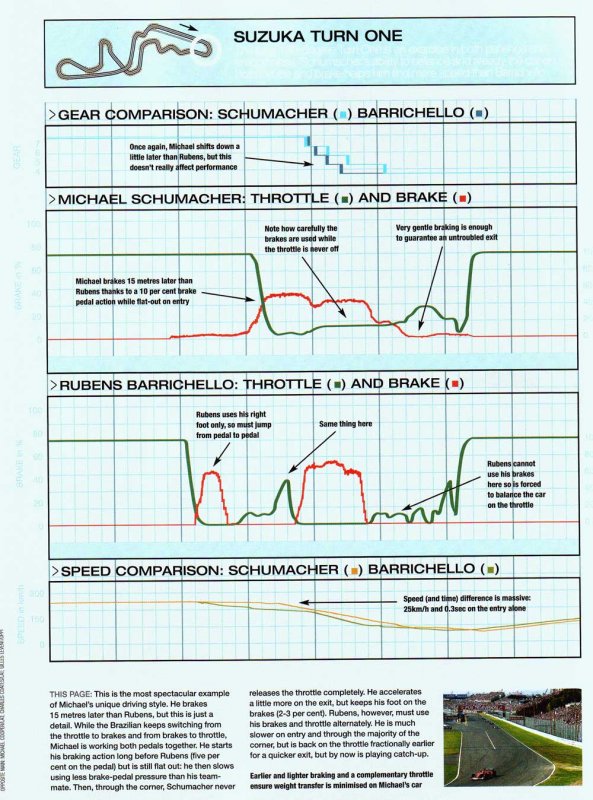
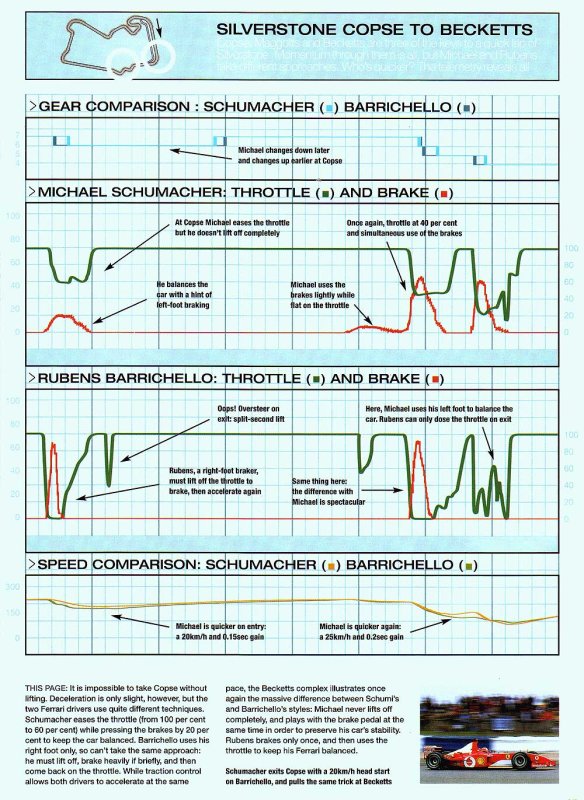
For those interested in left foot braking…you can see that Michael likes to keep some gas on much of the time, something you can't do if your right foot has to be doing one thing or the other like for Rubens.
Reply
0
0