


Front fender aero testing


I see more and more of this type of fender work in club racing. Guys are cutting the fender mid way down behind the wheel and folding it in to create a easy exit for air.
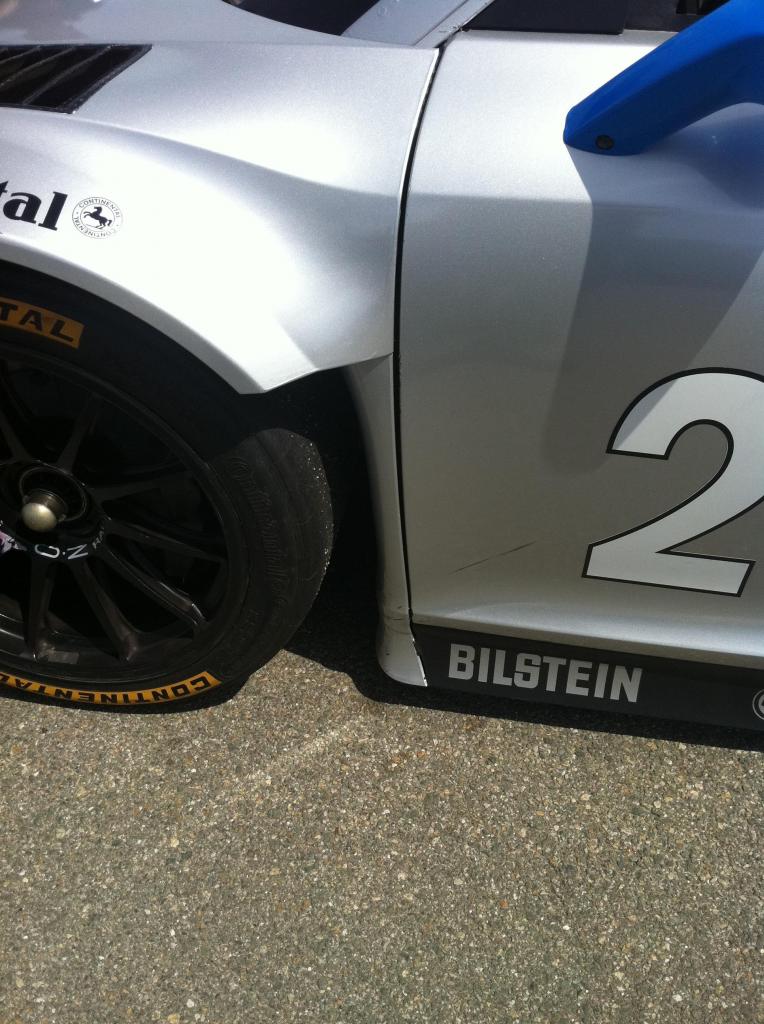

Reply
 0
0

0


^ and big louver on the top 
I took some inspiration from this car for my fenders:
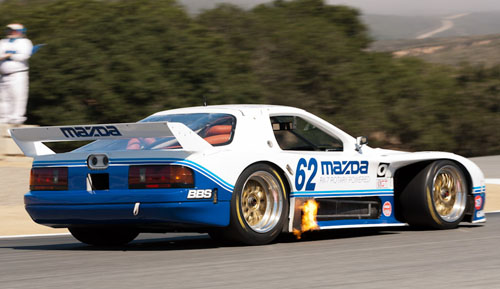
I took some inspiration from this car for my fenders:

Last edited by ThePass; Jul 22, 2014 at 04:58 AM.
Reply
0
0


Interesting topic this...
I decided to look at high dollar front engine GT cars to see what ideas can be "borrowed" since they have just a little more simulation resources than me. My reasoning was that GT cars are restricted look somewhat like the street cars, plus front engine cars have the double duty of aero for heat extraction and lowering drag/adding downforce.
The closest I saw to Keith's trial and lightyear's mod is the Bentley.

The difference I notice most is that the lower third of the fender is cut back to the door line, where the side skirt comes in to shape the flow.
AFAIR, Aston does a similar thing, except with no pulled fender but there are louvers on the side skirt that may be for clearing heat. Corvette does the 1/3 cut, no pulled fender, big vertical vents behind the wheel. BMW does a 2/3 cut that's about 6"(?) wide and louvers on the top of the fenders.
I decided to look at high dollar front engine GT cars to see what ideas can be "borrowed" since they have just a little more simulation resources than me. My reasoning was that GT cars are restricted look somewhat like the street cars, plus front engine cars have the double duty of aero for heat extraction and lowering drag/adding downforce.
The closest I saw to Keith's trial and lightyear's mod is the Bentley.
The difference I notice most is that the lower third of the fender is cut back to the door line, where the side skirt comes in to shape the flow.
AFAIR, Aston does a similar thing, except with no pulled fender but there are louvers on the side skirt that may be for clearing heat. Corvette does the 1/3 cut, no pulled fender, big vertical vents behind the wheel. BMW does a 2/3 cut that's about 6"(?) wide and louvers on the top of the fenders.
However, all those racers with cut fenders are what led me down this road in the first place. I'm trying to find out what's actually happening here before I cut anything myself.
Reply
0
0
Came across this fairly simplified article, but it's got a few notes.
Automotive Aerodynamics - Sport Compact Car Magazine All Pages
The front fenders are being used as exits for a front diffuser, for example. Some good pictures from NISMO are in there, I can't be bothered to figure out how to extract them from the gallery right now.
Automotive Aerodynamics - Sport Compact Car Magazine All Pages
The front fenders are being used as exits for a front diffuser, for example. Some good pictures from NISMO are in there, I can't be bothered to figure out how to extract them from the gallery right now.
Reply
0
0
^ actually a pretty cool article for simple/concise explanations for some of the most common aero devices.
Keith, out of curiosity, what lead you to start experimenting with this/what are you hoping to improve?
-Ryan
Keith, out of curiosity, what lead you to start experimenting with this/what are you hoping to improve?
-Ryan
Reply
0
0

Reply
0
0
What hose size are you currently using and how does it meet with the rotor/spindle?
Reply
0
0
I measured three points in the fender today, tried to copy your variables as close as possible Keith; 75 mph, windows removed, low pressure hose end in the passenger footwell...
@ inside top, centered above wheel: 0.20-0.25"
@ upper control arm by shock (where you measured): 0.20"
@ tie rod (basically right in the flow path of my front diffuser): 0.10" +/- 0.05 (needle bouncing a bit)
I remember reading that the pressure at the front of the radiator on a miata (with the control tube in the cabin afaik) was like 1.25" or something - that's the highest place of pressure on the car and undeniably there is a lot of force there, so then if we're dealing with a pressure range of like -0.1.5" to +1.5" (when compared to cabin pressure) then 0.05" is decently significant...
-Ryan
@ inside top, centered above wheel: 0.20-0.25"
@ upper control arm by shock (where you measured): 0.20"
@ tie rod (basically right in the flow path of my front diffuser): 0.10" +/- 0.05 (needle bouncing a bit)
I remember reading that the pressure at the front of the radiator on a miata (with the control tube in the cabin afaik) was like 1.25" or something - that's the highest place of pressure on the car and undeniably there is a lot of force there, so then if we're dealing with a pressure range of like -0.1.5" to +1.5" (when compared to cabin pressure) then 0.05" is decently significant...
-Ryan
Last edited by ThePass; Jul 23, 2014 at 12:32 AM.
Reply
0
0

Senior Member
Joined: Dec 2010
Posts: 993
Total Cats: 57
From: Auckland, NZ
Keith, Have you tried with out the backing plate type ducts?
I removed mine and just have a short hose from the front spoiler pointing in the vicinity....I "think" it has helped and also think it is reducing the development of micro cracks......
Not scientific though....
I removed mine and just have a short hose from the front spoiler pointing in the vicinity....I "think" it has helped and also think it is reducing the development of micro cracks......
Not scientific though....
Reply
0
0

I'm running the same on my '95... however Emilio mentioned on another site that they've found that 2.5" or 3" are what they run.
Pretty sure they've removed the backing plates and pointed the hose at the center of the hub... with judicious use of zip ties and duct tape (or clear tubing) to keep everything centered.
I'll do the same on my '94...
Reply
0
0
I'll take a separate look at the duct/rotor interface as well as other factors such as the inlet, but let's keep this discussion about potential front fender modifications.
Reply
0
0

Keith,
I'm running the same on my '95... however Emilio mentioned on another site that they've found that 2.5" or 3" are what they run.
Pretty sure they've removed the backing plates and pointed the hose at the center of the hub... with judicious use of zip ties and duct tape (or clear tubing) to keep everything centered.
I'll do the same on my '94...
I'm running the same on my '95... however Emilio mentioned on another site that they've found that 2.5" or 3" are what they run.
Pretty sure they've removed the backing plates and pointed the hose at the center of the hub... with judicious use of zip ties and duct tape (or clear tubing) to keep everything centered.
I'll do the same on my '94...
__________________


Reply
0
0

Yep. The best ducting is 2.5 or larger and I tell customers that when they ask me. It just won't fit in there in a production-style backing plate. 2" bolts up to everything (90-05, with or without ABS) and is better than nothing.
Reply
0
0
I run 3" ducts to my hubs/rotors. The Autokonexion bumper has 3" inlets to work with. For some reason everything fits fine without kinks. Maybe the 45 degree mounting of the radiator helps make room.
The cooling must be working cause the 949 11" rotors lasted 12 full track days before cracking. That's pretty good for a 300whp car.
Sorry for the hijack Keith. Just wanted to add my input on rotor cooling.
The cooling must be working cause the 949 11" rotors lasted 12 full track days before cracking. That's pretty good for a 300whp car.
Sorry for the hijack Keith. Just wanted to add my input on rotor cooling.
Reply
0
0

It would be hard to make a louver panel that dropped on top of the Miata fender, given the curved shape of the fender. It might be possible to cut and bend some, but again the louver is going to want to straighten that part of the panel. Should make for some interesting experimentation. I might do some pressure testing to find out where the biggest pressure differential is.
I'm done messing with this for now... need to focus on getting the motor back in the car lol. I'm anxious to see what you guys come up with.
Reply
0
0

Junior Member
Joined: Nov 2009
Posts: 53
Total Cats: 3
From: SF, CA
I'm trying to remember my fluid flow from my Mechanical Engineering degree. If it's not near sonic velocity it's a pressure drop per foot issue and not choke flow(?). So then the mixed run would help? Use an exhaust reducer for a fairly smooth transition. Of course in the real world this might be a mounting PITA.
Reply
0
0


