


Lead increase in Blackstone oil report


Thread Starter
Senior Member
iTrader: (2)
Joined: May 2013
Posts: 735
Total Cats: 62
From: Boyertown, PA
 Lead increase in Blackstone oil report
I've been getting Blackstone reports since the engine was at 100 miles, just to see progress. I started to see an increase in Lead after installing my turbo. I'm currently running 10 PSI, bearings are ACL.
My last oil change only had 1,200 miles on it and was showing 11 PPM lead, while their "average" is 3 PPM. Obviously the addition of the turbo is going to increase wear a bit, but almost 4x the average seems like a lot - so I'm just looking for something to compare this too. I'm including my three reports (100-500 miles, 500-1500, 1500-2700). The turbo was installed half way through the second report (at 1,000 miles on the engine).
Does this sound like abnormal wear? Should I be running something thicker than 10w40? Or something better suited for high stress (amsoil or other performance oriented oil)?
I'll also be replacing my air filter and redoing my intake since the silicon is still high. I want to reroute it anyway.
First
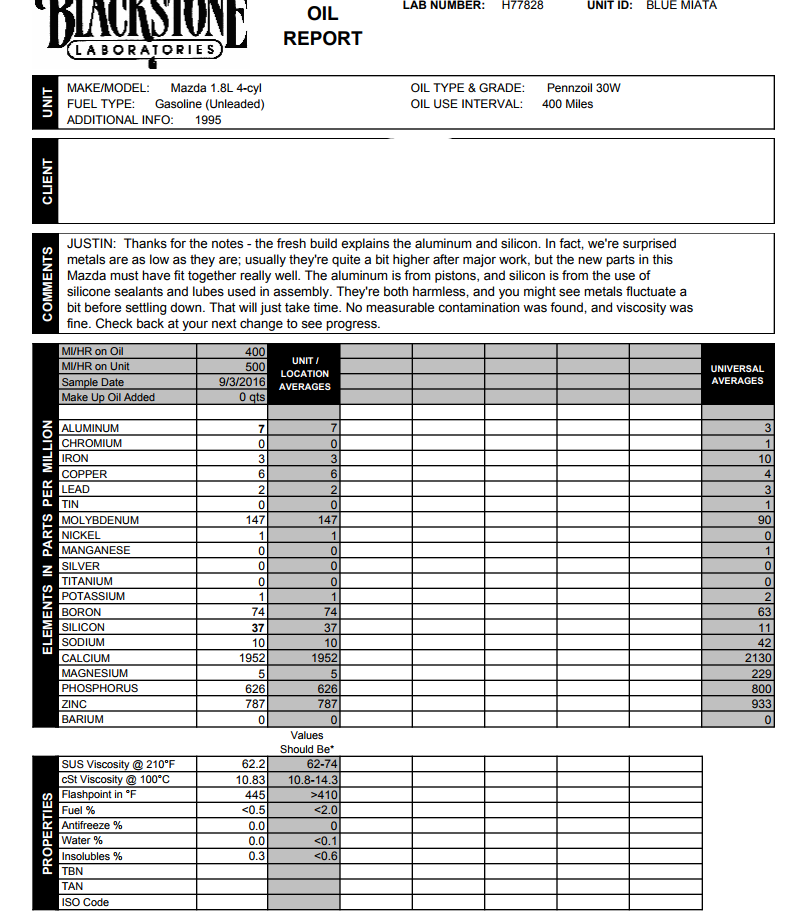
Second
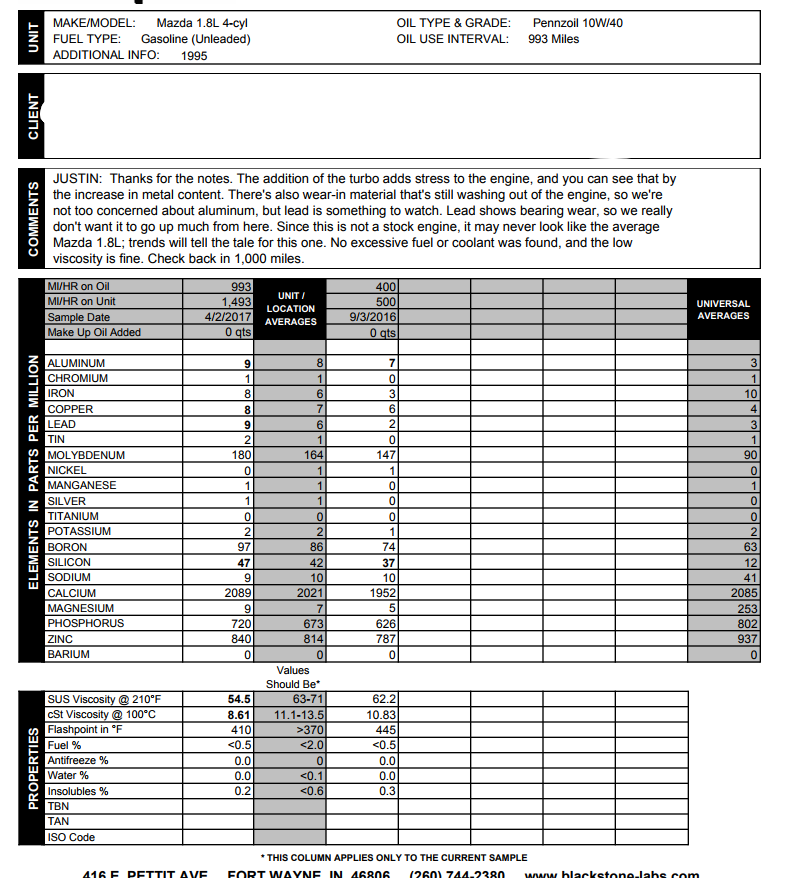
Third (current)
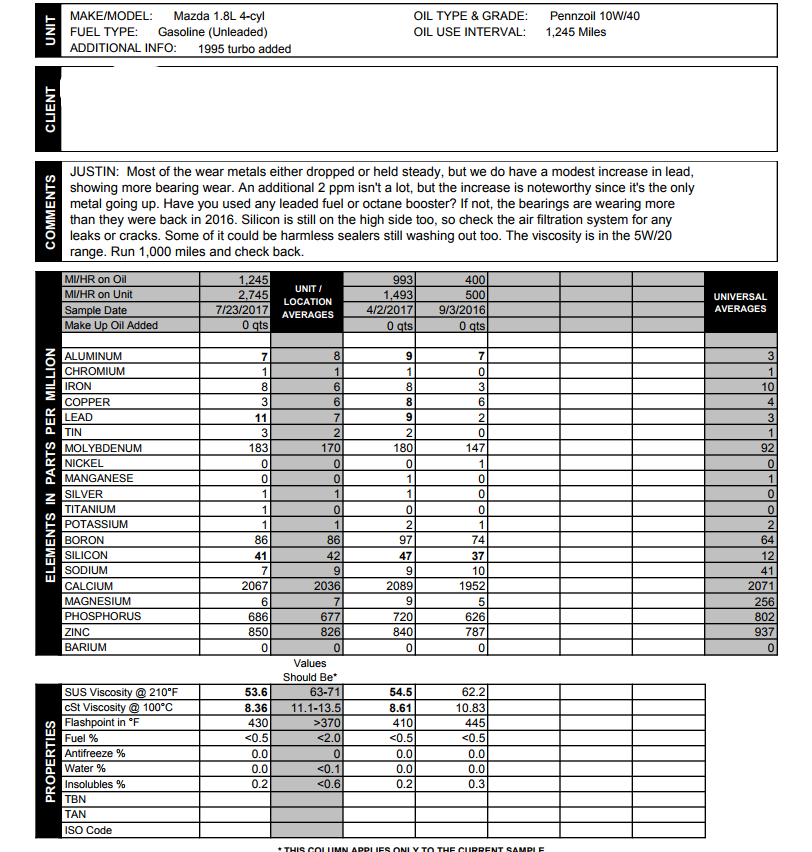
My last oil change only had 1,200 miles on it and was showing 11 PPM lead, while their "average" is 3 PPM. Obviously the addition of the turbo is going to increase wear a bit, but almost 4x the average seems like a lot - so I'm just looking for something to compare this too. I'm including my three reports (100-500 miles, 500-1500, 1500-2700). The turbo was installed half way through the second report (at 1,000 miles on the engine).
Does this sound like abnormal wear? Should I be running something thicker than 10w40? Or something better suited for high stress (amsoil or other performance oriented oil)?
I'll also be replacing my air filter and redoing my intake since the silicon is still high. I want to reroute it anyway.
First
Second
Third (current)
Reply
 0
0

0



It says you were using Pennsoil 10w40. Rotella T6 will prevent the wear you are seeing much better. It contains better EP lubricants. I am surprised you would spend the money on a rebuild and subject the engine to much higher pressures than stock but use economy oil. There is a difference.
Reply
0
0

Reply
0
0

Reply
0
0

Junior Member
Joined: Mar 2015
Posts: 179
Total Cats: 74
From: Columbus Indiana
However, that's not to say I disagree with the oil change strategy you describe though.
Reply
0
0

How much is "a lot" of seating? 80%? 90%? I assume the curve is not linear, but how exponential is it?
Reply
0
0
Junior Member
Joined: Mar 2015
Posts: 179
Total Cats: 74
From: Columbus Indiana
Bolded for emphasis, my question assumes you are either an OEM engineer/calibrator or race engineer involved in new engine testing with instrumentation everyone here can only dream of, or have seen that level of data first-hand.
How much is "a lot" of seating? 80%? 90%? I assume the curve is not linear, but how exponential is it?
How much is "a lot" of seating? 80%? 90%? I assume the curve is not linear, but how exponential is it?
For example, there is a standard break-in procedure that SAE recommends for new engines. At the transient points between speeds, you will see a spike in blow-by. The longer you go, the more this spike goes away, as you have improving contact between your piston rings, and the piston/bore. So, to your question, it is very logarithmic. The first few minutes will see the most wear, this is intuitive. How fast the break-in progresses is a factor of bore distortion, and hardness/surface finish of the cylinder bore, piston, and rings. All of this has been published many times in SAE papers, so you can find some real data there if you so choose.
Reply
4
4
OEM engineer, yes. It's tough to say the level of seating, as each engine can actually be a bit different in the amount of break-in it takes to be stable. The best way to determine if an engine is fully broken-in, is to look at blow-by (although oil consumption can be as well if you have sophisticated instruments). It will tell you if the rings have fully seated against the cylinder bore, and against the piston groove.
For example, there is a standard break-in procedure that SAE recommends for new engines. At the transient points between speeds, you will see a spike in blow-by. The longer you go, the more this spike goes away, as you have improving contact between your piston rings, and the piston/bore. So, to your question, it is very logarithmic. The first few minutes will see the most wear, this is intuitive. How fast the break-in progresses is a factor of bore distortion, and hardness/surface finish of the cylinder bore, piston, and rings. All of this has been published many times in SAE papers, so you can find some real data there if you so choose.
For example, there is a standard break-in procedure that SAE recommends for new engines. At the transient points between speeds, you will see a spike in blow-by. The longer you go, the more this spike goes away, as you have improving contact between your piston rings, and the piston/bore. So, to your question, it is very logarithmic. The first few minutes will see the most wear, this is intuitive. How fast the break-in progresses is a factor of bore distortion, and hardness/surface finish of the cylinder bore, piston, and rings. All of this has been published many times in SAE papers, so you can find some real data there if you so choose.

Reply
0
0

Would any of the piston skirt coatings available on the market require any special considerations for break-in procedures?
Op: I would do as others have suggested and run 1-2 changes with Rotella T6 5w40 and see what blackstone reports (noting to them you changed oils and to what). The additive package should help with wear.
Op: I would do as others have suggested and run 1-2 changes with Rotella T6 5w40 and see what blackstone reports (noting to them you changed oils and to what). The additive package should help with wear.
Reply
0
0
Junior Member
Joined: Mar 2015
Posts: 179
Total Cats: 74
From: Columbus Indiana
Meh, the toys are less exciting when you can't use them on your personal projects, but I do geek out to power cylinder topics. Happy to answer questions.
I've never heard of a special break-in process for skirt coatings, but I have no doubt that there is some break-in that happens, and a decrease in friction occurs. Generally, piston ring to cylinder bore takes the longest, and is the most important break-in item. My suggestion would be to ask the coating company, and see if they have a break-in procedure that would be different than the typical process.
I've never heard of a special break-in process for skirt coatings, but I have no doubt that there is some break-in that happens, and a decrease in friction occurs. Generally, piston ring to cylinder bore takes the longest, and is the most important break-in item. My suggestion would be to ask the coating company, and see if they have a break-in procedure that would be different than the typical process.
Reply
0
0


