When you click on links to various merchants on this site and make a purchase, this can result in this site earning a commission. Affiliate programs and affiliations include, but are not limited to, the eBay Partner Network.
I have a GT2554R on my 97. While driving home one day last week, the engine suddenly started "chugging" and blowing a lot of smoke out the tailpipe. The smoke was mostly white. The car stalled and I pulled over. It wouldn't start unless I had the accelerator to the floor and then wouldn't run smoothly. Same chugging and smoke.
I noticed oily looking stuff coming from between the exhaust manifold and turbo inlet. It seemed more water than just oil.
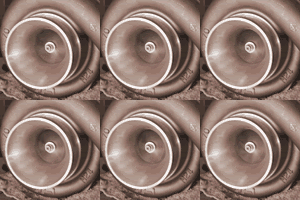
I removed the turbo and thought I would see try to diagnose the problem. I set my air compressor to 30psi and blew it in the oil port while plugging the other side with my thumb. I hear air escaping and feel it on the exhaust side. I did the same thing with the water ports and no air leaking.
Is that a conclusive test to determine that there is a blown seal?
Not sure if trolling, but... whether or not the turbo oil seal is blown, it's got nothing to do with your engine problems.
1) white smoke is usually coolant, not oil. Coolant is very unlikely leak into the exhaust from the turbo because it's in a physically separate cooling chamber. It doesn't touch the shaft, so there's no need for a seal.
2) Even if coolant (or oil) were getting into the turbine from the turbo, it's not going to make the engine fail to run. It's happening downstream of the cylinder combustion.
You need to start with a compression and/or leakdown test.
Performed the compression test today. Started with cylinder 1, cranked the car, water shot out of cylinder 3 like a geyser. Pressures were (1) 180psi (2) 65 (3) 50 (4) 65.
When I loosened the head bolts, the bolts around cylinder 3 required much less force to loosen.
left to right, cylinders 1 to 4
In the next picture, what does the appearance of the valves tell you? left to right, cylinders 1 to 4
Last edited by powellke; Jun 24, 2017 at 10:55 PM.
Reason: better formatting
Removed the head, had it resurfaced, valve job, reassembled everything last night. New head gasket, ARP studs, torqued properly. Started doing a compression check and coolant blows out of cylinder 3. Same issue as what started all of this. What could it be?
Pressure test on head is good. Tested up to 30psi with no leaks. Checking flatness of block with machined straight edge and see a gap of .003 between cylinders 2 and 3.
I put everything back together today. Used a Mazda head gasket this time. After torquing everything down and before connecting fuel, I did a compression test. The pressures I got were 180, 170, 170, and 170. After everything was reassembled, I tried to start the car. It ran a little but was very rough. My friend noticed something leaking from between the exhaust manifold and the turbo. It was fuel. I pulled the spark plugs and cranked the car and fuel spewed out of cylinder 3. In my earlier posts, it was coolant shooting out of cylinder 3. This was clearly fuel this time. I thought maybe an injector was stuck open so I swapped #3 with #1 and fuel still spewed from cylinder 3.
It seems too coincidental that cylinder 3 is the culprit in all of this.
Possibly related... when I turn on the key and the fuel pump starts, fuel seeps from the top of my fuel pressure regulator. I've never seen it do that before. The FPR shows 40psi.
I'm clearly out of my element at this point (and probably have been all along) and not sure what to do next.
I may have figured it out. The diaphragm on my FPR is blown allowing fuel to go through the vacuum line into the intake. The vacuum line is connected to the vacuum port in the middle of the intake which is between cylinders 2 and 3. So, all the fuel that is entering the intake is going primarily into cylinder 3. Does that sound reasonable?
Same exact thing happened to me last month, the diaphragm on my FPR failed and fuel was pumped into my intake, causing flooding and a no start situation. Double check any shared vacuum lines with the FPR and any of the lower vacuum lines on the intake. I had fuel get to my ECU and BOV. And yes, change oil ASAP. Mine wreaked of gas when I changed it.



 Turbo seal blown?
 0
0