


high idle-tps problem


Thread Starter
Junior Member
Joined: Nov 2008
Posts: 122
Total Cats: 1
From: Ontario, Canada
 high idle-tps problem
ok well my cars all running great,ran it through autotune which worked great but im having a problem with a high idle because of my tps. It seems i have no volts going to the sensor, even if i just adjust it back and forth the idle wont change at all. Is there a way to set it in the ecu? it worked before installing the mspnp.
Reply
 0
0

0
Thread Starter
Junior Member
Joined: Nov 2008
Posts: 122
Total Cats: 1
From: Ontario, Canada
okay so the only thing i can think of why i'm having no signal is the car use to be auto, so it has a 4 wire tps? i do have a 3 wire in my parts car, should i wire that one in.
Reply
0
0


You will need to mod your MSPNP to accept a variable TPS. Here are the instructions to do so:
If you want to modify the MSPNP to use a potentiometer type TPS, here’s what you need.
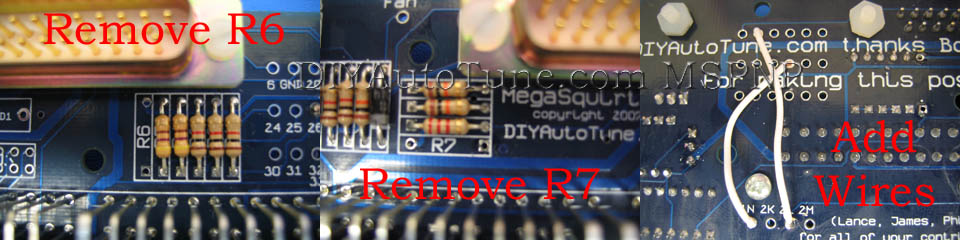
First, remove the TPS stabilizer resistors, R6 and R7. These are the "through-hole" resistors on the daughter board, not the surface mount R6 and R7 resistors on the V3.57 daughter board. Then you will need to connect the TPS signal and reference wires to the Miata harness. There are four holes that access pins on the Miata connector on the underside of the MSPNP board. Solder a jumper from the 5V VREF hole to 1N, and another jumper from the TPS hole to the 2L hole. This will bring the MegaSquirt’s connections out to the Miata wiring harness. This picture shows where to change the wiring.
 At the throttle position switch plug, you will have three wires. If you have modified the MSPNP as described, the red will supply a 5 volt reference voltage, the green and white wire will take the signal back to the MegaSquirt, and the black and green wire will provide a ground.
If you’re not sure which connection on your TPS goes to which wire, check it with an ohmmeter. Observe the resistance as the throttle opens and closes. Each pair of pins will behave differently:
The resistance between the 5 volt and ground pins will remain constant.
The resistance between the ground and signal pins will be low with the throttle closed and high with the throttle wide open.
The resistance between the 5 volt and signal pins will be high with the throttle closed and low with the throttle wide open.
Using these rules, you can establish which pin on the TPS goes to which wire.
If you want to modify the MSPNP to use a potentiometer type TPS, here’s what you need.
First, remove the TPS stabilizer resistors, R6 and R7. These are the "through-hole" resistors on the daughter board, not the surface mount R6 and R7 resistors on the V3.57 daughter board. Then you will need to connect the TPS signal and reference wires to the Miata harness. There are four holes that access pins on the Miata connector on the underside of the MSPNP board. Solder a jumper from the 5V VREF hole to 1N, and another jumper from the TPS hole to the 2L hole. This will bring the MegaSquirt’s connections out to the Miata wiring harness. This picture shows where to change the wiring.
If you’re not sure which connection on your TPS goes to which wire, check it with an ohmmeter. Observe the resistance as the throttle opens and closes. Each pair of pins will behave differently:
The resistance between the 5 volt and ground pins will remain constant.
The resistance between the ground and signal pins will be low with the throttle closed and high with the throttle wide open.
The resistance between the 5 volt and signal pins will be high with the throttle closed and low with the throttle wide open.
Using these rules, you can establish which pin on the TPS goes to which wire.

Reply
0
0
Do you have a variable type TPS? Or an on/off switch type TPS?
If you have a variable TPS, then you will need to follow my directions in the earlier post in order to use it.
If you have a on/off type TPS (such as what came in a stock manual 1.6 miata), then you do not hook it up to your MS ECU because it will not give any usable signal.
If you have a variable TPS, then you will need to follow my directions in the earlier post in order to use it.
If you have a on/off type TPS (such as what came in a stock manual 1.6 miata), then you do not hook it up to your MS ECU because it will not give any usable signal.
Reply
0
0

Supporting Vendor

Joined: Sep 2006
Posts: 2,332
Total Cats: 67
The stock TPS only says if you have the throttle closed, open, or somewhere in between. Doesn't do very much for the MSPNP, as there's no separate idle and WOT tables - and if your idle is too high, it's either your idle settings or a vacuum leak.
Reply
0
0
Supporting Vendor
Joined: Sep 2006
Posts: 2,332
Total Cats: 67
Right, the TPS is used to kick the IAC open a little further when you snap the throttle shut, but that's about it. Could you post a data log of it idling and your MSQ? That will show if the IAC is staying open or not.
Reply
0
0
Thread Starter
Junior Member
Joined: Nov 2008
Posts: 122
Total Cats: 1
From: Ontario, Canada

heres the idle log and tune, the lo9g is from a cold start up to idle, its crazy lean then goes rich
miata tune.msq
miata idle.xls
getting it to idle lower isnt my biggest concern. i just hate how it is on warm up
miata tune.msq
miata idle.xls
getting it to idle lower isnt my biggest concern. i just hate how it is on warm up
Last edited by whitemiata; Mar 19, 2010 at 01:40 PM.
Reply
0
0
Supporting Vendor
Joined: Sep 2006
Posts: 2,332
Total Cats: 67
Add more VE to the cells you're idling in, you have lean surge issues.
Reply
0
0


Matt, can you tell me if this is also the case for a 1994 1.8L? I'm battling an issue that and am trying to eliminate the TPS as the problem.
Reply
0
0
Supporting Vendor
Joined: Sep 2006
Posts: 2,332
Total Cats: 67
Yes, the TPS's only idle related function is the dashpot adder that kicks up the idle when the throttle snaps closed. It could also be used for some other things like AE and boost control. Exactly what issue are you having?
Reply
0
0
My issue is based off using Powercards for fuel/timing. Basically, it's a super rich idle issue. Try to start the car and it dies if I don't open the throttle. With the throttle open, it just gurgles and pops and the spark plugs become jet black from being rich. I've check tested/checked the MAF & TPS. I am thinking I may have to trace down the wiring for the Powercards...
Reply
0
0
Supporting Vendor
Joined: Sep 2006
Posts: 2,332
Total Cats: 67
You're trying to use a Powercard with an MSPNP? If so, that's your problem...
If it is a stock ECU, I am not sure what effects a failing TPS may have, it may use it for more things than the MSPNP does.
If it is a stock ECU, I am not sure what effects a failing TPS may have, it may use it for more things than the MSPNP does.
Reply
0
0

Thread
Thread Starter
Forum
Replies
Last Post
Zaphod
MEGAsquirt
47
Oct 26, 2018 11:00 PM


