


Interesting oil analysis results


Thread Starter
Elite Member
iTrader: (15)
Joined: Dec 2007
Posts: 4,847
Total Cats: 27
From: San Antonio, Texas
 Interesting oil analysis results
About a week ago I changed the oil in my track car and decided out of curiosity to send an oil sample to Blackstone Laboratories for used oil analysis (UOA). The results just came in this evening so I am sharing for those who may be interested, like the other UOA geeks.
More specifically the oil sample is Rotella-T6 5W-40 Synthetic taken from my LS1 Miata after 8 hours of cumulative track time (about 6 days at the track, or 3 weekends). This engine, a stock 2002 LS1, uses about 6-7 quarts in the oil pan, about 3 quarts in the Accusump, and a bit more in the oil cooler. I added two quarts between oil change intervals of which I think only one quart was really necessary.
Depending on the air temperature the coolant temperatures run between 180-210F and the oil temperatures run between 210-240F. On the last weekend before the oil change the coolant temperatures were at 220F and the oil was at 260F. That is higher than I normally see but is reasonable considering the track, and no problem for the engine and the oil.
Quoting from the UOA synopsis
Granted a turbo motor is going to be harder on the oil depending on the oil temperatures while on track. But, the message here for me, is that I do not need to change my engine oil after every weekend. After every third weekend is fine.
More specifically the oil sample is Rotella-T6 5W-40 Synthetic taken from my LS1 Miata after 8 hours of cumulative track time (about 6 days at the track, or 3 weekends). This engine, a stock 2002 LS1, uses about 6-7 quarts in the oil pan, about 3 quarts in the Accusump, and a bit more in the oil cooler. I added two quarts between oil change intervals of which I think only one quart was really necessary.
Depending on the air temperature the coolant temperatures run between 180-210F and the oil temperatures run between 210-240F. On the last weekend before the oil change the coolant temperatures were at 220F and the oil was at 260F. That is higher than I normally see but is reasonable considering the track, and no problem for the engine and the oil.
Quoting from the UOA synopsis
"Thanks for the note on the race use your engine sees. Because your engine sees hard use, it may never wear exactly like our averages show, which are based on ~4,000-mile oil runs. After 8 hours on this oil, though, most metals look great by comparison. Everything read in the average range, and metals are mostly well-balanced compared to one another (copper did read a little low to be perfectly balanced), so we don't see any obvious problems here. The TBN was fine at 8.0 and no other contamination or problems were found. This interval is working well for you."
Last edited by ZX-Tex; Apr 18, 2012 at 11:10 PM.
Reply
 0
0

0




Joined: Sep 2005
Posts: 34,414
Total Cats: 7,531
From: Chicago. (The less-murder part.)
Hopefully they're pouring the money into an approved recycling container. The state of California tends to frown on used money winding up in the sewer system (especially in the coastal areas where the storm drains vent directly to sea.)
Reply
0
0
Thread Starter
Elite Member
iTrader: (15)
Joined: Dec 2007
Posts: 4,847
Total Cats: 27
From: San Antonio, Texas
Ha Joe. In Texas, unlike those Commie Calie-forne-iayns, we dispose of our oil the way God intended it. Burning it in an oil drum out-back, while drinking beer, and shootin' stuff.
The results seem to imply that I could go longer on the change interval and still be quite OK. I am getting clarification on that.
The results seem to imply that I could go longer on the change interval and still be quite OK. I am getting clarification on that.
Reply
1
1

Joined: Jun 2006
Posts: 29,085
Total Cats: 375
From: Republic of Dallas
Ha Joe. In Texas, unlike those Commie Calie-forne-iayns, we dispose of our oil the way God intended it. Burning it in an oil drum out-back, while drinking beer, and shootin' stuff.
The results seem to imply that I could go longer on the change interval and still be quite OK. I am getting clarification on that.
The results seem to imply that I could go longer on the change interval and still be quite OK. I am getting clarification on that.
Reply
0
0
Thread Starter
Elite Member
iTrader: (15)
Joined: Dec 2007
Posts: 4,847
Total Cats: 27
From: San Antonio, Texas
That might be OK. The TBN is 8, which is very high from what I can tell.
Holy sh.. He gave his kid buckshot in a lightweight pump 12ga shotgun with a standard stock? It looked like it kicked the crap out of him. His kid was probably like "Give me the buckshot dad, I can handle it". HA!
I would not be happy shooting buckshot in my short barrel pump without my Knoxx Stock, which is awesomely effective at absorbing recoil.
Holy sh.. He gave his kid buckshot in a lightweight pump 12ga shotgun with a standard stock? It looked like it kicked the crap out of him. His kid was probably like "Give me the buckshot dad, I can handle it". HA!
I would not be happy shooting buckshot in my short barrel pump without my Knoxx Stock, which is awesomely effective at absorbing recoil.
Reply
0
0


All kids should be indoctrinated by large doses of gunpowder behind larger doses of lead shot. When they come back for more you have a keeper that is worthy of your time for additional training.
My nephew is 11 and can't wait until he turns 12 and I can take him on a mentor hunt. I can't wait either. His dad has zero interest in guns which is a complete fail as far as I'm concerned. Cool uncle rules.
My nephew is 11 and can't wait until he turns 12 and I can take him on a mentor hunt. I can't wait either. His dad has zero interest in guns which is a complete fail as far as I'm concerned. Cool uncle rules.
Reply
0
0

Junior Member
Joined: Oct 2010
Posts: 175
Total Cats: 0
From: Wake Forest, NC
Holy sh.. He gave his kid buckshot in a lightweight pump 12ga shotgun with a standard stock? It looked like it kicked the crap out of him. His kid was probably like "Give me the buckshot dad, I can handle it". HA!
I would not be happy shooting buckshot in my short barrel pump without my Knoxx Stock, which is awesomely effective at absorbing recoil.
Reply
0
0
Joined: Jun 2006
Posts: 29,085
Total Cats: 375
From: Republic of Dallas
How is parking the car for a month a problem? I had severe lifter tick when the 1.6 was in the car, after switching to magic blue-bottle oil I never again had it in that engine and I did something like 8-days at the track on the same oil, lol.
Reply
0
0
Junior Member
Joined: Oct 2010
Posts: 175
Total Cats: 0
From: Wake Forest, NC

Reply
0
0
Joined: Jun 2006
Posts: 29,085
Total Cats: 375
From: Republic of Dallas
Have you ever seen proof of this or just marketing? I'm not a chemist nor amd I generally "intelligent", but I don't see how this is the case.
Reply
0
0
Junior Member
Joined: Oct 2010
Posts: 175
Total Cats: 0
From: Wake Forest, NC
There used to be a good write up from a principal scientist for Pennzoil that detailed this, but I cant find it on the interwebs anymore. Talk to Blackstone though, they can confirm it for you. Thats why they ask for you to sample hot motor oil, because it burns off moisture and fuel contaminants and gasses that are dissolved in the oil from blow by.
From an industrial engineering standpoint, we've found that continuous use oiled pumps that get taken down once a year or so for PM procedures have significantly less wear and tear than pumps that are start/run/stopped and then let sit frequently. Oil that comes from the latter tends to be frothy and contaminated, partly from their use patters, and partly from their intended use (cleaning systems with NaOH and the like).
The chemist/engineer in me says, sure, its bad. To what extent though?

Reply
0
0

Our showroom stock civic gets it's oil changed once a year. And we use poopy mobil 1. This car has been raced hard, continuously for 5 years and it's still on it's original engine, with all of 5 or 6 oil changes.
Stock motor, stock power, N/A = longer interval I guess
Stock motor, stock power, N/A = longer interval I guess
Reply
0
0
Thread Starter
Elite Member
iTrader: (15)
Joined: Dec 2007
Posts: 4,847
Total Cats: 27
From: San Antonio, Texas
Since it came up, I'll mention I had two cold starts on that batch of oil right before I drained it. One was backing the car out of the trailer into the garage. The other was stirring up the oil before I drained the oil. Both runs were less than 5 minutes of idling.
I know the sample should be taken from a motor that has been driven for a long period of time to get the oil up to temperature and drive out the water/antifreeze/fuel. But it was interesting that there was still very little oil and water in the sample. The lack of antifreeze is no surprise since I only have water and Water Wetter in the radiator.
BTW here is the report
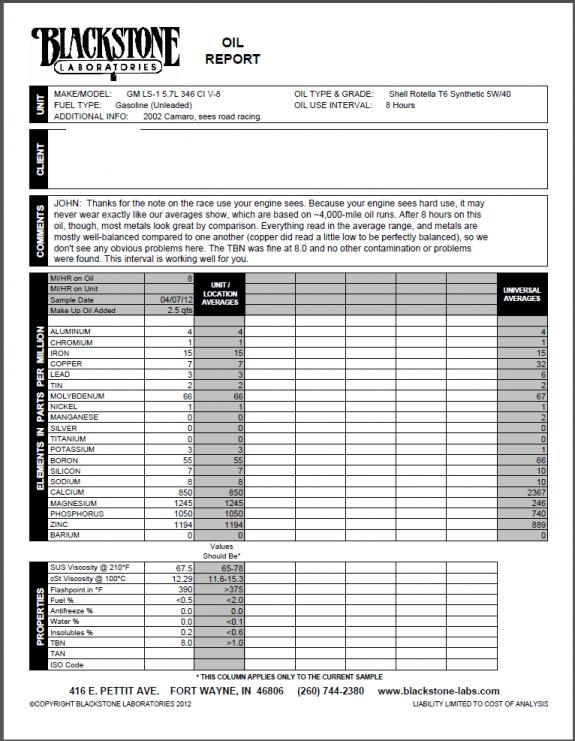
I know the sample should be taken from a motor that has been driven for a long period of time to get the oil up to temperature and drive out the water/antifreeze/fuel. But it was interesting that there was still very little oil and water in the sample. The lack of antifreeze is no surprise since I only have water and Water Wetter in the radiator.
BTW here is the report
Reply
0
0

Yes... I swam to shore... got a stick and went back to battle those buggers. I am now 10 bucks richer thanks to my free ocean money.
Reply
1
1
Joined: Jun 2006
Posts: 29,085
Total Cats: 375
From: Republic of Dallas
Yes.
There used to be a good write up from a principal scientist for Pennzoil that detailed this, but I cant find it on the interwebs anymore. Talk to Blackstone though, they can confirm it for you. Thats why they ask for you to sample hot motor oil, because it burns off moisture and fuel contaminants and gasses that are dissolved in the oil from blow by.
From an industrial engineering standpoint, we've found that continuous use oiled pumps that get taken down once a year or so for PM procedures have significantly less wear and tear than pumps that are start/run/stopped and then let sit frequently. Oil that comes from the latter tends to be frothy and contaminated, partly from their use patters, and partly from their intended use (cleaning systems with NaOH and the like).
The chemist/engineer in me says, sure, its bad. To what extent though?
There used to be a good write up from a principal scientist for Pennzoil that detailed this, but I cant find it on the interwebs anymore. Talk to Blackstone though, they can confirm it for you. Thats why they ask for you to sample hot motor oil, because it burns off moisture and fuel contaminants and gasses that are dissolved in the oil from blow by.
From an industrial engineering standpoint, we've found that continuous use oiled pumps that get taken down once a year or so for PM procedures have significantly less wear and tear than pumps that are start/run/stopped and then let sit frequently. Oil that comes from the latter tends to be frothy and contaminated, partly from their use patters, and partly from their intended use (cleaning systems with NaOH and the like).
The chemist/engineer in me says, sure, its bad. To what extent though?
Reply
0
0

Thread
Thread Starter
Forum
Replies
Last Post
stoves
Suspension, Brakes, Drivetrain
5
Apr 21, 2016 03:00 PM


