


Where did all the Borg Warner EFRs go?





Our goal from the start has been to design and build a turbo kit that can be bolted onto a track car and driven at 10/10ths without changing a single part. We don't think that privateers and hobbyists should be wasting their time doing R&D on their track toy - that's our job. This community needs a kit that will work flawlessly right out of the box - IMO that kit doesn't exist today.
Last edited by Savington; Nov 16, 2011 at 07:47 PM.
Reply
 1
1

1

Joined: Jun 2006
Posts: 29,085
Total Cats: 375
From: Republic of Dallas
Pricing will be on par with what's currently on the market. Component selection won't be.
Our goal from the start has been to design and build a turbo kit that can be bolted onto a track car and driven at 10/10ths without changing a single part. We don't think that privateers and hobbyists should be wasting their time doing R&D on their track toy - that's our job. This community needs a kit that will work flawlessly right out of the box - IMO that kit doesn't exist today.
Our goal from the start has been to design and build a turbo kit that can be bolted onto a track car and driven at 10/10ths without changing a single part. We don't think that privateers and hobbyists should be wasting their time doing R&D on their track toy - that's our job. This community needs a kit that will work flawlessly right out of the box - IMO that kit doesn't exist today.
Reply
0
0

Pricing will be on par with what's currently on the market. Component selection won't be.
Our goal from the start has been to design and build a turbo kit that can be bolted onto a track car and driven at 10/10ths without changing a single part. We don't think that privateers and hobbyists should be wasting their time doing R&D on their track toy - that's our job. This community needs a kit that will work flawlessly right out of the box - IMO that kit doesn't exist today.
Our goal from the start has been to design and build a turbo kit that can be bolted onto a track car and driven at 10/10ths without changing a single part. We don't think that privateers and hobbyists should be wasting their time doing R&D on their track toy - that's our job. This community needs a kit that will work flawlessly right out of the box - IMO that kit doesn't exist today.
let me know if you need a prototype dummy

Reply
0
0

The integrated BOV works flawlessly.
This turbo has lived up to all the hype. I am extremely busy right now, and my car still isn't tuned perfectly, but I am fully spooled (10 psi) before 3000 rpms. Once borg fixes their casting problem and replenishes the market garrett is going to have a serious problem.
Reply
0
0


Here's the backside of the EFR turbine:
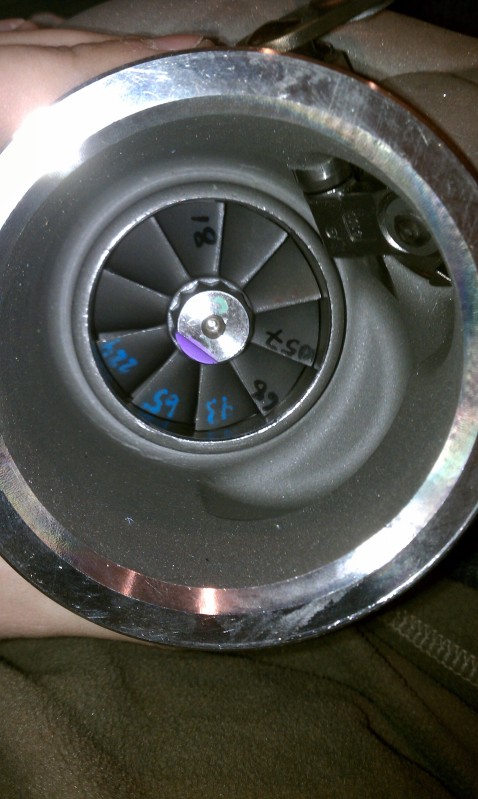
That huge cavity below the flapper is a low-pressure zone to promote wastegate flow. The wall around the turbine wheel is also lifted up off the back of the housing by 5-6mm, which creates a low-pressure zone around the entire housing. That low-pressure zone will draw wastegate gases in and blend them with the gases exiting the turbine wheel.
The design of the flapper angle and cavity in the housing mean that the EFR's IWG will outperform a TiAL EWG, and it will decimate any Garrett IWG. If we thought that an EWG would be superior, we'd use one.
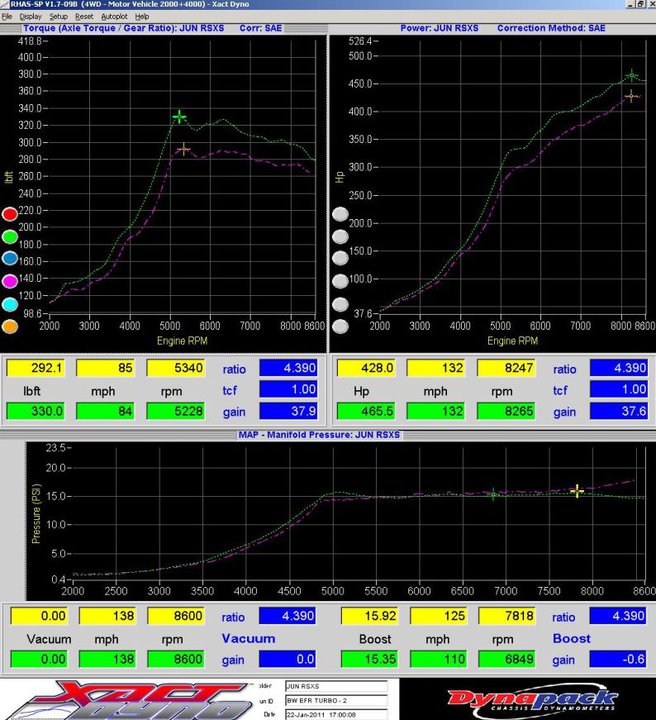
This is a Honda K20 test done by Full-Race, with a GT3582R .82a/r single-scroll (purple line) vs. an EFR8374 .83a/r single-scroll, both at 15psi on 91 octane. The GT35R had a TiAL 44mm EWG, the EFR8374 had a 42mm IWG. Check out the boost curve - the TiAL 44mm creeps up top, but the EFR is rock solid all the way to redline. The K20 is notorious for having incredibly high VE at high RPM which causes boost creep, and the EFR's internal gate has no problem keeping it under control.
http://honda-tech.com/showthread.php?t=2889919
I'll post some more detailed photos of the turbo as we go forward. Needless to say, this turbo has an enormous amount of thought put into places that you've never given a second glance to before. Our kits will have that same attention to detail.
That huge cavity below the flapper is a low-pressure zone to promote wastegate flow. The wall around the turbine wheel is also lifted up off the back of the housing by 5-6mm, which creates a low-pressure zone around the entire housing. That low-pressure zone will draw wastegate gases in and blend them with the gases exiting the turbine wheel.
The design of the flapper angle and cavity in the housing mean that the EFR's IWG will outperform a TiAL EWG, and it will decimate any Garrett IWG. If we thought that an EWG would be superior, we'd use one.
This is a Honda K20 test done by Full-Race, with a GT3582R .82a/r single-scroll (purple line) vs. an EFR8374 .83a/r single-scroll, both at 15psi on 91 octane. The GT35R had a TiAL 44mm EWG, the EFR8374 had a 42mm IWG. Check out the boost curve - the TiAL 44mm creeps up top, but the EFR is rock solid all the way to redline. The K20 is notorious for having incredibly high VE at high RPM which causes boost creep, and the EFR's internal gate has no problem keeping it under control.
http://honda-tech.com/showthread.php?t=2889919
I'll post some more detailed photos of the turbo as we go forward. Needless to say, this turbo has an enormous amount of thought put into places that you've never given a second glance to before. Our kits will have that same attention to detail.
Reply
0
0

Thread Starter
Elite Member
iTrader: (16)
Joined: Oct 2006
Posts: 1,656
Total Cats: 526
From: Las Cruces, NM
Pricing will be on par with what's currently on the market. Component selection won't be.
Our goal from the start has been to design and build a turbo kit that can be bolted onto a track car and driven at 10/10ths without changing a single part. We don't think that privateers and hobbyists should be wasting their time doing R&D on their track toy - that's our job. This community needs a kit that will work flawlessly right out of the box - IMO that kit doesn't exist today.
Our goal from the start has been to design and build a turbo kit that can be bolted onto a track car and driven at 10/10ths without changing a single part. We don't think that privateers and hobbyists should be wasting their time doing R&D on their track toy - that's our job. This community needs a kit that will work flawlessly right out of the box - IMO that kit doesn't exist today.
Reply
0
0
Think about the companies that have produced game-changing parts in the last 5 years. The 6UL has become the gold standard motorsport wheel for Miatas, but 5 years ago it was an idea in Emilio's head. His frustrations from being unable to buy the parts he wanted for his own track car spawned the 8" 6UL, then the 9" 6UL, and now the 10" 6UL. The rigors of regular competitive motorsport provide the kind of environment that quality parts come from.
If you aren't testing your products by bolting them to a race car and beating the snot out of it, you're going to end up with egg on your face when one of your customers goes out and does it (with sub-par results). I know this first-hand - I've spent the better part of 4 years being that customer.
There is a big difference between street systems and track systems.
Reply
2
2

^This is why I'm willing to spend the cash to send my motor to you. When the cash fairy takes a huge dump in my wallet, you'll get my babies guts. <meant in a good way, just got married and living on military disability doesn't help buy motors.
Reply
0
0

Thread Starter
Elite Member
iTrader: (16)
Joined: Oct 2006
Posts: 1,656
Total Cats: 526
From: Las Cruces, NM
If you aren't testing your products by bolting them to a race car and beating the snot out of it, you're going to end up with egg on your face when one of your customers goes out and does it (with sub-par results). I know this first-hand - I've spent the better part of 4 years being that customer.
Reply
0
0
^^ That wastegate design is fantastic. There is no need or reason I can see for a separated gases downpipe with that design. Between that, and the v-band fitting, it makes the downpipe super simple to fabricate without buying a v-band adapter. And the flow is still better anyway. Very nice. That is another big pro for the DIY customers.
Reply
0
0

If you aren't testing your products by bolting them to a race car and beating the snot out of it, you're going to end up with egg on your face when one of your customers goes out and does it (with sub-par results). I know this first-hand - I've spent the better part of 4 years being that customer.
How many track hours do you typically put on component(s) such as those found in your turbo kit before feeling confident in their durability? What is your tentative schedule to fully track test the EFR's before you release the kit? I hate spreading them, but internet rumor is the EFR Ti-AL wheel + sustained track temps = higher risk of


 compared to traditional turbine technology.
Reply
0
0


How many track hours do you typically put on component(s) such as those found in your turbo kit before feeling confident in their durability? What is your tentative schedule to fully track test the EFR's before you release the kit? I hate spreading them, but internet rumor is the EFR Ti-AL wheel + sustained track temps = higher risk of compared to traditional turbine technology.
compared to traditional turbine technology.
Reply
0
0
The rumor I heard was that they had a few issues with the early wheels shattering while being used with anti-lag. They redesigned the wheel and beefed it up a bit and haven't had any issues AFAIK.
Reply
0
0
Raffi from full race told me that i should take it easy on the turbo during my first start, because the wheel is fragile at first, but as it is used over and over again and heat cycled, it gains strength.
Reply
0
0
http://forums.evolutionm.net/evo-dyn...yno-graph.html
And as was said earlier, EFR's turbine alloy is Titanium-Aluminum stuff.
Reply
0
0
I was given this thread to read, but I have not yet. I don't know what it says but supposedly the EFR came apart after 10 laps. I'll read it once I get the time.
http://forums.evolutionm.net/evo-dyn...yno-graph.html
http://forums.evolutionm.net/evo-dyn...yno-graph.html
-Big power E85 Evo w/ cams and a 7670 has shitty response on dyno
-Goes to track, shaft bends, damages compressor wheel, turbine blades are chipped
-Shop owner pulls his personal 7670 off his DD, sells to customer, installs
-Customer takes car to SLB and grenades the motor in 10 laps (melted spark plugs)
At the very end of the thread, the theories being throws out are that the first turbo was damaged from the factory, or from a previously damaged engine, or it ingested something which chipped the turbine blades and bent the shaft.
The replacement turbo spools significantly quicker. The customer takes the car to the track, where it promptly uses un-used portions of the map and significantly increased airflow levels to run itself lean and blow the new motor up.
They are still waiting for word from BW on the first turbo. With more experience using EFRs, the tuner may have caught the poor spool-up earlier, but everyone is still gathering data on what these things are supposed to do in various applications.
I'm still confident that the 6258 will perform as expected (a.k.a. better than everything else on the market today).
Reply
0
0


