


PCV/catch can setup for a street car


Thread Starter
Senior Member
Joined: Dec 2004
Posts: 1,278
Total Cats: 37
From: Brisbane, Australia
 PCV/catch can setup for a street car
Hi guys,
I know there's a bit of info on the forum in relation to catch can setups. I've found Jason's thread where he has measured the pressure, as well as another fairly long thread. They all seem to be a work in progress.
Anyway I daily drive my MX-5 but also use it for track days. I am currently only running wastegate boost but I want to be able to run up to 18psi eventually as the motor is fully built.
I am already having turbo to manifold stud backing out issues at this boost level but that's a different story.
Here is my current PCV setup:
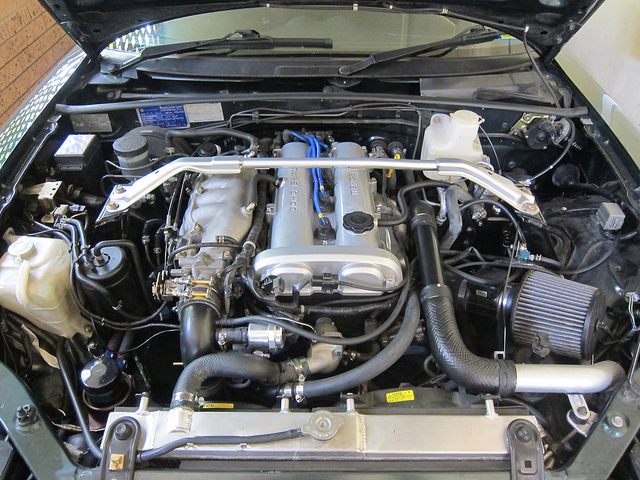
Notice the catch can tucked under the suspension tower brace, then feeding back into the intake:
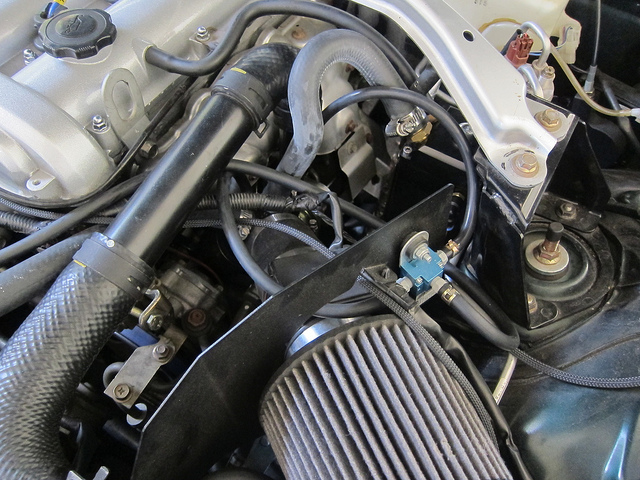
It seems to work OK for now, but I am assuming this will be an issue when power and boost levels are raised.
Do you think there's any point in all or any of the following?
Thoughts?
I know there's a bit of info on the forum in relation to catch can setups. I've found Jason's thread where he has measured the pressure, as well as another fairly long thread. They all seem to be a work in progress.
Anyway I daily drive my MX-5 but also use it for track days. I am currently only running wastegate boost but I want to be able to run up to 18psi eventually as the motor is fully built.
I am already having turbo to manifold stud backing out issues at this boost level but that's a different story.
Here is my current PCV setup:
Notice the catch can tucked under the suspension tower brace, then feeding back into the intake:
It seems to work OK for now, but I am assuming this will be an issue when power and boost levels are raised.
Do you think there's any point in all or any of the following?
- Replace hose from cam cover to catch can with -8 or -10 fittings and line.
- Enlarge internal hole feeding hotside baffle (like Jason C has done).
- Replace PCV valve with another line going to catch can, then have a vent from catch can to either atmosphere or back to intake.
Thoughts?
Reply
 0
0

0


Did you add any baffling to that can? I have the same one sitting at home that came off my last car and hasnt made its way into the miata yet and I went through 3 variations of baffling before I got something that worked really well.
Reply
0
0




Junior Member
Joined: Oct 2009
Posts: 212
Total Cats: 3
From: Stamford, CT
I think your setup looks decent. Are you collecting oil in the catch can? My favorite catch can setups have both a pre-turbo "suction" pipe (which you have) and a drainback outlet for the can into the crankcase.
Oh and yes, I'd ditch the PCV. PCVs are for emissions not power. They also have the potential for letting boost into the crankcase and blowing engine seals.
Oh and yes, I'd ditch the PCV. PCVs are for emissions not power. They also have the potential for letting boost into the crankcase and blowing engine seals.
Reply
-1
-1
If there was only a cheap plastic device that worked 100% of the time and allowed flow through a pipe in one direction and not the other...
Reply
0
0
Junior Member
Joined: Oct 2009
Posts: 212
Total Cats: 3
From: Stamford, CT
I know I know but the stock miata PCV is made to be open at WOT and let crankcase fumes be pulled out and burned. Is it rated to hold back 20+ lbs of boost?
Or an inline check valve, yeah those work too
Or an inline check valve, yeah those work too
Last edited by AlexL; Apr 18, 2013 at 09:43 AM.
Reply
0
0
the stock PCV is not made to be open at WOT. the plunger just doesn't always seal well. I'm still using a stock PCV with an inline check valve.
I don't lose a drop of oil, infact I'm pretty sure when I do oil changes I drain more than what I put in.
I don't lose a drop of oil, infact I'm pretty sure when I do oil changes I drain more than what I put in.
Reply
0
0
Junior Member
Joined: Oct 2009
Posts: 212
Total Cats: 3
From: Stamford, CT
Sure it is. Vacuum at idle draws the PCV valve almost shut, and the less vacuum the more it opens when finally at WOT the PCV is essentially open.
From wiki:
Like you said, an inline check valve is a great way to ensure no boost enters the crankcase.
From wiki:
Originally Posted by Wikipedia
At idle, the intake manifold vacuum is near maximum. It is at this time the least amount of blow by is actually occurring, so the PCV valve provides the largest amount of (but not complete) restriction. As engine load increases, vacuum on the valve decreases proportionally and blow by increases proportionally. With a lower level of vacuum, the spring returns the cone to the "open" position to allow more air flow. At full throttle, vacuum is much reduced, down to between 1.5 and 3" Hg. At this point the PCV valve is nearly useless, and most combustion gases escape via the "breather tube" where they are then drawn in to the engine's intake manifold anyway.
Reply
0
0
WOT means massive amounts of boost, which means the boost overloads the flimsy little spring and the plunger seals up against the back of the valve. PCVs are designed to close in boost and during backfires.
the pcv is pretty much a check valve, the only issue being they dont always seal so well. so you add a check valve that does, then the pcv can work in normal operation and boost will absolutely not creep past and pressurize the crankcase.
the miata engine needs nothing special for low-boost setups as far as im concerned.
the pcv is pretty much a check valve, the only issue being they dont always seal so well. so you add a check valve that does, then the pcv can work in normal operation and boost will absolutely not creep past and pressurize the crankcase.
the miata engine needs nothing special for low-boost setups as far as im concerned.
Last edited by Braineack; Apr 18, 2013 at 11:28 AM.
Reply
-1
-1


 . I agree with everything you just said.
Reply
0
0

So what's the solution? 1-way check valve or just gutting the PCV entirely?
ASSuming one doesn't have any need to pass emissions and is running an aftermarket ECU, is gutting completely the preferred way?
ASSuming one doesn't have any need to pass emissions and is running an aftermarket ECU, is gutting completely the preferred way?
Reply
0
0
..... not sure if trolling....
.... Or a retarded BP thing that i've never run across on any other car i've ever owned.
Maybe i should clarify: By "gutting" i mean removing the valve, running from that location to a vented catch can, not running back into intake.
Ah. K.
Doubtful i'll ever run anything more than 17-18psi on my BP car, so i'm likely overthinking this?
.... Or a retarded BP thing that i've never run across on any other car i've ever owned.
Maybe i should clarify: By "gutting" i mean removing the valve, running from that location to a vented catch can, not running back into intake.
Doubtful i'll ever run anything more than 17-18psi on my BP car, so i'm likely overthinking this?
Reply
0
0


