


Boost Vs. Flow Article in Sport Compact Car.


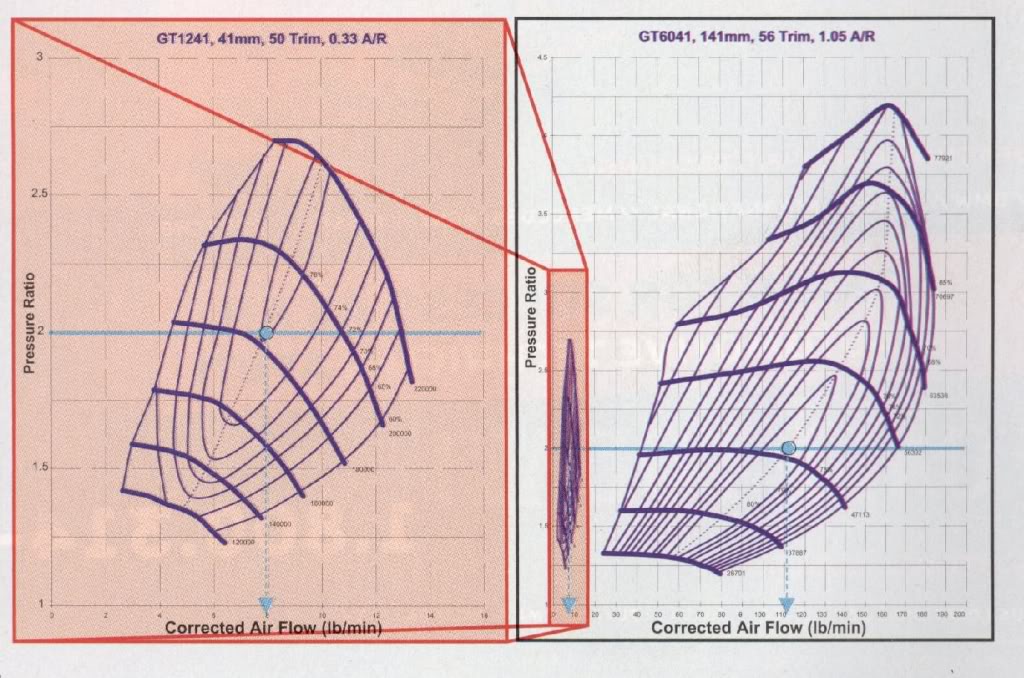



I just glanced at it. I think everyone here knows 12psi out of a 2554 doesn't equal 12psi out of a 2871. If they don't then they should  For me, I don't really care how much boost you are running, but how much power you are putting down at that boost level. And how does it spool.
Ehh whatever time for lunch.
For me, I don't really care how much boost you are running, but how much power you are putting down at that boost level. And how does it spool.Ehh whatever time for lunch.
Reply
 0
0

0
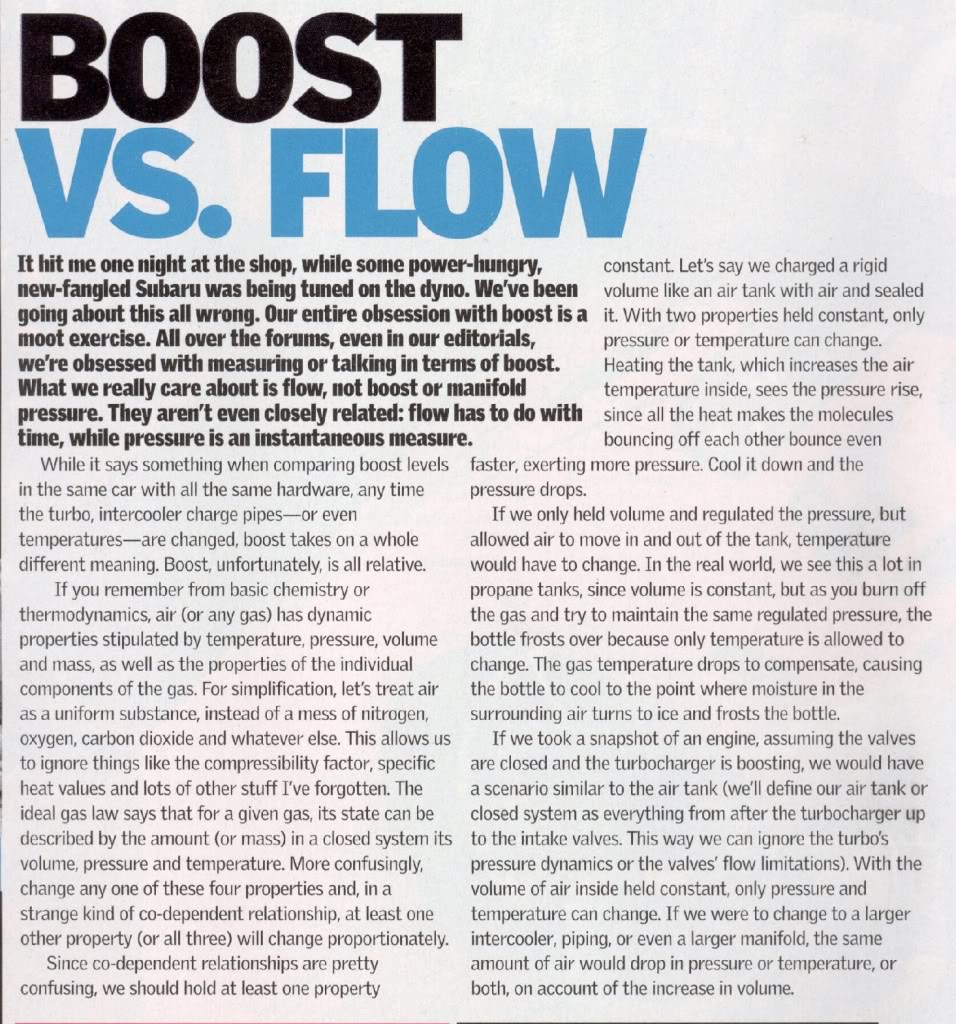
Sucks that I can't copy that text, but above the compressor maps, when they say that propane tanks frost because Pressure and Volume are held constant and mass is leaving, that's wrong. Temp should increase to keep the pressure constant if mass is lowered.
The tank frosts cause it's liquid in the tank and it's evaporating? I.E. as the gas at high pressure leaves the valve/nozzle and goes to atmospheric/lower pressure it gets cooler because as pressure goes down so does temp?
or I'm wrong. Either way it doesn't have much to do with the point of the article.
The tank frosts cause it's liquid in the tank and it's evaporating? I.E. as the gas at high pressure leaves the valve/nozzle and goes to atmospheric/lower pressure it gets cooler because as pressure goes down so does temp?
or I'm wrong.
Either way it doesn't have much to do with the point of the article.
Last edited by TurboTim; Mar 13, 2008 at 01:04 PM.
Reply
0
0


Joined: Jun 2005
Posts: 19,338
Total Cats: 574
From: Fake Virginia
they frost because rapid expansion of liquid (to gas). since volume and pressure change, the temperature tries to keep up.
if you boil water, you add heat to the water to increase volume.
if propane expands, it has to take heat from somewhere. removing heat from the bottle causes the frost.
I hate SCC. what is it, like 80 pages of "we built a show car and think we're engineers"?
if you boil water, you add heat to the water to increase volume.
if propane expands, it has to take heat from somewhere. removing heat from the bottle causes the frost.
I hate SCC. what is it, like 80 pages of "we built a show car and think we're engineers"?
Reply
0
0
they frost because rapid expansion of liquid (to gas). since volume and pressure change, the temperature tries to keep up.
if you boil water, you add heat to the water to increase volume.
if propane expands, it has to take heat from somewhere. removing heat from the bottle causes the frost.
I hate SCC. what is it, like 80 pages of "we built a show car and think we're engineers"?
if you boil water, you add heat to the water to increase volume.
if propane expands, it has to take heat from somewhere. removing heat from the bottle causes the frost.
I hate SCC. what is it, like 80 pages of "we built a show car and think we're engineers"?
and last time I checked, the pressure in my propane tank/nitrous tank/paintball tank/birthday balloon doesn't stay constant as the contants are expelled. The "regulated pressure" is after the valve, not inside the tank.
Reply
0
0



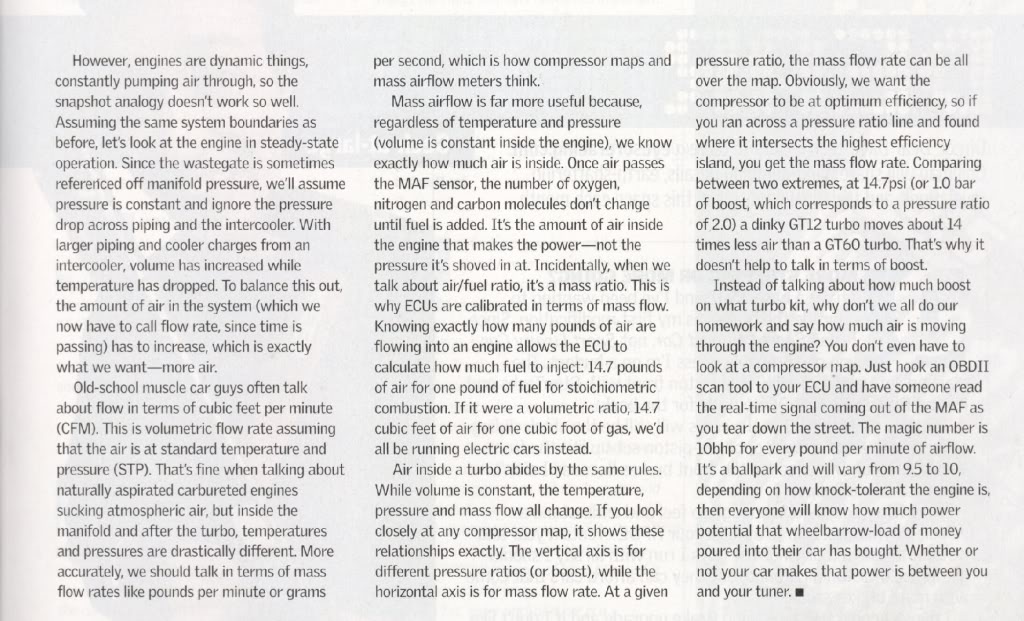
Good article. The author has it all right from an engineering perspective, except for the aforementioned implication about the propane tank. Not sure if constant pressure inside the tank is what he meant by talking about the regulator. If so that is wrong.
The author's point about focusing on flow instead of boost (across different engines and configurations) is a good one. Though I am using a speed-density setup right now with the Megasquirt, I would think another way to determine fuel flow (injector pulse width) might be to use a MAF to determine the base fuel requirement (to get 14.7:1), then apply enrichments based on MAP (to richen up the mixture for WOT and/or boost). Of course a speed-density VE table (tuned using WB02 feedback) is indirectly doing this already.
Stephanie at BEGi mentioned that the HE-X system is using MAF with a Xede I believe. I wonder if this is how they are doing it, MAF with MAP, maybe even AIT modifications?
The author's point about focusing on flow instead of boost (across different engines and configurations) is a good one. Though I am using a speed-density setup right now with the Megasquirt, I would think another way to determine fuel flow (injector pulse width) might be to use a MAF to determine the base fuel requirement (to get 14.7:1), then apply enrichments based on MAP (to richen up the mixture for WOT and/or boost). Of course a speed-density VE table (tuned using WB02 feedback) is indirectly doing this already.
Stephanie at BEGi mentioned that the HE-X system is using MAF with a Xede I believe. I wonder if this is how they are doing it, MAF with MAP, maybe even AIT modifications?
Reply
0
0

they frost because rapid expansion of liquid (to gas). since volume and pressure change, the temperature tries to keep up.
if you boil water, you add heat to the water to increase volume.
if propane expands, it has to take heat from somewhere. removing heat from the bottle causes the frost.
I hate SCC. what is it, like 80 pages of "we built a show car and think we're engineers"?
if you boil water, you add heat to the water to increase volume.
if propane expands, it has to take heat from somewhere. removing heat from the bottle causes the frost.
I hate SCC. what is it, like 80 pages of "we built a show car and think we're engineers"?
exactly!
the article was... entertaining. some good info and some good misinformation...
Reply
0
0

Who give a $h1t how many PSI you run. I think that cfm and more stroke are the keys. You can stuff all the air you want in the cylinder but ultimatley the compression is what does the real work. Turbo cars have lower compression pistons NA cars have higher compression pistons. It's all pretty simple. Now all that being said there are obvious charictaristics to both scenerios and even a supercharger, but the basic premise of my post is that PSI means da da.
Reply
0
0
Who give a $h1t how many PSI you run. I think that cfm and more stroke are the keys. You can stuff all the air you want in the cylinder but ultimatley the compression is what does the real work. Turbo cars have lower compression pistons NA cars have higher compression pistons. It's all pretty simple. Now all that being said there are obvious charictaristics to both scenerios and even a supercharger, but the basic premise of my post is that PSI means da da.
Reply
0
0
Reply
0
0




Frost forming on propane tank = Heat of vaporization (Technical term)
Other than that, I think this should definitely be put in front of the people who still don't know that x boost from one turbo = x boost from another turbo in terms of power.
Other than that, I think this should definitely be put in front of the people who still don't know that x boost from one turbo = x boost from another turbo in terms of power.
Reply
0
0

well its from the ideal gas law which covers the principle concept, the phase change explains the great quantity amount of heat absorbed. Cause its liquid propane in the cylinders right?
Reply
0
0
Joined: Jun 2005
Posts: 19,338
Total Cats: 574
From: Fake Virginia
careful throwing around that "ideal" there. and yeah, the propane in the cylinders is liquid. and because it's liquid at room temperature, it's gotta be at high pressure.
Reply
0
0

i'm a bit distressed that these guys are just now publishing this article
if this was in their second issues i would simply concur, but jeezus, how long have these guys been around? should this not be common knowledge to everyone who ever even thought about boosting a motor? therefore i ahve to call these guys idiots...dont get me wrong, i am no engineer by any means and would get my *** handed to me if i tried to school any of them on boosting cars...
i guess what i'm trying to say is that this article makes me want to say: "uhhhhhh........ok, now would you like to show examples about how the world is round and not flat?"
if this was in their second issues i would simply concur, but jeezus, how long have these guys been around? should this not be common knowledge to everyone who ever even thought about boosting a motor? therefore i ahve to call these guys idiots...dont get me wrong, i am no engineer by any means and would get my *** handed to me if i tried to school any of them on boosting cars...
i guess what i'm trying to say is that this article makes me want to say: "uhhhhhh........ok, now would you like to show examples about how the world is round and not flat?"
Reply
0
0
http://en.wikipedia.org/wiki/Ideal_gas_law
Im not sure what to be careful about.
Reply
0
0
Joined: Jun 2005
Posts: 19,338
Total Cats: 574
From: Fake Virginia
err its the ideal gas law.
http://en.wikipedia.org/wiki/Ideal_gas_law
Im not sure what to be careful about.
http://en.wikipedia.org/wiki/Ideal_gas_law
Im not sure what to be careful about.
Reply
0
0
Reply
0
0


