


Clutchnet Thread-chime in please


Mine isn't in the car... it's on my shelf as of now, I'm still working on a few things. So I can't tell you anything about it holding up in my car, but the unsprung hub is a bitch in stop and go rudh hour traffic...
Reply
 0
0

0

Elite Member
iTrader: (22)
Joined: Dec 2006
Posts: 3,224
Total Cats: 3
From: Sunny Spanish speaking Non US Caribbean
I'm happy with my sprung 6 puck cerametallic from clutchnet. Feels like the trans will give before the disk on hard launch. Traffic stop N go isn't any fun. The ebay sprung disks don't look like mine- similar, but they lack the "encapsulation" flanges that surround the springs. That's what tore apart on my spec... the second time.
If I understand where Dan is coming from, I would like a clutch similar to the one he's thinking about buying. Heavy clutches are for young people, I'd rather use what's left of my strength for other fun things

And Dan, I'm not implying you're in my age group

Reply
0
0



I drove an ACT HD 4 puck clutch a few weeks ago. Based on driving it, I wouldn't be afraid of a 6 puck clutch.
Reply
0
0


Joined: Jun 2005
Posts: 19,338
Total Cats: 574
From: Fake Virginia
I'm happy with my sprung 6 puck cerametallic from clutchnet. Feels like the trans will give before the disk on hard launch. Traffic stop N go isn't any fun. The ebay sprung disks don't look like mine- similar, but they lack the "encapsulation" flanges that surround the springs. That's what tore apart on my spec... the second time.
also fwiw the kevlar disks also have a lower coeff of friction and like scott said will glaze if you look at them funny. they're for high mileage work vehicles or big rigs.
Reply
0
0
yes, in droptopdrifter's (unthrottled) supercharged NB.
and when it comes to clutches, I'm a ***** (blew left knee and broke all 3 leg bones nearly 2 yrs ago)
and when it comes to clutches, I'm a ***** (blew left knee and broke all 3 leg bones nearly 2 yrs ago)
Reply
0
0

I quite like my sprung-hub 6 puck clutch, stop and go isn't as smooth as before, but that might also be the ACT prolite flywheel 
here's the disk I use btw:
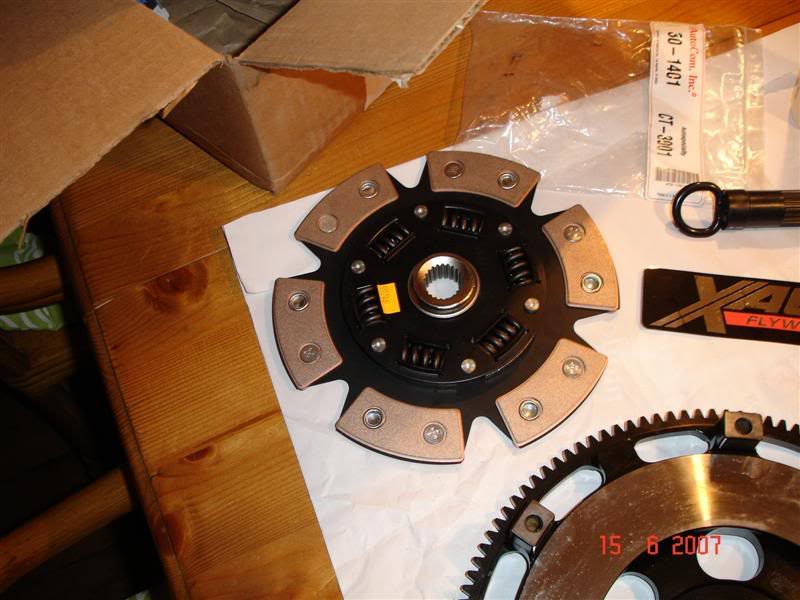
here's the disk I use btw:
Last edited by Oscar; Dec 13, 2007 at 07:22 AM.
Reply
0
0

Based on what the previous owner told me i have a 6 puck HD in my car. I don't mind it. Grabs great, though i'm not making any real power right now anyway. Very streetable. Makes some noise, but i guess that's part of having a ceramic clutch with heavy PP. That is, if my friction disc even is ceramic.
Reply
0
0

Senior Member
Joined: Mar 2006
Posts: 1,380
Total Cats: 2
Mark
Reply
0
0


I don't track my car... not yet. But in a road racing environment you don't need that kind of lock up anyway since you're not (or most likely not) doing standing starts. I got the cerametallic material because clutchnet said that the cut off for holding power with carbon material was 300ftlbs. - and that wasn't being abusive to it. I'd already had a spec clutch fail on me twice and didn't want to have to do another clutch change from failure, so I went with something that the seller could honestly tell me would manage abuse and power that I plan to put down (if I ever get there). The irony is that it's probably more expensive to tear up your clutch assembly than replace the transmission.
here's some pics of my clutchnet disk- note the spring chambers


And my spec after the second failure. I don't blame spec for this one. It was essentially stick stage3 material on a stage1-2 disk. The disk failed the first time with kevlar material, which wore out to the rivets in 5k miles- that's on a supercharged 1.6 and moderate driving. But it illustrates my concern for having a good foundation for a sprung system.


here's some pics of my clutchnet disk- note the spring chambers
And my spec after the second failure. I don't blame spec for this one. It was essentially stick stage3 material on a stage1-2 disk. The disk failed the first time with kevlar material, which wore out to the rivets in 5k miles- that's on a supercharged 1.6 and moderate driving. But it illustrates my concern for having a good foundation for a sprung system.
Reply
0
0
Joined: Jun 2005
Posts: 19,338
Total Cats: 574
From: Fake Virginia
rob my issue with the cerametallic was that it wore out the flywheel, floater, and pressure plate much faster and on a twin disk that is bad news. it came out in under a year because it started slipping. everything was worn to ****.
Reply
0
0

Thread Starter
Joined: Sep 2007
Posts: 4,850
Total Cats: 8
From: High Point NC
good feedback
based on everything so far, i think im still gonna go with the sprung solid organic
Y8S, did you mix and match the springs, is that why they are different colors?
thats what i wanted as well, 3 regular 3 HD...
based on everything so far, i think im still gonna go with the sprung solid organic
Y8S, did you mix and match the springs, is that why they are different colors?
thats what i wanted as well, 3 regular 3 HD...
Reply
0
0



smooth vs on/off.
since the friction surfaces are more focused, they clamp stronger/faster. therefore, you typically have to relearn (5-minutes) how to drive with one, as you'll refrain from slowly engaging them as you inch forward from a stop.
since the friction surfaces are more focused, they clamp stronger/faster. therefore, you typically have to relearn (5-minutes) how to drive with one, as you'll refrain from slowly engaging them as you inch forward from a stop.
Reply
0
0
AH. very interesting.
I noticed clutch net has carbon fiber discs as well, why hasnt that been mentioned in the thread? I am guessing they are in the same league as kevlar with the same problems?
I noticed clutch net has carbon fiber discs as well, why hasnt that been mentioned in the thread? I am guessing they are in the same league as kevlar with the same problems?
Reply
0
0
Thread Starter
Joined: Sep 2007
Posts: 4,850
Total Cats: 8
From: High Point NC
sprung engages smoother
solid vs pucks-solid is more stock like in engaging while pucks tend to just grip
solid is also easier on the tranny supposedly
Reply
0
0
I'm running a carbon composite (carbon fiber) clutch disc. the coefficient of friction is somewhere between .5-1.0, which is higher than most. whereas kevlar is less than most. it's also lighter, the less weight the better. so technically a carbon disc would require less pressure to clamp and hold the same torque as a kevlar disc.
if you wanna get really nerdy, the torque capacity equation is fun:
T = N x R x F x P
* T = torque capacity in ft. lbs.
* N = number of friction surfaces
* F = coefficient of friction
* P = lbs. of pressure plate clamp force
* R = radius of gyration in feet
R = (OD + ID) / 4 = Average radius of the disc in mm.
Then convert to ft where 25.4 mm = 1 inch,
12 inches = 1 ft.
eg. a typical 225mm outer diameter disc will have an
R=0.308 ft
if you wanna get really nerdy, the torque capacity equation is fun:
T = N x R x F x P
* T = torque capacity in ft. lbs.
* N = number of friction surfaces
* F = coefficient of friction
* P = lbs. of pressure plate clamp force
* R = radius of gyration in feet
R = (OD + ID) / 4 = Average radius of the disc in mm.
Then convert to ft where 25.4 mm = 1 inch,
12 inches = 1 ft.
eg. a typical 225mm outer diameter disc will have an
R=0.308 ft
Reply
0
0


