


Koyo Hyper V-Core?


Thread Starter
Senior Member
Joined: Dec 2004
Posts: 1,278
Total Cats: 37
From: Brisbane, Australia
 Koyo Hyper V-Core?
The previous owner of my car fitted an ASI (Chinese) 52mm radiator, I'm looking to swap to the VH060650 for a more efficient core.
Anyone have any real world track experience with these new 2015 Koyo Hyper V-Core radiators?
Cheers
Anyone have any real world track experience with these new 2015 Koyo Hyper V-Core radiators?
Cheers
Reply
 0
0

0


So overall, and sort of generically, I put the Hyper V halfway between the old 37mm Koyo and a good Crossflow.
__________________


Reply
3
3



Joined: Sep 2005
Posts: 34,424
Total Cats: 7,547
From: Chicago. (The less-murder part.)
Smartass content:
I support any Miata cooling product which has the word "Hyper" in its name.
Serious content:
Not knowing what a "Hyper V-Core" radiator was, I googled it and landed on Koyo's "Radiator Technology" page. There I found a description of their "N-FLO Technology" (multi-pass radiator.) To wit:
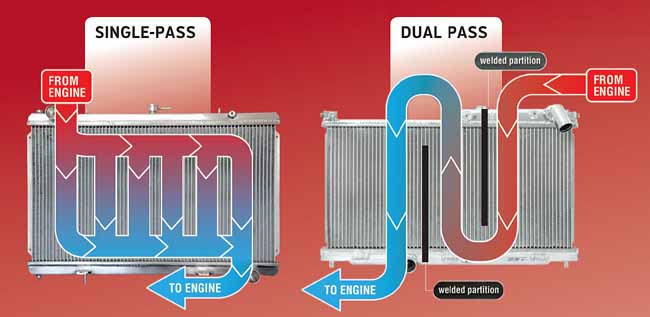
"This is Koyorad’s N-Flo Technology which allows for a double or triple pass radiator. This design cools more efficiently by allowing the coolant to remain in the radiator for a longer period of time therefore transferring more heat to the surrounding air."Allowing coolant to remain in the radiator for a longer period of time?
Last time I checked, the amount of time coolant remained in the radiator was governed by only two factors:
Now, having worked in the corporate equipment-manufacturing world myself, I understand that there is a large disconnect between Engineering and Marketing. But still...
Am I missing something?
I support any Miata cooling product which has the word "Hyper" in its name.
Serious content:
Not knowing what a "Hyper V-Core" radiator was, I googled it and landed on Koyo's "Radiator Technology" page. There I found a description of their "N-FLO Technology" (multi-pass radiator.) To wit:
"This is Koyorad’s N-Flo Technology which allows for a double or triple pass radiator. This design cools more efficiently by allowing the coolant to remain in the radiator for a longer period of time therefore transferring more heat to the surrounding air."
Last time I checked, the amount of time coolant remained in the radiator was governed by only two factors:
- The flowrate of the water (liters per minute), and
- The size (volume) of the radiator.
Now, having worked in the corporate equipment-manufacturing world myself, I understand that there is a large disconnect between Engineering and Marketing. But still...
Am I missing something?
Reply
0
0

Joined: Sep 2005
Posts: 34,424
Total Cats: 7,547
From: Chicago. (The less-murder part.)
Now, I'll be the first to admit that I don't understand the justification for running a multi-pass radiator over a conventional one. Both have the same active area and the same volume, and should perform equally. Yet some people staunchly support the idea that multi-pass radiators offer a performance advantage, at least in some conditions.
Is there a solid technical justification for this, or are multi-pass radiators a gris-gris? I have no idea.
Reply
0
0
But that water molecule has to take a longer path between the inlet and outlet. So a higher linear speed within the core tubes.
But you're right, the literature is wrong.
But you're right, the literature is wrong.
Reply
0
0
Hyper-V not to be confused with N-Flo, multi pass or whatever it is. Hyper-V is simply more FPI, (Fins Per Inch). Rest of the radiator is the same as the old V&R series rads. For most motorsports oriented radiators in production based cars (given pressure gradients, temp deltas), 18-21 FPI is sort of the sweet spot in fin density. The previous Koyos were about 14FPI. With the Hyper-V Koyo enters the modern era where all purpose built, higher end radiators are using 18-21 FPI.
Our crossflow, TSE, FM, PWR, Ron Davis, C&R are all in the 18-21FPI range.

Our crossflow, TSE, FM, PWR, Ron Davis, C&R are all in the 18-21FPI range.
__________________
Reply
2
2

The higher linear speed is the good part here. Makes for a higher reynolds number. Forced convection is not time dependent. I think I'd rather see the triple pass setup go back to front rather than side to side though.
Reply
0
0

Junior Member
Joined: Aug 2010
Posts: 162
Total Cats: 11
From: Texas

Reply
0
0

This made me happy.
FWIW I have the old Koyo 37mm, and have a really hard time with temps just driving on the freeway here in phoenix. If it's 100°F or higher, I'm gonna see 220 if I have the AC and I'm not really comfortable with that. My hood vent helps, but it's not enough area by itself. I I'm not keen to cut more holes though, because I park my car outside. I logged it coming home from work for a week before the vent, and then again after and I think it’s given a 2-3° improvement. The biggest help I saw so far was from sealing the OEM fan shroud to the radiator using aluminum tape. That was good for about 5° by my observation. If I could do it again I would have bought the 53mm koyo.
FWIW I have the old Koyo 37mm, and have a really hard time with temps just driving on the freeway here in phoenix. If it's 100°F or higher, I'm gonna see 220 if I have the AC and I'm not really comfortable with that. My hood vent helps, but it's not enough area by itself. I I'm not keen to cut more holes though, because I park my car outside. I logged it coming home from work for a week before the vent, and then again after and I think it’s given a 2-3° improvement. The biggest help I saw so far was from sealing the OEM fan shroud to the radiator using aluminum tape. That was good for about 5° by my observation. If I could do it again I would have bought the 53mm koyo.
Reply
0
0
Joined: Sep 2005
Posts: 34,424
Total Cats: 7,547
From: Chicago. (The less-murder part.)
Understood, wasn't confusing the two. Merely noting that while researching the Hyper-V, I came across the aforementioned apparent misinformation on the Multipass.
(And I got a pretty good chuckle out of the GIF.)
I can see that. Higher velocity = more turbulent flow inside the core.
I'd love to see some hard data that compares the heat transfer potential of two otherwise identical radiators back to back.
(And I got a pretty good chuckle out of the GIF.)
I'd love to see some hard data that compares the heat transfer potential of two otherwise identical radiators back to back.
Reply
0
0
Crossflow is still go. Just no ETA. Had to fire the original engineer. Good work but seriously overbooked himself. It's all in house now and moving forward.
__________________
Reply
0
0


Reply
0
0
Just fitment stuff. Same basic unit and performance, you would be hard pressed to tell them apart. Final rev will just fit better and be easier to install.
__________________
Reply
0
0

I'm now at the crossroads of needing a radiator and as the 949 is on the undefined hiatus I'm looking at this Hyper V Koyo unit and FM's version of the crossflow. My wallet wants the Koyo, but I don't want another situation where $100-200 would have saved me downtime and irritation.
Reply
0
0

Thread Starter
Senior Member
Joined: Dec 2004
Posts: 1,278
Total Cats: 37
From: Brisbane, Australia
I haven't had a chance to install this yet but there's not many pics out there showing the Hyper V core, so here we go:
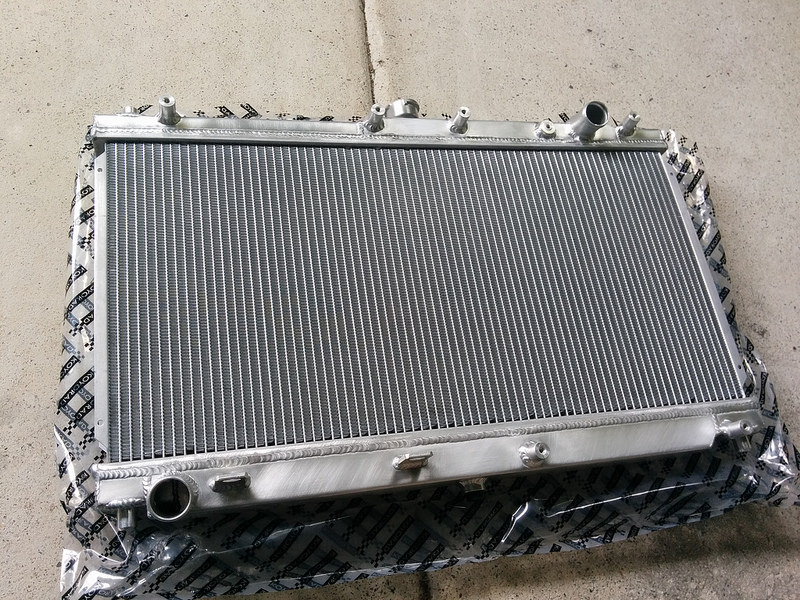
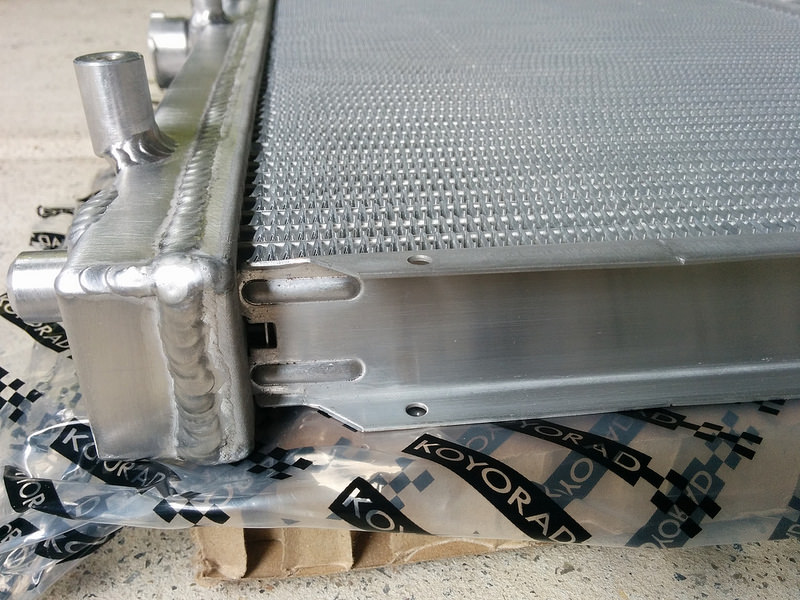
Hopefully this thing works better than my old radiator!
Cheers
Hopefully this thing works better than my old radiator!
Cheers
Reply
0
0
Our revised Crossflow was put back into production a few weeks ago but is still probably 10 weeks away. Long lead time. Revisions are to make it fit better and allow NB's to retain A/C. Not taking pre orders until they are in port. Website will have a "buy" button when we do so.
Meanwhile, here is a pic I took of the NA Hyper-V

Meanwhile, here is a pic I took of the NA Hyper-V
__________________
Reply
0
0

Sorry to resurrect an old thread, but I have this radiator on my NB. Last night I noticed it has what appears to be a bung for a temperature sending unit right next to the water inlet. Is this a good place to get a reasonably accurate reading? Obviously, closer to the engine would be better, but I haven't done a reroute yet and I don't want to screw anything up.
If so, does anyone know what size/thread dimension it is? I want to replace my factory temp gauge with something that's accurate and has numbers, and this seems like an easy way to do it.
** Never mind. I think it's 1/8NPT since apparently that's what they put on all their other radiators. It'll work for now.
If so, does anyone know what size/thread dimension it is? I want to replace my factory temp gauge with something that's accurate and has numbers, and this seems like an easy way to do it.
** Never mind. I think it's 1/8NPT since apparently that's what they put on all their other radiators. It'll work for now.
Last edited by WMP; Sep 22, 2015 at 10:42 AM.
Reply
0
0

Thread
Thread Starter
Forum
Replies
Last Post


