Notices
General Miata Chat A place to talk about anything Miata

Mechanical engineers: help me calculate stuff.

Thread Tools
 
Search this Thread
 
Old Dec 17, 2014 | 04:59 PM
  #21  
Leafy's Avatar
Elite Member
iTrader: (1)
 
Joined: Jun 2012
Posts: 9,491
Total Cats: 105
From: NH
Default

Originally Posted by nitrodann
Going back to why dont youy just do a log and then use a dyno?
Because the VD software, just like dynojet software, doesnt work if you're not accelerating.
Old Dec 17, 2014 | 08:49 PM
  #22  
dcamp2's Avatar
Senior Member
iTrader: (4)
 
Joined: Nov 2012
Posts: 818
Total Cats: 69
From: Colorado
Default

has anyone asked the most important question- why do you (Joe P) care?

you making an electric miata commuter?
Old Dec 17, 2014 | 08:55 PM
  #23  
nitrodann's Avatar
Elite Member
 
Joined: Apr 2010
Posts: 2,826
Total Cats: 66
From: Newcastle, Australia
Default

No no no.

Drive the desired speed in the desired conditions. Log manifold pressure and rpm or use tps or whatever you prefer. Simulate on dyno. Read HP output.

Easy.
Old Dec 18, 2014 | 09:20 AM
  #24  
y8s's Avatar
y8s
DEI liberal femininity
iTrader: (8)
 
Joined: Jun 2005
Posts: 19,338
Total Cats: 574
From: Fake Virginia
Default

Originally Posted by Leafy
with frictionless rollers on it in a perfect vacuum at absolute zero?
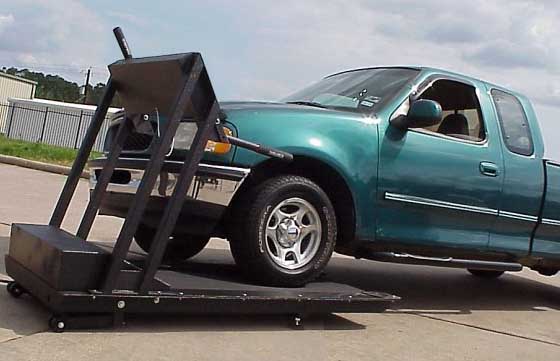
No. Joe never asked for theoretical frictionless coefficient of drag. He wants to know steady state. Which means I have to revise my suggestion to using several ramps of varying angle until you find one that sustains 50 mph terminal velocity.

Originally Posted by Joe Perez
Such as how much HP does it take to move an NA down the highway at a constant 50 MPH on level ground, assuming ordinary all-season tires in the ~195 width range.

With the top up / down?

With the headlights up / down?

What about 65 MPH?

Etc.

I think nitrodann has the easiest solution. do it empirically. except for the dyno part. I hear those aren't so great at determining drag. maybe an inside out dyno. One where the car is stationary and the wind moves. I'm sure there's one at Ames:

Old Dec 18, 2014 | 09:35 AM
  #25  
fooger03's Avatar
Elite Member
iTrader: (2)
 
Joined: Jan 2009
Posts: 4,149
Total Cats: 230
From: Columbus, OH
Default

Attached Thumbnails Mechanical engineers: help me calculate stuff.-noramco%25204600pr%2520-%2520car.jpg  
Old Dec 18, 2014 | 10:15 AM
  #26  
Joe Perez's Avatar
Thread Starter
Boost Pope
iTrader: (8)
 
Joined: Sep 2005
Posts: 34,402
Total Cats: 7,523
From: Chicago. (The less-murder part.)
Default

Originally Posted by dcamp2
has anyone asked the most important question- why do you (Joe P) care?

you making an electric miata commuter?
I'm merely curious as to the practicality of constructing a series-hybrid Miata, utilizing a small Li-ion battery back capable of providing the vehicle with a very short pure-electric range (say, 20 miles or so), while affording the capacity to travel unlimited distances on an occasional basis by utilizing a gasoline-powered generator.

Such vehicles have been constructed in the past which accommodate an external generator mounted on a small trailer, however I find this to be both grossly inelegant and also quite inconvenient. Sadly, gasoline-powered generators, at least those available at the consumer-level at a reasonable cost, are not especially compact.
Old Dec 18, 2014 | 10:22 AM
  #27  
curly's Avatar
Cpt. Slow
iTrader: (25)
 
Joined: Oct 2005
Posts: 15,197
Total Cats: 1,398
From: Oregon City, OR
Default

Attached Thumbnails Mechanical engineers: help me calculate stuff.-top-gear-hammer-eagle-ithrust1.jpg  
Old Dec 18, 2014 | 11:06 AM
  #28  
DNMakinson's Avatar
Elite Member
iTrader: (3)
 
Joined: Jan 2013
Posts: 5,030
Total Cats: 861
From: Seneca, SC
Default

Y8s, with the Dann Plan, the dyno needs no drag. On the street, run all test conditions, logging the MAP and RPM, with maybe pulse width as well. Then on the dyno, run those same settings and read the HP. Now you have the HP required for each of the street-logged conditions.

Top down, 60 mph, MAP was 62kPa. On dyno, run same gear at 60 mph, and 62 kPa. Record the HP. This is the requirement for 60 mph with top down. And so on for each condition. Need no wind and flat road, or average multiple runs on the street for each condition; then a single, multipoint, load controlled dyno session.
Old Dec 18, 2014 | 11:29 AM
  #29  
Joe Perez's Avatar
Thread Starter
Boost Pope
iTrader: (8)
 
Joined: Sep 2005
Posts: 34,402
Total Cats: 7,523
From: Chicago. (The less-murder part.)
Default

Originally Posted by DNMakinson
On the street, run all test conditions, logging the MAP and RPM, with maybe pulse width as well. Then on the dyno, run those same settings and read the HP. Now you have the HP required for each of the street-logged conditions.
That seems like more work than just expecting someone to magically spoon-feed me the exact information I want.
Old Dec 18, 2014 | 12:06 PM
  #30  
Godless Commie's Avatar
Elite Member
iTrader: (2)
 
Joined: Jun 2009
Posts: 3,227
Total Cats: 1,707
From: Istanbul, Turkey
Default

My guess would be something in the 28 to 32 Hp for the conditions you are describing.
Maybe a bit less even.
Old Dec 18, 2014 | 12:43 PM
  #31  
Joe Perez's Avatar
Thread Starter
Boost Pope
iTrader: (8)
 
Joined: Sep 2005
Posts: 34,402
Total Cats: 7,523
From: Chicago. (The less-murder part.)
Default

Originally Posted by Godless Commie
My guess would be something in the 28 to 32 Hp for the conditions you are describing.
Maybe a bit less even.
I've found some sources within the DIY community which suggest that a generator capable of supplying 15kWe, powered by an engine capable of producing 20HP, is sufficient to sustain 60-65 MPH continuously in an average passenger car.

Of course, commercially-available generators so rated, while extremely inexpensive, are hilariously large and heavy.


Now, I'm going to branch off here for a moment to point out a few select pieces of the 2012 California Air Resources Board regulations on the sale of range-extended EVs.


First, the vehicle must have a rated all-electric range of at least 75 miles, which is higher than the 50 miles required of a zero-emission vehicle.

Second, the auxiliary power unit must provide range less than, or at most equal to, that battery range.

Third, and I quote directly: "The objective of the BEVx is not to develop a PHEV with universal appeal."


Dafuq?

I have no idea what CARB is trying to do here. On the one hand, they want to address range-axiety and broaden the appeal of battery-powered EVs. So to do that, they're first going to drive up and weight and cost of these vehicles by loading them with unnecessarily large battery packs (50% larger than a conventional, battery-only EV), and then they're going to deliberately cripple them by not allowing the added gasoline engine to give them a range which is sufficiently useful to cover those 10% of use-cases which rational, ordinary people will cite as the reason why owning an EV as their only car is not a practical proposition.

Well, I guess they achieved the objective of not developing a car with universal appeal.


Attached Thumbnails Mechanical engineers: help me calculate stuff.-ultimate_facepalm.jpg  
Old Dec 18, 2014 | 12:48 PM
  #32  
Leafy's Avatar
Elite Member
iTrader: (1)
 
Joined: Jun 2012
Posts: 9,491
Total Cats: 105
From: NH
Default

Joe if the Volt is sold in california then sum ting wong with what you just posted since the volt doesnt meat any of those requirements.
Old Dec 18, 2014 | 01:02 PM
  #33  
Joe Perez's Avatar
Thread Starter
Boost Pope
iTrader: (8)
 
Joined: Sep 2005
Posts: 34,402
Total Cats: 7,523
From: Chicago. (The less-murder part.)
Default

Originally Posted by Leafy
Joe if the Volt is sold in california then sum ting wong with what you just posted since the volt doesnt meat any of those requirements.
The Volt is classified as PHEV (Plug-in Hybrid Electric Vehicle), not a BEVx (Battery Electric Vehicle, extended.)

The distinction between these two classes is a point of great controversy with the greenies, but what it really boils down to is that California has pretty much eliminated any possibility of buying a small, lightweight, inexpensive vehicle which has just enough battery capacity to deal with your everyday commute, yet is still able to be driven on long trips from time to time as the need arises. Instead, you must either own two cars, or you must own a single car which is larger, heavier, more expensive and less efficient than is necessary.

They might as well outlaw four-door Sedans and require that everyone in CA instead purchase both a Miata and a Chevy Surburban.
Old Dec 18, 2014 | 01:05 PM
  #34  
Leafy's Avatar
Elite Member
iTrader: (1)
 
Joined: Jun 2012
Posts: 9,491
Total Cats: 105
From: NH
Default

So... make your car meet the PEHV standards? Whats the difference between a PEHV and a BEVx besides the electrical cord that plugs into the wall and not being forced to meet stupid rules?
Old Dec 18, 2014 | 01:13 PM
  #35  
Joe Perez's Avatar
Thread Starter
Boost Pope
iTrader: (8)
 
Joined: Sep 2005
Posts: 34,402
Total Cats: 7,523
From: Chicago. (The less-murder part.)
Default

Originally Posted by Leafy
Whats the difference between a PEHV and a BEVx besides the electrical cord that plugs into the wall and not being forced to meet stupid rules?
Well, the electric cord itself isn't even a difference, since both PHEVs and BEVxs are able to plug in and charge their battery from grid power.

The honest answer is that the difference between a PHEV and a BEVx is whatever the regulatory agency says it is, and I have utterly no idea why its necessary to have a distinction between the two in the first place.


Attached Thumbnails Mechanical engineers: help me calculate stuff.-charged.jpg  

Last edited by Joe Perez; Dec 18, 2014 at 01:36 PM.
Old Dec 18, 2014 | 01:14 PM
  #36  
Leafy's Avatar
Elite Member
iTrader: (1)
 
Joined: Jun 2012
Posts: 9,491
Total Cats: 105
From: NH
Default

My palm and forehead are very sore right now.
Old Dec 18, 2014 | 03:20 PM
  #37  
DNMakinson's Avatar
Elite Member
iTrader: (3)
 
Joined: Jan 2013
Posts: 5,030
Total Cats: 861
From: Seneca, SC
Default

Originally Posted by Joe Perez
That seems like more work than just expecting someone to magically spoon-feed me the exact information I want.
I totally understand. I was just trying to clarify the concept. Seems like, on occasion, Dann has plausible ideas but people don't understand what he is trying to convey.
Old Dec 24, 2014 | 06:44 AM
  #38  
skidude's Avatar
Elite Member
iTrader: (3)
 
Joined: Apr 2008
Posts: 2,023
Total Cats: 19
From: Outside Portland Maine
Default

Joe, it sort of sounds like the BEHX is supposed to be a small, lightweight vehicle for around-town stuff, while the PEHV is more open to be an EV with an unlimited-range extension. I mean, depending on what you do with it, the name itself may not exactly describe the vehicle, but who cares?

If I missed something in there, I hope somebody will correct me.
Old Dec 24, 2014 | 09:04 AM
  #39  
rleete's Avatar
Elite Member
iTrader: (21)
 
Joined: Jun 2007
Posts: 6,794
Total Cats: 1,342
From: Rochester, NY
Default

I have the chance to buy a citicar (actually a Comuta-Car) for fairly cheap. Need batteries & some basic TLC. should I do it?
Old Dec 24, 2014 | 09:46 AM
  #40  
Leafy's Avatar
Elite Member
iTrader: (1)
 
Joined: Jun 2012
Posts: 9,491
Total Cats: 105
From: NH
Default

How cheap? Lithium batteries are cheap now a days, even buying your own LiFePO4 cells from alibaba is cheapish now.


All times are GMT -4. The time now is 07:53 PM.