


My Radiator/shroud build step by step



Thread Starter

Joined: Sep 2007
Posts: 4,850
Total Cats: 8
From: High Point NC

not sure on surface area of radiator
the fans are rated at 1500CFM each, so total of 3000CFMs safe to say?
there are better ways to build the shroud im sure, but i was really thinking that this would be sufficient for my needs...
if i had the means i would build one that looks something like this
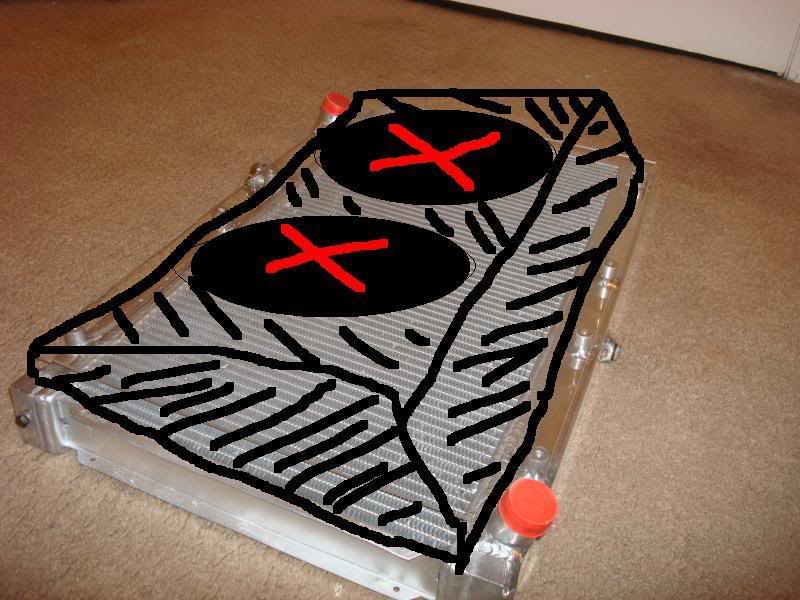
sorry for tge lack of skillz in paint, its the only program i have
the fans are rated at 1500CFM each, so total of 3000CFMs safe to say?
there are better ways to build the shroud im sure, but i was really thinking that this would be sufficient for my needs...
if i had the means i would build one that looks something like this
sorry for tge lack of skillz in paint, its the only program i have
Reply
 0
0

0
Thread Starter
Joined: Sep 2007
Posts: 4,850
Total Cats: 8
From: High Point NC
i didnt measure anything, i lined the lexan up with the radiator and marked accordingly, the lexan was a bit taller so i dremmeled it off and then just dremmeled the loops for rad. feed and return
i think ill be ok with this setup once the shroud is sealed
i may start developement on the next shroud at a later time out of ABS or lexan again, but i think ill make a mold and then just use heat gun to bend the lexan/ABS over the mold...that should be easily achieved
i think ill be ok with this setup once the shroud is sealed
i may start developement on the next shroud at a later time out of ABS or lexan again, but i think ill make a mold and then just use heat gun to bend the lexan/ABS over the mold...that should be easily achieved
Reply
0
0

not sure on surface area of radiator
the fans are rated at 1500CFM each, so total of 3000CFMs safe to say?
there are better ways to build the shroud im sure, but i was really thinking that this would be sufficient for my needs...
if i had the means i would build one that looks something like this
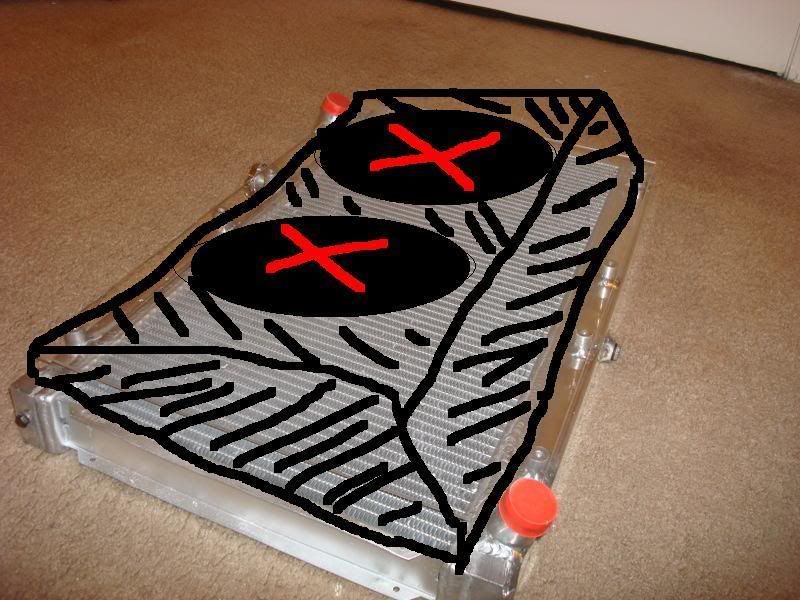
sorry for tge lack of skillz in paint, its the only program i have
the fans are rated at 1500CFM each, so total of 3000CFMs safe to say?
there are better ways to build the shroud im sure, but i was really thinking that this would be sufficient for my needs...
if i had the means i would build one that looks something like this
sorry for tge lack of skillz in paint, its the only program i have
A local forum member found that his stock fans flowed more with a rad infront of them then generic ebay type.
Reply
0
0
not sure on surface area of radiator
the fans are rated at 1500CFM each, so total of 3000CFMs safe to say?
there are better ways to build the shroud im sure, but i was really thinking that this would be sufficient for my needs...
if i had the means i would build one that looks something like this
sorry for tge lack of skillz in paint, its the only program i have
the fans are rated at 1500CFM each, so total of 3000CFMs safe to say?
there are better ways to build the shroud im sure, but i was really thinking that this would be sufficient for my needs...
if i had the means i would build one that looks something like this
sorry for tge lack of skillz in paint, its the only program i have
1) Is this shroud simple going to be flat on the back of the radiator? from your "layout" it looks flat, but your pic shows it inverted. I could see a significant gain from the wedge approach, especially with an extractor hood, and a significant loss from the "flat approach". I agree with olderguy's assessment that the "flat" design will compromise high speed airflow.
2) It looks like like fans are built "into" your shroud. If you use the wedge approach, personally I would put the fans on the radiator themselves (see everyone elses GS install pics). It would really "seal" off the area, rather then leaving two gaping fan holes that would release pressure. Your extractor hood should release enough pressure as it is. I'm sure you thought of this, but the paint program just wouldn't let you express it

Reply
0
0
Thread Starter
Joined: Sep 2007
Posts: 4,850
Total Cats: 8
From: High Point NC
on my original shroud, the shroud doesnt sit on the radiator, there is about 1" gap
on the proposed idea, the point is to direct all airflow that goes through the radiator towards the fans, so even if fans are off the airflow still finds its way to a lower pressure area, thats why i have the fans leaning up towards the vent in the hood
the fans are meant to be flush with the shroud surface
on the proposed idea, the point is to direct all airflow that goes through the radiator towards the fans, so even if fans are off the airflow still finds its way to a lower pressure area, thats why i have the fans leaning up towards the vent in the hood
the fans are meant to be flush with the shroud surface
Reply
0
0


Thread Starter
Joined: Sep 2007
Posts: 4,850
Total Cats: 8
From: High Point NC
if it doesnt work i can always change it or add a pcpro or two, right? QUACK lol
but anyways, i cant explain this well nor draw it up well, but here is another perspective on what i think would be the best solution
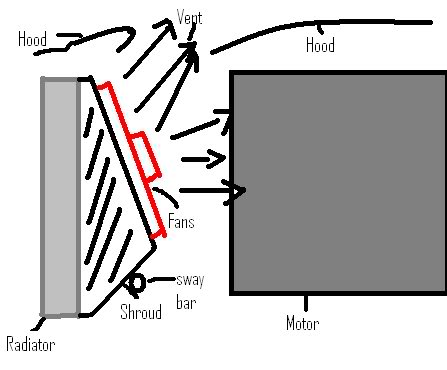
but anyways, i cant explain this well nor draw it up well, but here is another perspective on what i think would be the best solution
Reply
0
0

Looks good to me. I need to think of something like that. Temps in my car (even before my new larger intercooler) will increase on the highway until the fans turn on, then it goes down very quickly. Constant cycle, even in the winter. I have lots of open spaces/very little sealed.
Reply
0
0


1" off the rad surface is definitely adequate- that's what I did, but your second drawing is a far more interesting project 
sealing up the shrouded area (mouth) pre exchangers, makes a HUGE difference on hwy temps providing everything else is in order
sealing up the shrouded area (mouth) pre exchangers, makes a HUGE difference on hwy temps providing everything else is in order
Reply
0
0

I sealed up my opening to force air through mine and I have to agree. I didn't do any hard baseline or testing but I am guessing intake temps dropped 10+ degrees with more air being forced through the intercooler.
When you strap on a turbo, I believe that is in the near future for him. You will have an intercooler to feed as well so every little bit counts. The issue will most definitely be space so angles and shapes will become more important.
On a side note I'd be interested to see what the difference in under hood temp are with my cowl hood verses his extractor. Anyone have any science on that in here?
This is a good topic and some big brains on here.
When you strap on a turbo, I believe that is in the near future for him. You will have an intercooler to feed as well so every little bit counts. The issue will most definitely be space so angles and shapes will become more important.
On a side note I'd be interested to see what the difference in under hood temp are with my cowl hood verses his extractor. Anyone have any science on that in here?
This is a good topic and some big brains on here.
Reply
0
0
the purpose of the extractor is for engine cooling, not engine bay cooling. im sure yours does a better job cooling the engine bay, but his does a better job creating a more efficient cooling system, where your's adversely effects it.
Reply
0
0
So your saying a cowl actually hood decreases cooling? Whats your logic? I am also going on the assumption that your statement of the cowl hood adversely affecting the cooling is even over stock hoods.
Reply
0
0
Thread Starter
Joined: Sep 2007
Posts: 4,850
Total Cats: 8
From: High Point NC
/\ +1
I just picked a piece of lexan up at home depot a little while ago for another project that got shoved in the back of the line and had it laying around, decided it was good enough for this duty thanks to information provided by Loki...
I will run this setup as is (plus seal) for now, if any problems pop up i will redo it...
if i can figure out a way how to get my hands on some big ABS pieces for cheap i will try the other design at a later time or i just may attempt it with lexan and a heat gun, we'll see
I just picked a piece of lexan up at home depot a little while ago for another project that got shoved in the back of the line and had it laying around, decided it was good enough for this duty thanks to information provided by Loki...
I will run this setup as is (plus seal) for now, if any problems pop up i will redo it...
if i can figure out a way how to get my hands on some big ABS pieces for cheap i will try the other design at a later time or i just may attempt it with lexan and a heat gun, we'll see
Reply
0
0
an open cowl increases the under hood pressures, therefore decreases the airflow through the radiator.
an extractor hood promotes flow through the radiator, by creating a super-low pressure zone behind it.
thus forth, an extractor does better for the cooling system (important) and a cowl cools the engine bay (who cares)
Reply
0
0
Thread Starter
Joined: Sep 2007
Posts: 4,850
Total Cats: 8
From: High Point NC
interesting, i never looked at it that way
question: if you are using a completely sealed shroud does the underhood pressure account for anything at all? I would assume it does when fans are not on, but once the fans come on, does it make a difference.
Also, isnt a cowl hood an extractor hood in a way?
question: if you are using a completely sealed shroud does the underhood pressure account for anything at all? I would assume it does when fans are not on, but once the fans come on, does it make a difference.
Also, isnt a cowl hood an extractor hood in a way?
Reply
0
0
I think even a cowl will indirectly help cool the engine when sitting in traffic by reducing the amount of radiant heat the rad is exposed to before the fans come on. But the extractor does both, and the cowl works against the desire (of most) at speed.
Reply
0
0


