


Sanity check: inverted primary trigger required for JimStim?




Joined: Sep 2005
Posts: 34,422
Total Cats: 7,542
From: Chicago. (The less-murder part.)

by default I tend to assume that any signal can have an unexpected voltage on it eventually, especially one that comes from the engine bay and passes near the spark plug wires.
In the OEM design, these circuits are not optoisolated within the ECU- they drive the input of an opamp-based comparator.
In the MSExtra manual, the instructions for wiring the second trigger on the 4G63 do specify the use of a second 4N25, however in the traditional MS1 build for the Miata (including the MSPNP, so far as I'm aware) the second input does not have any isolation whatsoever- the CAS's CMP output is directly connected to the CPU pin through a current-limiting resistor. Lots of cars running around this way, and I've never heard of one blowing a CPU on account of the CAS.
Like everything else, there's more than one way to skin this cat.
Reply
 0
0

0
Joined: Sep 2005
Posts: 34,422
Total Cats: 7,542
From: Chicago. (The less-murder part.)
I wouldn't recommend that. While it's not going to start fires, the output of a VR sensor can easily reach 10-20 volts or more peak-peak, depending upon RPM and gap. Microprocessors really don't like having voltages greater than Vdd (or lower than Vss) applied to their inputs
Reply
0
0

Good lord! Anyway, yeah, the miata sensors on the '99+ (sorry, posting when I'm busy so I forgot you're using that CAS, it's bad timing on my part) - and I think on the 94 and up crank triggers? - have a readout build into them, and are just open collector outputs themselves.
Reply
0
0
Joined: Sep 2005
Posts: 34,422
Total Cats: 7,542
From: Chicago. (The less-murder part.)
In '95.5, they added a crank sensor, but it was a raw VR device. This stayed until '99, when the crank sensor went open-collector and became a primary trigger, instead of just a misfire detector.
Reply
0
0


Thread Starter
Junior Member
Joined: Aug 2008
Posts: 223
Total Cats: 0
From: Boston
Some more pics:


Reply
0
0
Oh, it looks great, kinda big, it might be nice to come up with a stacking arrangement. Surface mount will scare off a lot of people, which is too bad.
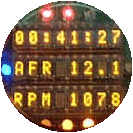
I'm curious, what to the gauges need to know? Are those tri-state LED's?
I'm curious, what to the gauges need to know? Are those tri-state LED's?
Reply
0
0
Thread Starter
Junior Member
Joined: Aug 2008
Posts: 223
Total Cats: 0
From: Boston
Surface mount is really not hard with the right technique, even with just a normal iron. I'd rather do an 0805 resistor than a through-hole one now...
The displays I'm using now take a synchronous serial input. Just a big shift register. But those too would be different in a kit, since they cost $40 per 8 characters. (I bought a few tubes of them surplus a long time ago...)
The LEDs on the bottom are bicolor red/green. The idea is those are for warning indicators -- e.g. coolant temp / oil temp / oil pressure. Red=bad, orange=cold, green = normal. There is a small AVR on the back of the center display board which PWMs the LEDs on behalf of the big AVR.
For a kit I would use something like a 20x2 OLED display and it wouldn't fit nicely in the cluster. But it would be $20 instead of 9*$40.
Reply
0
0
That's really impressive stuff! I'm actually gonna be graduating as an Electronics Engineer in May so SMD stuff doesn't bother me. What software did you use to develop the schematic/PCB? I don't have a ton of experience designing PCB's yet, but the custom footprints for the ECU connectors and such would be nice to have. This project looks really neat and whenever you get more time, please elaborate on it!
Reply
0
0
Thread Starter
Junior Member
Joined: Aug 2008
Posts: 223
Total Cats: 0
From: Boston
I use Eagle. It has its quirks but it is affordable for hobby use, and I am about 10 for 10 in terms of getting working boards back from fab, mostly thanks to Eagle's decent design rule checking.
Sure, I'll post them when I get a chance.
Sure, I'll post them when I get a chance.
Reply
0
0
I'd love to see a good way to go back and forth from KiCAD and Eagle. A lot of folks use the later, though the utterly free aspects of the prior make it hard to ignore. I'm liking it more and more, though to be fair I've yet to work up the guts to send a board out to be made. :-)
Reply
0
0
Thread Starter
Junior Member
Joined: Aug 2008
Posts: 223
Total Cats: 0
From: Boston
I don't know anything about KiCAD. I do know that sometimes free can be expensive 
Incidentally these boards are the first ones I had done at Gold Phoenix. The quality is good and they are hard to beat price-wise. I paid less than $150 for all the boards above (4 large, 12 small of the center display, 8 of the left/right) I've used a number of vendors (Olimex, PCBFabExpress, Advanced Circuits, etc.) and GP is higher quality than Olimex and much cheaper than the other two if you have more than one design.
Incidentally these boards are the first ones I had done at Gold Phoenix. The quality is good and they are hard to beat price-wise. I paid less than $150 for all the boards above (4 large, 12 small of the center display, 8 of the left/right) I've used a number of vendors (Olimex, PCBFabExpress, Advanced Circuits, etc.) and GP is higher quality than Olimex and much cheaper than the other two if you have more than one design.
Reply
0
0
Personally since I'm at school I get a crazy discount on software so I use the NI Circuit Design Suite that has MultiSim (schematic) and Ultiboard (PCB design). Professors of mine use Eagle, never had experience with it though. We only use Advanced Circuits too, I think mainly because of student discounts and such.
Seeing this makes me want to do something similar....
Seeing this makes me want to do something similar....
Reply
0
0
Joined: Sep 2005
Posts: 34,422
Total Cats: 7,542
From: Chicago. (The less-murder part.)
I'm with you on the SMD. 0805 or 1206 are pretty easy to do with some tweezers, a roll of .025" solder, and a regular iron with a clean tip. And no leads to trim on the backside.

Reply
0
0
Getting more reasonable, figure $50 + board plus LEDs... not cheap but very useful. Sure starts to make the dash-mounted EEEpc look pretty good.
As to the surface mount, I'm certainly a fan, but it's hard to get the "world at large" to accept it.
As to the surface mount, I'm certainly a fan, but it's hard to get the "world at large" to accept it.
Reply
0
0

Thread
Thread Starter
Forum
Replies
Last Post
Zaphod
MEGAsquirt
47
Oct 26, 2018 11:00 PM
chris101
Miata parts for sale/trade
5
Feb 19, 2016 07:13 PM


