


Question about nozzle placement


Thread Starter
Senior Member
iTrader: (2)
Joined: Aug 2005
Posts: 562
Total Cats: 1
From: Granbury, TX
 Question about nozzle placement
I know everyone has their own opinion, but I've been trying to decide where I want to mount my nozzle for my WI system. I'm thinking either right below the top 90 degree coupler right before the TB, or down lower at the bottom of the pipe about halfway between the IC and the TB.
I've heard if you get it too close to the TB that it wont have as much of an effect because it has less time to cool the charge, but I've also heard that mounting it lower down can cause the water to pool at the bottom of the pipe. Basically I'm wondering if there's any truth to either of these thoughts or if it really even matters betweent the two spots.
I was thinking if i mounted it higher, i could get away without a checkvalve on the nozzle, saving me like $30 plus shipping.
I've heard if you get it too close to the TB that it wont have as much of an effect because it has less time to cool the charge, but I've also heard that mounting it lower down can cause the water to pool at the bottom of the pipe. Basically I'm wondering if there's any truth to either of these thoughts or if it really even matters betweent the two spots.
I was thinking if i mounted it higher, i could get away without a checkvalve on the nozzle, saving me like $30 plus shipping.
Reply
 0
0

0


Thread Starter
Senior Member
iTrader: (2)
Joined: Aug 2005
Posts: 562
Total Cats: 1
From: Granbury, TX
As in tapping the IM and mounting it there? I would except I would then for sure have to get a sturdy check valve because vacuum would suck the water out. I just wanted to avoid paying $30 for a freakin check valve
Reply
0
0
Thread Starter
Senior Member
iTrader: (2)
Joined: Aug 2005
Posts: 562
Total Cats: 1
From: Granbury, TX
I've pretty much decided a check valve is a must. Before I go and buy a new one for $30 does anyone have an extra they want to let go cheap? (obviously one with the correct cracking pressure please)
Reply
0
0


I suspect that water/meth will travel in a similar way as nitrous. I had a fogger just before the throttle body, and all the nitrous went to the back cylinder and very little went to the front. I broke two pistons  before I figured it out.
Single foggers should be set about 12" from the throttle body to insure proper mixing of what you are injecting (nitrous or water/meth) and air. Unless you have individual sensors at each cylinder, you will not know if there is a problem with everything going to the back, and very little going to the front.
before I figured it out. Single foggers should be set about 12" from the throttle body to insure proper mixing of what you are injecting (nitrous or water/meth) and air. Unless you have individual sensors at each cylinder, you will not know if there is a problem with everything going to the back, and very little going to the front.
Reply
0
0

I am going to individual WI nozzles on each of the four runners. I have already tapped holes in the lower intake runners for the nozzles. Before you ask, no pictures yet, the system is not installed.
Reply
0
0

Glad I read this before installing mine. I guess I'll be installing mine toward the bottom of the pipe near the IC. Maybe I can angle it a bit so it shoots up to reduce the chances of it pooling.
Reply
0
0

Guess I'm not understanding something, but I'm not sure how the water could ever pool, especially if you're only injecting under boost. The sprayed fluid has no choice as to where it goes, it must follow the airstream.
Reply
0
0

I run my nozzle half way between the throttle body and the intercooler. It's a 10gph nozzle and I haven't had any problems with it yet. I would recommend a check valve, but that's just me.
Reply
0
0

i was thinking about mounting mine in the top of my IC end tank spraying down... i figured the air is accelerating in that spot, as the cross section narrows quickly... should provide good mixing?
Reply
0
0
I think unless the water completely vaporizes into extremely small droplets then you could still have some uneven distribution. It is a matter of the mass of air versus the mass of water. Loosely speaking, air can turn a tighter corner than a droplet of water. The manifold was designed for dry flow after all.
One way to compensate with a single nozzle could be to spray a lot more than what you need to compensate for the uneven distribution. But, if it needs to be taken to the extreme in order to keep #1 happy, then performance will suffer because the remaining cylinders would get too much.
Reply
0
0
Where do you have your nozzle now? What was your reasoning for changing it and does it work better?
Reply
0
0

I think Zex-Tex is right. Water will never disperse as well as nitrous. Nitrous would be converting to a gas and then mix with the air (dry systems). Even then, single nozzle systems are considered dangerous. Knowing this, to really get a water system right, individual nozzles would have to be better.
Reply
0
0
I have seen debates on the WI forums in both directions on whether port WI is better than single nozzle. Really though the only reasons not to do it are if it is too difficult due to runner design and/or the cost of the additional parts. Port WI is easy to do on the NB manifold and it really only takes about another $100 in stuff to do port WI. That is a lot cheaper than fixing a damaged engine. 350-400 BHP from a 1.8L on pump gas is pushing pretty hard IMO so I am doing what I can to make it more robust. YMMV
Reply
0
0
Thread Starter
Senior Member
iTrader: (2)
Joined: Aug 2005
Posts: 562
Total Cats: 1
From: Granbury, TX
I dont really have interest at doing individual nozzles on each runner, so I'm stuck with one nozzle down low on the IC pipe. However, the problem I had with doing that is it's before my BOV, which for obvious reasons could cause problems when it goes off allowing the meth mix into the atmosphere of the engine bay.
Any thoughts on that?
Any thoughts on that?
Reply
0
0



Joined: Sep 2005
Posts: 34,428
Total Cats: 7,548
From: Chicago. (The less-murder part.)
There is research which demonstrates a particular benefit when atomized water is present in certain areas of the combustion chamber after the compression cycle and at the beginning of the ignition event, which is referred to in the literature as end-zone liquid injection. (In one study in particular, the water was injected directly into the chamber at various locations immediately prior to the ignition event, in much the same was that fuel is administered into a diesel engine.)
Reply
0
0

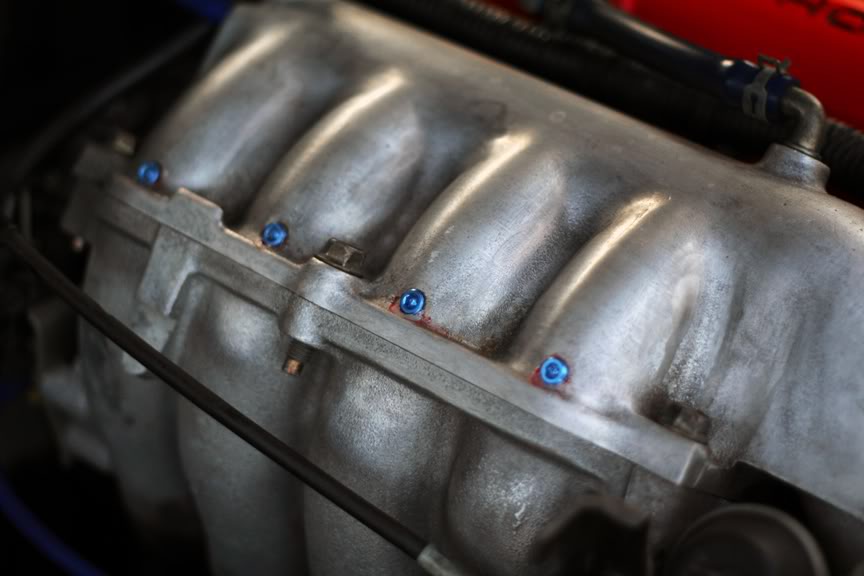
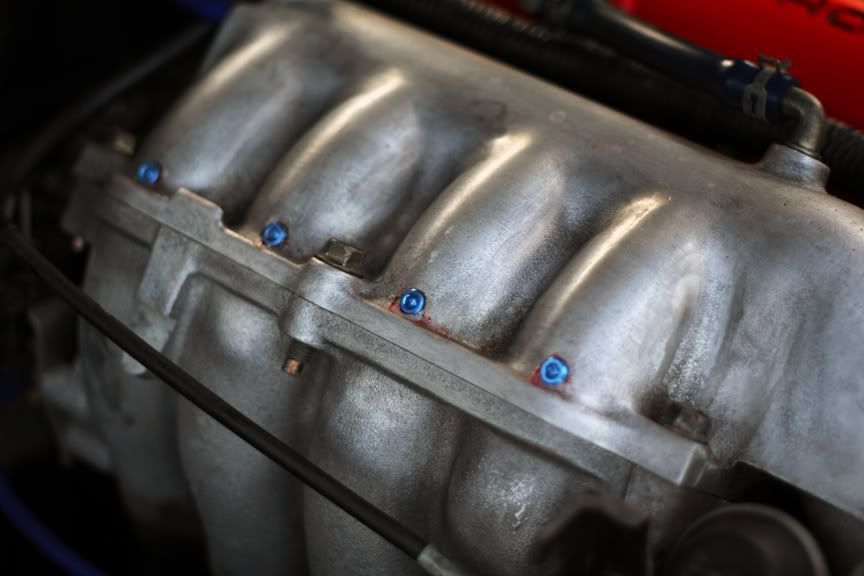
Yep that will work. I thought about putting them there myself. Mine are in the same spot, but on the other side of the flange. I put them on the lower half of the manifold for the additional hood clearance.
Agreed with Joe on all points. In particular:
- Port injection lets the manifold designer do whatever they want (comparatively speaking) to improve the flow regime. Before, with wet flow manifolds, a compromise had to be struck between flow velocity (to keep the fuel suspended), fuel distribution, and restriction (pressure drop). Most modern port injection manifolds would work like **** with a wet flow.
- From what I remember on what I read, the water droplets in the combustion chamber slow down the propagation of the flame front, just like high octane fuel; thus it limits knock in more or less the same manner.
Agreed with Joe on all points. In particular:
- Port injection lets the manifold designer do whatever they want (comparatively speaking) to improve the flow regime. Before, with wet flow manifolds, a compromise had to be struck between flow velocity (to keep the fuel suspended), fuel distribution, and restriction (pressure drop). Most modern port injection manifolds would work like **** with a wet flow.
- From what I remember on what I read, the water droplets in the combustion chamber slow down the propagation of the flame front, just like high octane fuel; thus it limits knock in more or less the same manner.
Last edited by ZX-Tex; Nov 13, 2009 at 04:19 PM.
Reply
0
0


