


Acceleration curve vs torque curve vs HP curve.



3 Ways to Calculate Acceleration - wikiHow
Unless i'm misunderstanding your **** though.
Reply
 0
0

0

Thread Starter
Elite Member
Joined: Apr 2010
Posts: 2,826
Total Cats: 66
From: Newcastle, Australia
Yes, it will be different units and scale but yes. Matter of fact thats how Drum dynos work to calculate HP/tq. They know the mass of the drum and they measure how quickly your car accelerates the drum.
3 Ways to Calculate Acceleration - wikiHow
Unless i'm misunderstanding your **** though.
3 Ways to Calculate Acceleration - wikiHow
Unless i'm misunderstanding your **** though.
Reply
0
0
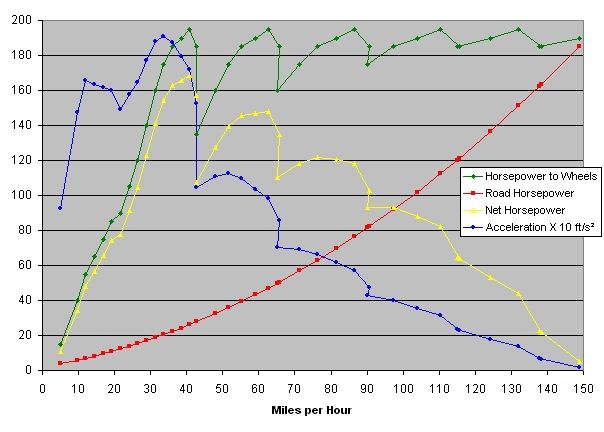
I'm looking for a 1 gear graph however this is for multiple and the acceleration is skewed because it's of speed. Would be pretty close to accurate up to 40mph though.
Reply
0
0


ʎpunq qoq
Joined: Jan 2014
Posts: 604
Total Cats: 202
From: Western Australia
Basically if you can get some data points. Ie Speed, RPM @ set 0.1 second time intervals then it would be easy to graph against a dyno plot for that engine.
I think acceleration = HP graph. Speed = area under HP graph (multiplied by a constant which is something like Diff * gear / mass of vehicle)
Reply
0
0

18psi sort of gave a representation above. Problem is the x-axis for acceleration is time, while for torque and HP it is RPM. You would have to skew one curve or the other to get an overlay.
But, the answer is clear. F=ma (somebody already said that). For example, VD calculates torque from the acceleration curve taking into account aerodynamic drag plus a fudge factor for road and drivetrain resistance. It then multiplies torque by RPM to derive HP.
But, the answer is clear. F=ma (somebody already said that). For example, VD calculates torque from the acceleration curve taking into account aerodynamic drag plus a fudge factor for road and drivetrain resistance. It then multiplies torque by RPM to derive HP.
Reply
2
2
And from what I've seen the accel curve doesn't follow the tq curve as closely as many seem to think.
The tq on that plot comes on really violently, but the resulting accel curve is barely impacted at all, looking almost linear
The tq on that plot comes on really violently, but the resulting accel curve is barely impacted at all, looking almost linear
Reply
0
0
That's because it isn't an acceleration curve. It's a speed curve. Acceleration would be the first time-derivative of the curve your showing. I don't think it's a logged parameter from the MS though. When VD does it's calculation, it is calculating linear acceleration in little chunks of time based upon the change in speed.
Reply
0
0
Oh, well that makes more sense.
And that log is not made by MS, it's made by an OEM ecu
I just screenshot everything in MLV because I like how it looks.
I have hundreds of logs and dyno plots from all sorts of cars with the speed/torque plotted, but if what you're saying is true then none of it will be of any use for this particular question. And I doubt many (any?) other people will have accel curves for that matter. It's just not something people.....record?
And that log is not made by MS, it's made by an OEM ecu
I just screenshot everything in MLV because I like how it looks.
I have hundreds of logs and dyno plots from all sorts of cars with the speed/torque plotted, but if what you're saying is true then none of it will be of any use for this particular question. And I doubt many (any?) other people will have accel curves for that matter. It's just not something people.....record?
Reply
0
0


Reply
-2
-2


If you get a log of speed + rpms plotted on a time axis (or just RPMs if gearing and tire circumference is known), and a graph of torque plotted on an RPMs axis, an overlay can be created
Reply
0
0
https://www.physics.uoguelph.ca/tuto...ro.angacc.html
All the other stuff you enter like Cd, tire diameter, rear end and gear ratios and the basic speed vs. time data are meant to create the numbers from which you can calculate torque from the above Newtonian formula. Once you have torque, it's a simple matter to multiply by RPM and get HP.
Reply
1
1
You know, I use an iPod on track that has accelerometers built-in. With some effort, might be able to match up a VD graph with directly measured longitudinal acceleration. Hmmmm . . . .
Someone with a Trackmate could get the data as well.
Someone with a Trackmate could get the data as well.
Reply
0
0
Thread Starter
Elite Member
Joined: Apr 2010
Posts: 2,826
Total Cats: 66
From: Newcastle, Australia
Now its feeling like a clever conversation.
Anyone with an overlay that includes G force can probably do this right?
Preferably the person would have a non flat torque curve with an easy to see obvious knee point.
Dann
Anyone with an overlay that includes G force can probably do this right?
Preferably the person would have a non flat torque curve with an easy to see obvious knee point.
Dann
Reply
0
0
Reply
0
0
Thread Starter
Elite Member
Joined: Apr 2010
Posts: 2,826
Total Cats: 66
From: Newcastle, Australia
As hornet said if you wanted the exact number you can calculate it either direction, but just a torque curve thats kinda unique and a matching acceleration curve thats kinda unique would do because you can just stretch the images to get the scaling comparable for a visual check.
I want to do this so I can show others that infact the math is totally correct, and explain how torque curve shape affects driveability and how a flat hp curve within a given range is worse than a constantly increasing HP curve (with the same are under the curve) for reasons of driveability, and loading components/things likely to break (conrods, clutches, gearboxes, diffs, axles, and finally traction).
Dann
I want to do this so I can show others that infact the math is totally correct, and explain how torque curve shape affects driveability and how a flat hp curve within a given range is worse than a constantly increasing HP curve (with the same are under the curve) for reasons of driveability, and loading components/things likely to break (conrods, clutches, gearboxes, diffs, axles, and finally traction).
Dann
Reply
0
0
This is the fundamental equation being used:
https://www.physics.uoguelph.ca/tuto...ro.angacc.html
All the other stuff you enter like Cd, tire diameter, rear end and gear ratios and the basic speed vs. time data are meant to create the numbers from which you can calculate torque from the above Newtonian formula. Once you have torque, it's a simple matter to multiply by RPM and get HP.
https://www.physics.uoguelph.ca/tuto...ro.angacc.html
All the other stuff you enter like Cd, tire diameter, rear end and gear ratios and the basic speed vs. time data are meant to create the numbers from which you can calculate torque from the above Newtonian formula. Once you have torque, it's a simple matter to multiply by RPM and get HP.
If you've ever used a Dynojet and had trouble with the RPM pickup, you'll understand what I'm saying. Dynojets don't need to know RPM to generate an accurate power curve, and they never ask for tire diameter or gear ratios at all. They measure raw power based on the time it takes to accelerate a known mass (the drum), then use RPM to back-calculate torque output from there.
Reply
0
0


