


BMEP divided by MAP, and why it's important


Thread Starter
Elite Member
Joined: Jul 2005
Posts: 6,420
Total Cats: 84
 BMEP divided by MAP, and why it's important
Branching off from another thread.
And some discussion here too, with several examples:
http://forum.miata.net/vb/showthread.php?p=5375293
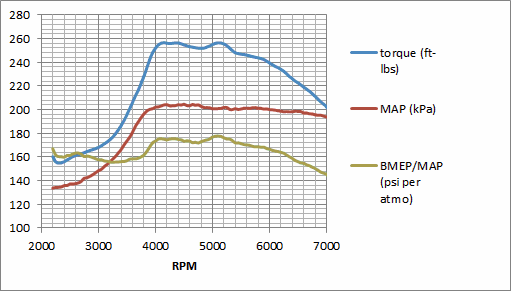
Here's a great way to analyze a dyno plot.
BMEP (in psi) and BMEP per MAP in psi per atmosphere of MAP
BMEP (in psi) = tq (ft-lbs) / displacement (L) * 2.47
BMEP per MAP = BMEP / MAP (in atmosheres)
BMEP per MAP = BMEP / MAP *101 (if MAP is in kPa)
The magic number is 180 psi at torque peak.
This translates to 73 ft-lbs per L per atmo of MAP.
Here's the importance of BMEP
http://www.epi-eng.com/piston_engine..._yardstick.htm
The resulting BMEP/MAP is an indication of VE and correct ignition timing.
In my curve above, the plot from 4000-7000 is VE
The reduced VE below 4000 RPM is due to the the wastegate being closed, TIP is higher to accelerate the turbo shaft.
And some discussion here too, with several examples:
http://forum.miata.net/vb/showthread.php?p=5375293
Here's a great way to analyze a dyno plot.
BMEP (in psi) and BMEP per MAP in psi per atmosphere of MAP
BMEP (in psi) = tq (ft-lbs) / displacement (L) * 2.47
BMEP per MAP = BMEP / MAP (in atmosheres)
BMEP per MAP = BMEP / MAP *101 (if MAP is in kPa)
The magic number is 180 psi at torque peak.
This translates to 73 ft-lbs per L per atmo of MAP.
Here's the importance of BMEP
http://www.epi-eng.com/piston_engine..._yardstick.htm
The resulting BMEP/MAP is an indication of VE and correct ignition timing.
In my curve above, the plot from 4000-7000 is VE
The reduced VE below 4000 RPM is due to the the wastegate being closed, TIP is higher to accelerate the turbo shaft.
Reply
 2
2

2
Thread Starter
Elite Member
Joined: Jul 2005
Posts: 6,420
Total Cats: 84
Comparing my dyno plot and my friend's with the 3071 at ~15 psi,
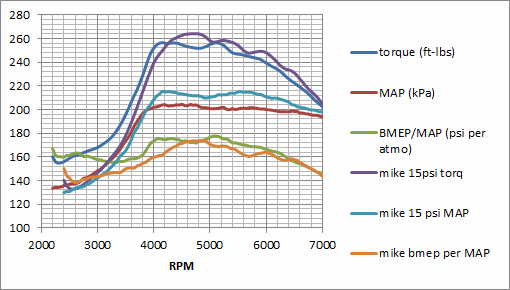
looking at the BMEP/MAP curve, I can see that my VVT produces a broader torque band, and better breathing in the spoolup region (2500-4000 RPM). Or perhaps the ignition timing in the 3071 setup during spoolup, can be improved.
In the 2500-4000 RPM region, because boost is rising, one can't directly compare torque outputs between 2 setups with different boost curves. BMEP/MAP allows you to do so.
looking at the BMEP/MAP curve, I can see that my VVT produces a broader torque band, and better breathing in the spoolup region (2500-4000 RPM). Or perhaps the ignition timing in the 3071 setup during spoolup, can be improved.
In the 2500-4000 RPM region, because boost is rising, one can't directly compare torque outputs between 2 setups with different boost curves. BMEP/MAP allows you to do so.
Reply
0
0
Thread Starter
Elite Member
Joined: Jul 2005
Posts: 6,420
Total Cats: 84
Reply
0
0

You get a prop because this is so cool.
I'm trying to get the Virtual Dyno guy to at least add text output of calculated torque so I can drill down to this for street spark tuning. We'll see.
I'm trying to get the Virtual Dyno guy to at least add text output of calculated torque so I can drill down to this for street spark tuning. We'll see.
Reply
0
0

Its funny how few people dont know about BMEP
Im constantly seeing NA dynos (usually on dynojets) where the BMEP at peak power is well over 200 psi, sometimes as high as 240
Im constantly seeing NA dynos (usually on dynojets) where the BMEP at peak power is well over 200 psi, sometimes as high as 240
Reply
0
0
Thread Starter
Elite Member
Joined: Jul 2005
Posts: 6,420
Total Cats: 84
BMEP for gasoline peaks at 220 psi (89 ft-lbs per L per atmo) -this is true both for F1 and NASCAR. They must have >100% VE, maybe like running 3 psi of boost.
This link shows that both F1 and NASCAR both have a BMEP of 15 bar:
http://www.epi-eng.com/piston_engine..._cup_to_f1.htm
The following link explains BMEP. A bit lost in there is that BMEP is exactly proportional to Torque divided by Displacement (the units I like to use personally is ft-lbs per L), or simply Torque per Liter for a n/a motor at sea level. For a boosted engine, BMEP/MAP is the equivalent figure of merit, or ft-lbs per L per atmo of MAP.
http://www.epi-eng.com/piston_engine..._yardstick.htm
This link shows that both F1 and NASCAR both have a BMEP of 15 bar:
http://www.epi-eng.com/piston_engine..._cup_to_f1.htm
The following link explains BMEP. A bit lost in there is that BMEP is exactly proportional to Torque divided by Displacement (the units I like to use personally is ft-lbs per L), or simply Torque per Liter for a n/a motor at sea level. For a boosted engine, BMEP/MAP is the equivalent figure of merit, or ft-lbs per L per atmo of MAP.
http://www.epi-eng.com/piston_engine..._yardstick.htm
Reply
0
0
Thread Starter
Elite Member
Joined: Jul 2005
Posts: 6,420
Total Cats: 84
Super duper 1.6L setup, 340 hp from 1.6L, probably runs TIP<MAP at the torque peak.
72 ft-lbs per L per atmo of MAP:
http://forum.miata.net/vb/showthread.php?t=453975
72 ft-lbs per L per atmo of MAP:
http://forum.miata.net/vb/showthread.php?t=453975
Reply
0
0

This seems to be the first reasonably easy way to create some sort of street spark tuning. I've been waiting for you and the Virtual Dyno guy to get this data output problem in place before I start messing with it.
Reply
0
0

Thread
Thread Starter
Forum
Replies
Last Post
Mikel
MEGAsquirt
4
Sep 28, 2015 04:46 PM


