

What is the optimal front ride height for different springs. I'm assuming 1/4 to 1/2 inch rake is optimal.
450#
550#
700#
450#
550#
700#



Junior Member
4" up front? That's pretty low! Mine is at 4 1/8" F and 4 6/16" (4.375") in the R and looks like this with 10kg/mm front spring rates (560 lbs/in)
(I'm actually thinking of raising the front a little...)
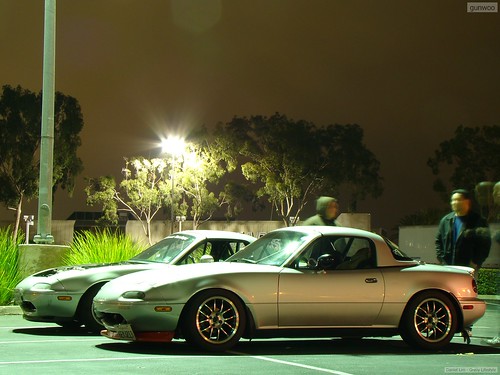
(I'm actually thinking of raising the front a little...)

As low as possible without bottoming the suspension or screwing up geometry, so basically 4" with rake to taste.
Quote:
Ok, that's probably perfect for heavy spring rates of 750# + but as the rates soften the ride height probably needs to increase to compensate or else you end up riding around on the bumpstops a lot. Now for a track only car minimal travel and engaging the bumpstops sooner might be the fastest way around the trackOriginally Posted by Savington
As low as possible without bottoming the suspension or screwing up geometry, so basically 4" with rake to taste.

Or whatever height leaves the front tie rod ends flat to the ground at static rest and tune for driving conditions by springrate or bumpstop variations

Quote:
Are you tracking the car?Originally Posted by wannafbody
Or whatever height leaves the front tie rod ends flat to the ground at static rest and tune for driving conditions by springrate or bumpstop variations
No, I'm just throwing this out there for discussion purposes. My ride height is about 13 inches.

Newb
Depends what you classify as best? Best in my book would be grip (contact patch loading), and you have to work with what you're given. You'd need to find the best place for the RC and migration, which determines whether the load transfer is elastic (springs/sways/dampers) or geometric (suspension arms, chassis).
Low will make it feel like a go cart, but control is king. IMO.
Phil
Low will make it feel like a go cart, but control is king. IMO.
Phil
Junior Member
Quote:
Low will make it feel like a go cart, but control is king. IMO.
Phil
Doesn't the elastic part usually try to minimize geometric issues? (stiffer to reduce mvmt along suspension curve?) Originally Posted by PhilMD
You'd need to find the best place for the RC and migration, which determines whether the load transfer is elastic (springs/sways/dampers) or geometric (suspension arms, chassis).Low will make it feel like a go cart, but control is king. IMO.
Phil
Also, how would you determine these elastic and geometric issues by "feel"? Or is that possible?

Quote:
93LE tie rods.Originally Posted by wannafbody
Or whatever height leaves the front tie rod ends flat to the ground at static rest and tune for driving conditions by springrate or bumpstop variations
Edit: I think
Newb
Quote:
Also, how would you determine these elastic and geometric issues by "feel"? Or is that possible?
Springs and sways will provide a resistance to roll, but that's different to weight transfer. Unless you can re-write the laws of physics, it doesn't matter how stiff the springs/sways are, weight transfer is going to happen, you just don't see all the effect of it with big springs. Originally Posted by greeenteeee
Doesn't the elastic part usually try to minimize geometric issues? (stiffer to reduce mvmt along suspension curve?) Also, how would you determine these elastic and geometric issues by "feel"? Or is that possible?
That's a lot more difficult. I'd say you need a lot of ride and handling training and experience. Datalogging traces will work as well.
Phil

This is 4" at the pinch welds, correct? I'd heard frame rails from some and pinch welds from others, making sure.
Junior Member
Quote:
I've always measured from the side jacking points that extend out a little more than the entire side pinch welds. Frame rails are closer to ground, no? Savington's looks higher than mine so maybe he measured from the frame rail?Originally Posted by Nagase
This is 4" at the pinch welds, correct? I'd heard frame rails from some and pinch welds from others, making sure.
OP: Are you trying to find a height for specific spring rates or trying to keep the tie rod arms parallel? FWIW at my current height, I like the height and wish I didn't have to raise it, but I will since I need more clearance. I don't even pay attention to the angle of the arms.
Quote:
OP: Are you trying to find a height for specific spring rates or trying to keep the tie rod arms parallel? FWIW at my current height, I like the height and wish I didn't have to raise it, but I will since I need more clearance. I don't even pay attention to the angle of the arms.
Finding ride height for 700/400 springs and RB hollow front sway, MSM rear. I know it's 4", I'm just not sure from where.Originally Posted by greeenteeee
I've always measured from the side jacking points that extend out a little more than the entire side pinch welds. Frame rails are closer to ground, no? Savington's looks higher than mine so maybe he measured from the frame rail?OP: Are you trying to find a height for specific spring rates or trying to keep the tie rod arms parallel? FWIW at my current height, I like the height and wish I didn't have to raise it, but I will since I need more clearance. I don't even pay attention to the angle of the arms.
Junior Member
Well since it seems your're looking for Sav's height...
FWIW, I copied 949's 4.1F 4.4R PINCH WELD height but will be raising it for clearance-- under a splitter, not under the fenderwell.
FWIW, I copied 949's 4.1F 4.4R PINCH WELD height but will be raising it for clearance-- under a splitter, not under the fenderwell.
Quote:
FWIW, I copied 949's 4.1F 4.4R PINCH WELD height but will be raising it for clearance-- under a splitter, not under the fenderwell.
Awesome, thanks.Originally Posted by greeenteeee
Well since it seems your're looking for Sav's height...FWIW, I copied 949's 4.1F 4.4R PINCH WELD height but will be raising it for clearance-- under a splitter, not under the fenderwell.

Junior Member
Quote:
the height should be set so you can draw a horizontal line. From the center of the lower control arm bushing and the lower ball joint.Originally Posted by wannafbody
What is the optimal front ride height for different springs.


