


Actual data, advance vs. torque (MBT)
 06-09-2009, 09:50 PM
#1
Elite Member
Thread Starter

Join Date: Jul 2005
Posts: 6,420
Total Cats: 84
 Actual data, advance vs. torque (MBT)
I found this graph on efi101.com
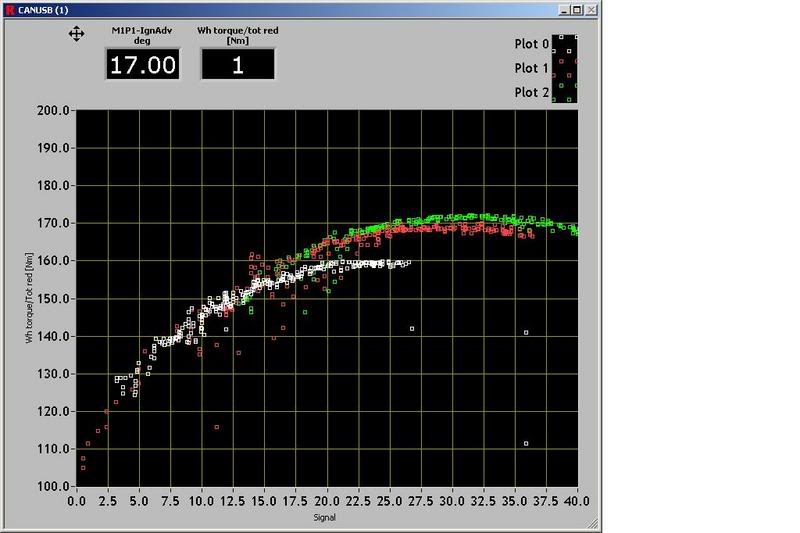
X axis is timing advance, and Y axis is torque, plotted by a dyno that can communicate with the ECU.
The 3 curves are for 1500, 2000, and 2500 RPM, at WOT on an NA car.
Take the green curve, 2500 RPM. The (geometric) peak occurs at around 31°. The torque is fairly constant from 31°-33°. MBT is 31°.
However you can see that at 25°-26°, the car is only ~1.5 ft-lbs down from 31° (< 1%). That 4-5° of retard down from MBT is a lot less peak force pushing down on the rod (from cylinder pressure). Rods will see less compressive loading... even in the absence of detonation.
Now if only I could find that graph of cylinder pressure vs. time at different values of advance, to show the reduction in peak cylinder pressure.
X axis is timing advance, and Y axis is torque, plotted by a dyno that can communicate with the ECU.
The 3 curves are for 1500, 2000, and 2500 RPM, at WOT on an NA car.
Take the green curve, 2500 RPM. The (geometric) peak occurs at around 31°. The torque is fairly constant from 31°-33°. MBT is 31°.
However you can see that at 25°-26°, the car is only ~1.5 ft-lbs down from 31° (< 1%). That 4-5° of retard down from MBT is a lot less peak force pushing down on the rod (from cylinder pressure). Rods will see less compressive loading... even in the absence of detonation.
Now if only I could find that graph of cylinder pressure vs. time at different values of advance, to show the reduction in peak cylinder pressure.

Reply
 0
0

0
 06-10-2009, 12:11 AM
#3
Elite Member
iTrader: (12)

Join Date: Jan 2007
Location: Hermosa Beach, CA
Posts: 2,573
Total Cats: 12
Now what I want to see is graps of 4k, 5k, 6k at around 23 kpa, that was I could tune for cruise timing lol.
Reply
0
0



 06-10-2009, 02:33 PM
#5
Elite Member
Thread Starter
Join Date: Jul 2005
Posts: 6,420
Total Cats: 84
At any RPM the general shape will be the same, at least in the absence of detonation.
Detonation, IIRC causes momentary dips in torque, at least I've seen it in RPM sweep dyno plots (knock sensor turned off).
Detonation, IIRC causes momentary dips in torque, at least I've seen it in RPM sweep dyno plots (knock sensor turned off).
Reply
0
0
07-01-2009, 03:45 PM
#6
Elite Member
Thread Starter
Join Date: Jul 2005
Posts: 6,420
Total Cats: 84
Here's a plot of cyl pressure vs timing (on the left)>
See that with more advance peak cylinder pressures rise.
Retarding timing so that torque is 1-2% down from MBT will reduce peak cylinder pressures, probability of knock, and stress on ring lands and rods.
See that with more advance peak cylinder pressures rise.
Retarding timing so that torque is 1-2% down from MBT will reduce peak cylinder pressures, probability of knock, and stress on ring lands and rods.
Reply
0
0
 07-01-2009, 08:27 PM
#10
Junior Member

Join Date: Nov 2005
Location: Athens
Posts: 197
Total Cats: 0
Great thread.
I'm curious though.
Lets take 2 motors both FI'd both running the same fuel, boost intake temps etc.
Only thing different between the 2 motors would be the CR.
Lets say motor #1 is 10.5:1 CR, #2 is 9:1.
Obviously for the same amount of advance the higher compression motor will make more power and run more efficiently.
But if the boost means the higher compression motor can't meet MBT without det but motor #2 can how will this affect the power outputs?
What i'm asking is will the higher compression motor make just as much power even though we need to pull timing, or will the lower compression motor reaching MBT be THAT much more efficient?
To my limited understanding if your retarding the timing on a high compression motor then your starting your ignition before you've reached full squish.
But on the other hand if your running a lower compression motor the squish is not going to be as much anyways.
But what about the efficiency of the other 3 cycles?
Cheers
Mark
I'm curious though.
Lets take 2 motors both FI'd both running the same fuel, boost intake temps etc.
Only thing different between the 2 motors would be the CR.
Lets say motor #1 is 10.5:1 CR, #2 is 9:1.
Obviously for the same amount of advance the higher compression motor will make more power and run more efficiently.
But if the boost means the higher compression motor can't meet MBT without det but motor #2 can how will this affect the power outputs?
What i'm asking is will the higher compression motor make just as much power even though we need to pull timing, or will the lower compression motor reaching MBT be THAT much more efficient?
To my limited understanding if your retarding the timing on a high compression motor then your starting your ignition before you've reached full squish.
But on the other hand if your running a lower compression motor the squish is not going to be as much anyways.
But what about the efficiency of the other 3 cycles?
Cheers
Mark
Reply
0
0
07-02-2009, 05:39 PM
#11
Elite Member
Thread Starter
Join Date: Jul 2005
Posts: 6,420
Total Cats: 84
But if the boost means the higher compression motor can't meet MBT without det but motor #2 can how will this affect the power outputs?
What i'm asking is will the higher compression motor make just as much power even though we need to pull timing, or will the lower compression motor reaching MBT be THAT much more efficient?
What i'm asking is will the higher compression motor make just as much power even though we need to pull timing, or will the lower compression motor reaching MBT be THAT much more efficient?
 1 point of compression is worth 3-4% in thermal efficiency, (and may also affect VE). You can easily lose 5-10% in output if you have to retard lots and lots, not to mention your EGT's will spiral up.
To my limited understanding if your retarding the timing on a high compression motor then your starting your ignition before you've reached full squish.
Reply
0
0
07-02-2009, 09:06 PM
#12
Junior Member
Join Date: Nov 2005
Location: Athens
Posts: 197
Total Cats: 0
Interesting stuff thanks.
That's what i love about engineering and motor tuning.
It's finding that ideal compromise.
Yep WI might well allow you to claw back that few degrees of timing, but then start injecting too much water and again you start to loose power.
That's what i love about engineering and motor tuning.
It's finding that ideal compromise.
Yep WI might well allow you to claw back that few degrees of timing, but then start injecting too much water and again you start to loose power.
Reply
0
0
07-02-2009, 10:07 PM
#14
Elite Member
Thread Starter
Join Date: Jul 2005
Posts: 6,420
Total Cats: 84
Dunno man, where on earth do you find all the good stuff you post LOL
The last one was from Autospeed.com, found it while I was looking for a different article. Lots of little gems over there.
The last one was from Autospeed.com, found it while I was looking for a different article. Lots of little gems over there.
Reply
0
0


Thread
Thread Starter
Forum
Replies
Last Post
StratoBlue1109
Miata parts for sale/trade
21
09-30-2018 01:09 PM


