


The Current Events, News, and Politics Thread


So I take it that you have no problem with the FED's lending $7.7 Trillion dollars to Euro banks during the bank crisis. No problems not because they didn't tell anybody, but because it's not real money anyway. PFEW! I was worried and fearmongered there for a second, but your graph has made me feel much better! 
What will be the negative impact of swapping ~$100 bln worth of USD for ~$100 bln worth of euros (plus interest) during the first quarter of 2012?
If you really want to educate yourself on the topic, I'm happy to take it to PM or email. If you have no interest in being open to a different perspective, I'll let you take the blue pill and not waste any more of anyone's time.

Reply
 0
0

0

Thread Starter


Joined: May 2005
Posts: 80,590
Total Cats: 4,371
From: Chantilly, VA

Obama in 2007 told CNN that Executive Priviledge was not a good reason to with hold information from Congress.
Obama in 2012 asserts executive privilege on some Fast and Furious documents
http://www.cnn.com/2012/06/20/politi...html?hpt=hp_t1
Obama in 2012 asserts executive privilege on some Fast and Furious documents
http://www.cnn.com/2012/06/20/politi...html?hpt=hp_t1
Reply
0
0

[QUOTEIf you really want to educate yourself on the topic, I'm happy to take it to PM or email. If you have no interest in being open to a different perspective, I'll let you take the blue pill and not waste any more of anyone's time. [/QUOTE]
No blue pill--and no "education" needed from you, Jack. I'm aware of the issues, and side with the WSJ article.
Perhaps this little rap video will put things in more perspective...
[/QUOTE]No blue pill--and no "education" needed from you, Jack. I'm aware of the issues, and side with the WSJ article.
Perhaps this little rap video will put things in more perspective...
Reply
0
0

Mark - For a bonus prize, what did Hayek, Keynes, and von Mises all operate under that is no longer relevant to the analysis of US economic and banking operations?
Reply
0
0
I know the answer to your question, and the answer itself is one of the differences in theory that we share, and a partial reason for the 'house of cards' statement.
Reply
0
0
$9 Billion in ‘Stimulus’ for Solar, Wind Projects Made 910 Final Jobs -- $9.8 Million Per Job
http://cnsnews.com/news/article/9-bi...98-million-job
...house of cards
http://cnsnews.com/news/article/9-bi...98-million-job
...house of cards
Reply
0
0
Saying a government controlled fixed currency (e.g a peg to gold) is better than what we have is an opinion. Basing predictions on what someone thinks should be, rather than what is, leads to flawed analysis like those examples I have pointed out (and many more that I haven't).
And, in many cases, that flawed analysis leads to high blood pressure and pulling out of one's hair unnecessarily (
 ) or to being curmudgeonly far beyond one's years (
 ).
).
Reply
0
0

Being a sovereign issuer of a free-float fiat currency is not a theory. It is an observation of what is.
Saying a government controlled fixed currency (e.g a peg to gold) is better than what we have is an opinion. Basing predictions on what someone thinks should be, rather than what is, leads to flawed analysis like those examples I have pointed out (and many more that I haven't).
And, in many cases, that flawed analysis leads to high blood pressure and pulling out of one's hair unnecessarily () or to being curmudgeonly far beyond one's years ().
Saying a government controlled fixed currency (e.g a peg to gold) is better than what we have is an opinion. Basing predictions on what someone thinks should be, rather than what is, leads to flawed analysis like those examples I have pointed out (and many more that I haven't).
And, in many cases, that flawed analysis leads to high blood pressure and pulling out of one's hair unnecessarily (
) or to being curmudgeonly far beyond one's years (). I'm sympathetic to the communication struggle going on in this thread right now.
I'm still ideologically committed to the principles of an extremely limited government and an almost entirely free market. I firmly believe that only allowing individuals to make economic decisions using their own money results in increased and long-lasting wealth. I believe that government spending, by its nature (see: Milton Friedman's Four Ways to Spend Money), is economically inefficient compared to private spending, and actually drains resources that would otherwise be available for private consumption. Moreover, the inevitable malinvestment created through government spending distorts market prices for the private sector, creating all kinds of false incentives and disincentives with long-lasting detrimental effects on the economy.
I'm troubled that the MMT structure requires our government to wield public spending and taxation as tools to adjust sectoral balance, and that the trade-off for the (apparent) resilience of the monetary system is a constant unequal distribution of created money via government spending (see: poured honey analogy). While I recognize the problems with a strict gold standard or gold-pegged standard, I am by my nature much more comfortable with the natural budget constraint it places on government spending (admitting that plenty of gold or commodity-constrained governments have spent themselves into bankruptcy).
That said --
I am trying to learn how to re-apply my ideological principles to the language and structure of the monetary system as it currently operates. Any critique of MMT itself or of current government policy is doomed to confusion and failure if it's couched in the language of a gold-pegged, budget-constrained system.
Reply
0
0
Reply
0
0
This.
I'm sympathetic to the communication struggle going on in this thread right now.
I'm still ideologically committed to the principles of an extremely limited government and an almost entirely free market. I firmly believe that only allowing individuals to make economic decisions using their own money results in increased and long-lasting wealth. I believe that government spending, by its nature (see: Milton Friedman's Four Ways to Spend Money), is economically inefficient compared to private spending, and actually drains resources that would otherwise be available for private consumption. Moreover, the inevitable malinvestment created through government spending distorts market prices for the private sector, creating all kinds of false incentives and disincentives with long-lasting detrimental effects on the economy.
I'm troubled that the MMT structure requires our government to wield public spending and taxation as tools to adjust sectoral balance, and that the trade-off for the (apparent) resilience of the monetary system is a constant unequal distribution of created money via government spending (see: poured honey analogy). While I recognize the problems with a strict gold standard or gold-pegged standard, I am by my nature much more comfortable with the natural budget constraint it places on government spending (admitting that plenty of gold or commodity-constrained governments have spent themselves into bankruptcy).
That said --
I am trying to learn how to re-apply my ideological principles to the language and structure of the monetary system as it currently operates. Any critique of MMT itself or of current government policy is doomed to confusion and failure if it's couched in the language of a gold-pegged, budget-constrained system.
I'm sympathetic to the communication struggle going on in this thread right now.
I'm still ideologically committed to the principles of an extremely limited government and an almost entirely free market. I firmly believe that only allowing individuals to make economic decisions using their own money results in increased and long-lasting wealth. I believe that government spending, by its nature (see: Milton Friedman's Four Ways to Spend Money), is economically inefficient compared to private spending, and actually drains resources that would otherwise be available for private consumption. Moreover, the inevitable malinvestment created through government spending distorts market prices for the private sector, creating all kinds of false incentives and disincentives with long-lasting detrimental effects on the economy.
I'm troubled that the MMT structure requires our government to wield public spending and taxation as tools to adjust sectoral balance, and that the trade-off for the (apparent) resilience of the monetary system is a constant unequal distribution of created money via government spending (see: poured honey analogy). While I recognize the problems with a strict gold standard or gold-pegged standard, I am by my nature much more comfortable with the natural budget constraint it places on government spending (admitting that plenty of gold or commodity-constrained governments have spent themselves into bankruptcy).
That said --
I am trying to learn how to re-apply my ideological principles to the language and structure of the monetary system as it currently operates. Any critique of MMT itself or of current government policy is doomed to confusion and failure if it's couched in the language of a gold-pegged, budget-constrained system.
Reply
0
0



I could use some white privileges right now, whatever they may be, lol
http://d-umn.campusreform.org/group/...hite-privilege
http://d-umn.campusreform.org/group/...hite-privilege
Reply
0
0
http://www.cnbc.com/id/47903018
Moody’s Downgrade of 15 Banks Expected After the Bell
Did I mention that I work for Moody's?
Reply
0
0

Joined: Sep 2005
Posts: 34,434
Total Cats: 7,549
From: Chicago. (The less-murder part.)
It depends on your definition of "collapse", which is a word that can be applied in many different ways. (Economic, moral, political, lemon meringue pie, etc.)
If you mean a complete collapse of both the economy and the government, it already did in 1991. Except that it was the USSR. Different name, same sandvich.
If you mean a complete collapse of both the economy and the government, it already did in 1991. Except that it was the USSR. Different name, same sandvich.
Reply
0
0
...What I said two days ago.
http://www.cnbc.com/id/47903018
Moody’s Downgrade of 15 Banks Expected After the Bell
Did I mention that I work for Moody's?
http://www.cnbc.com/id/47903018
Moody’s Downgrade of 15 Banks Expected After the Bell
Did I mention that I work for Moody's?

The ratings agencies are always and ever either behind the curve or completely wrong.
August 5, 2011: S&P downgrades US debt from AAA
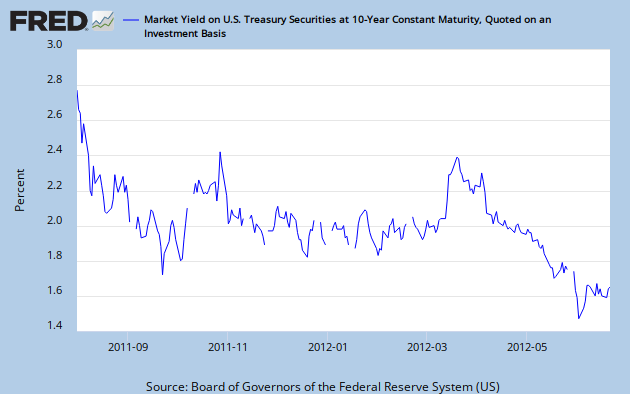
On the other hand, European banks have been undercapitalized for a long time (they did not delever nearly as quickly as the US banks) and they are operating in a flawed currency system with each nation acting as a currency user like a US state but without the constant internal transfer system we have.
Reply
0
0
My first reaction is:
The ratings agencies are always and ever either behind the curve or completely wrong.
August 5, 2011: S&P downgrades US debt from AAA
On the other hand, European banks have been undercapitalized for a long time (they did not delever nearly as quickly as the US banks) and they are operating in a flawed currency system with each nation acting as a currency user like a US state but without the constant internal transfer system we have.
The ratings agencies are always and ever either behind the curve or completely wrong.
August 5, 2011: S&P downgrades US debt from AAA
On the other hand, European banks have been undercapitalized for a long time (they did not delever nearly as quickly as the US banks) and they are operating in a flawed currency system with each nation acting as a currency user like a US state but without the constant internal transfer system we have.
Reply
0
0
Thread Starter
Joined: May 2005
Posts: 80,590
Total Cats: 4,371
From: Chantilly, VA
this. lets say the economy never springs back, stays depressed, people stay out of work, everything looks like Detroit, mad max, in 200 years u.s. is no longer...
Reply
0
0
Whoever's in charge needs four more years!
http://articles.businessinsider.com/...s-news-reports
http://money.cnn.com/2011/08/04/pf/f...high/index.htm
http://www.cbsnews.com/8301-500395_162-57429655/student-debt-clock-strikes-$1-trillion/
Remain calm...all is well!
Reply
0
0


