


How do you verify AFR?


Thread Starter

Joined: Jun 2006
Posts: 29,085
Total Cats: 375
From: Republic of Dallas
 How do you verify AFR?
I'm starting to run into some issues with AFR inconsistency across dynos. A car I tuned a few weeks ago went to another shop today and they show 14:1 AFR accross the board, the LC-1 shows 12.7-13.1 on this stock 1.6 car. How do you know which one to believe?
I believe the car, not the dyno. Typically the dyno operators shock me by either admitting their gauge is wrong and they don't care, or they don't use a clamp in the tail-pipe for a good ground, and therefore have miserable readings.
Thoughts?
I believe the car, not the dyno. Typically the dyno operators shock me by either admitting their gauge is wrong and they don't care, or they don't use a clamp in the tail-pipe for a good ground, and therefore have miserable readings.
Thoughts?
Reply
 0
0

0



Thread Starter
Joined: Jun 2006
Posts: 29,085
Total Cats: 375
From: Republic of Dallas
lol, good thing he didn't buy a $200 LC-1 that's accurate. Still, this stuff bothers me. I'd expect MER to run a tight ship with an accurate WBo2. Now I have to do more work on this tune so I can sleep at night.
Reply
0
0


A tail pipe probe will read a bit leaner than a sensor mounted further up in the exhaust at idle and light load. Generally the readings should start to line up as the engine starts to work.
If your wideband tells you 14:1 and you don't believe you're really that lean, easy test is to add fuel. If you make more power, you were too lean. Generally speaking, the 'correct' a/f ratio is the one that makes the most torque. That's the whole point of tuning on a dyno.
If your wideband tells you 14:1 and you don't believe you're really that lean, easy test is to add fuel. If you make more power, you were too lean. Generally speaking, the 'correct' a/f ratio is the one that makes the most torque. That's the whole point of tuning on a dyno.

Reply
0
0

Thread Starter
Joined: Jun 2006
Posts: 29,085
Total Cats: 375
From: Republic of Dallas
A tail pipe probe will read a bit leaner than a sensor mounted further up in the exhaust at idle and light load. Generally the readings should start to line up as the engine starts to work.
If your wideband tells you 14:1 and you don't believe you're really that lean, easy test is to add fuel. If you make more power, you were too lean. Generally speaking, the 'correct' a/f ratio is the one that makes the most torque. That's the whole point of tuning on a dyno.
If your wideband tells you 14:1 and you don't believe you're really that lean, easy test is to add fuel. If you make more power, you were too lean. Generally speaking, the 'correct' a/f ratio is the one that makes the most torque. That's the whole point of tuning on a dyno.
Reply
0
0



Joined: Jun 2005
Posts: 19,338
Total Cats: 574
From: Fake Virginia
Sensor01 is a narrowband sensor. The generic sensor input levels are set so that the horizontal "middle" line for both AFR and Sensor01 is 14.7 AFR. You can see that when Sensor01 switches rapidly, my Wideband is hovering around 14.9.
The sensors are a couple inches from each other. Notice how much faster the NBO2 reacts. It's a solid 200-300ms more immediate.
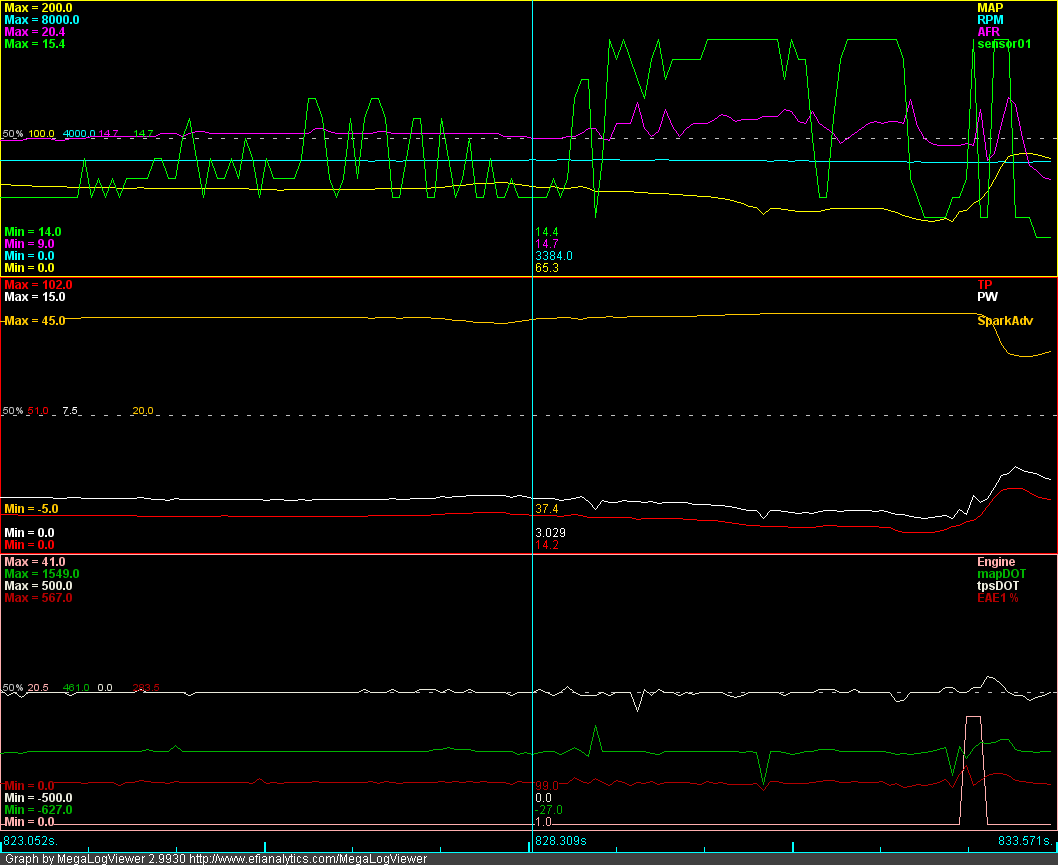
I guess my calibration is close but not perfect. Not that I can calibrate the PLX wideband controller.
The sensors are a couple inches from each other. Notice how much faster the NBO2 reacts. It's a solid 200-300ms more immediate.
I guess my calibration is close but not perfect. Not that I can calibrate the PLX wideband controller.
Reply
0
0
A narrowband is a nernst cell. The wideband is a nernst cell plus oxygen pump and control circuitry, so it's going to be not as quick to "respond" by nature. Interesting plot, but I can't say it's surprising.
Reply
0
0
Joined: Jun 2005
Posts: 19,338
Total Cats: 574
From: Fake Virginia
And it's ok if it's slower too because the MS has an O2 sensor delay setting for tuning.
The log post was mostly to satisfy hustler's question of how to prove it.
The log post was mostly to satisfy hustler's question of how to prove it.
Reply
0
0
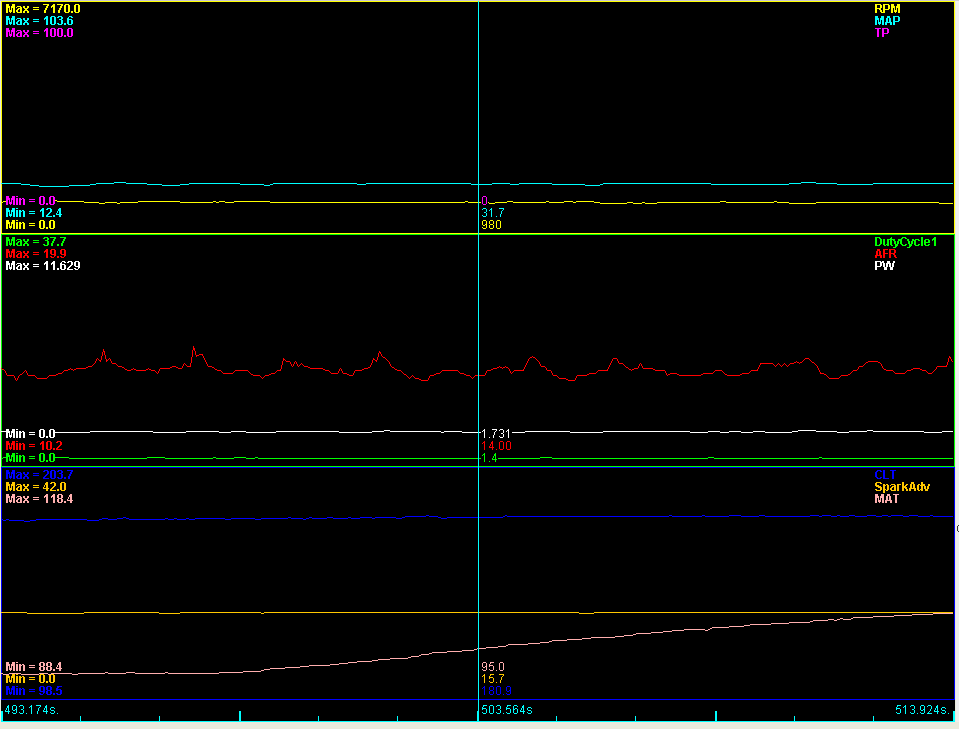
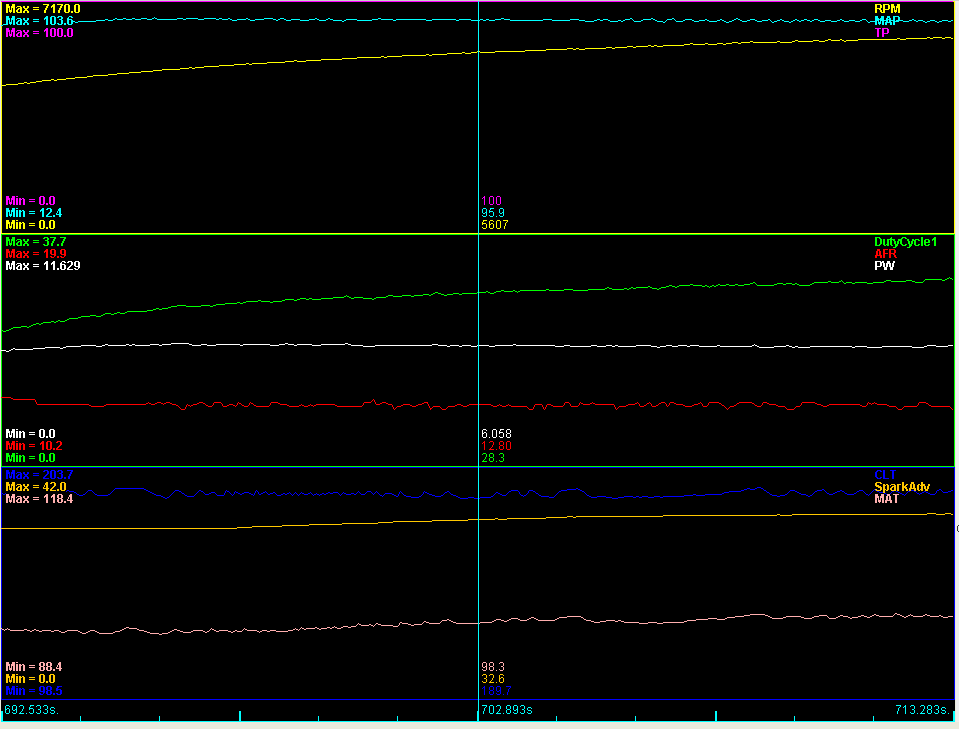
In you datalog as a whole, or just in certain points like idle? First I would make sure that the scale you have isn't making the oscillation look worse that it is. If it's oscillating a lot by .1 afr, then to me that isn't a big deal. The other option is to adjust the o2 sensor sampling rate.
Reply
0
0

Thread
Thread Starter
Forum
Replies
Last Post
Mikel
MEGAsquirt
4
Sep 28, 2015 04:46 PM
Motorsport-Electronics
ECUs and Tuning
0
Sep 5, 2015 08:02 AM


