


How to find your injector dead time





Reply
 0
0

0

Reply
0
0

Thread Starter
Elite Member
Joined: Jul 2005
Posts: 6,420
Total Cats: 84

Is that MLV software free?
FWIW AEMLog (free) has been doing scatter plots for years and years.
It can also run equations on your variables, and plot them. Such as to do software dyno runs.
FWIW AEMLog (free) has been doing scatter plots for years and years.
It can also run equations on your variables, and plot them. Such as to do software dyno runs.
Reply
0
0

Thread Starter
Elite Member
Joined: Jul 2005
Posts: 6,420
Total Cats: 84
Reply
0
0

Junior Member
Joined: Aug 2008
Posts: 223
Total Cats: 0
From: Boston
Yellow RX-8 injectors @ 13.2 volts. I ramped the dead time down from 2 ms to ~1.2 ms before the engine died. There are two distinct slopes:
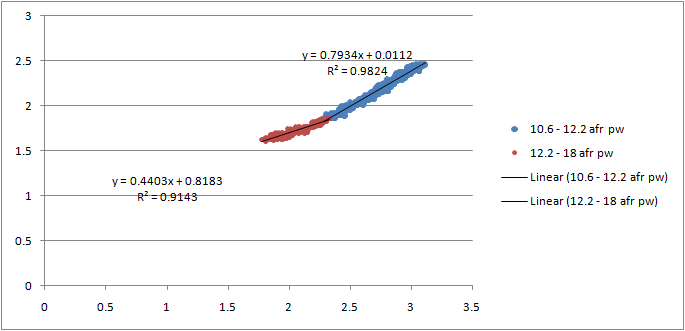
I had been running with a dead time of 1.0 ms but was leaning out as the intake temperature went up. I retuned for 1.45 ms based on the 2 vs 4 squirts method. Too early to say how that works. I'm not clear on how to square that with a 0.8 ms intercept here.
I had been running with a dead time of 1.0 ms but was leaning out as the intake temperature went up. I retuned for 1.45 ms based on the 2 vs 4 squirts method. Too early to say how that works. I'm not clear on how to square that with a 0.8 ms intercept here.
Reply
0
0
I'm going to use the published data for mine. No need for me to introduce error into this by evaluating a graph. The RC750 stops being linear when you get to 12V, but I've never seen 12V in any of my logs. I'm usually at 13.6V
Reply
0
0
Yellow RX-8 injectors @ 13.2 volts. I ramped the dead time down from 2 ms to ~1.2 ms before the engine died. There are two distinct slopes:
I had been running with a dead time of 1.0 ms but was leaning out as the intake temperature went up. I retuned for 1.45 ms based on the 2 vs 4 squirts method. Too early to say how that works. I'm not clear on how to square that with a 0.8 ms intercept here.
I had been running with a dead time of 1.0 ms but was leaning out as the intake temperature went up. I retuned for 1.45 ms based on the 2 vs 4 squirts method. Too early to say how that works. I'm not clear on how to square that with a 0.8 ms intercept here.
I have RX8 injectors too, 1.45ms seems rather high for a relatively modern injector deadtime though?
Reply
0
0
Supposedly the y-intercept is the deadtime, but I see a huge difference between the published deadtime and the experimental values achieved by users. I'm using the published data and it works fine. I had to retune fuel though.
deadtime for RC750 high impedance
10V 1.36ms
11V 1.12ms
12v .92ms
13v .76ms
14v .63ms
15v .50ms
Nice and linear from 13v-15v. My question is how can a big *** injector have a shorter deadtime than a smaller injector? Seems like smaller would be faster.
deadtimes: http://injector-rehab.com/shop/lag.html
deadtime for RC750 high impedance
10V 1.36ms
11V 1.12ms
12v .92ms
13v .76ms
14v .63ms
15v .50ms
Nice and linear from 13v-15v. My question is how can a big *** injector have a shorter deadtime than a smaller injector? Seems like smaller would be faster.
deadtimes: http://injector-rehab.com/shop/lag.html
Reply
0
0
Junior Member
Joined: Aug 2008
Posts: 223
Total Cats: 0
From: Boston
I'm not sure how to interpret it. Nor am I confident that 1.45 ms is the right dead time -- it does seem too long. The two measurement methods disagree considerably here. (1.45 is from the 2 vs 4 squirts method.) Barring any brilliant insights the flow may actually have to be measured when driven with the MS. But I am planning on going full sequential this summer, which will change the drive electronics, so I don't want to go to the effort of measuring flow until I have the final setup.
Reply
0
0
here's the thing, all the deadtime code does is add that value to the end of your calculated pulsewitdh. if the code calculated 1.7ms and you have a deadtime of .8ms, it will fuel 2.5ms total.
Just pick a number and go with it. Tune the voltage correction curve to mirror that of the published rates and be done with it.
Just pick a number and go with it. Tune the voltage correction curve to mirror that of the published rates and be done with it.
Reply
0
0
Yeah, but you only have a finite amount of time to get the next pulse into the cylinder on time. If you list a deadtime that is too long, then it may not start squirting until past the point you desire. The shorter the deadtime the better until you exceed the mechanical limit.
Reply
0
0


