


Idle Advance Control Valve (IACV) on Throttle Body



 Idle Advance Control Valve (IACV) on Throttle Body
Anyone ever fiddled with removing, capping off or closing the loop of the IACV, located at the bottom of the throttle body? I know that with a MS unit the idle can be controlled, but don't know what kind of hell I'd get in by simply disconnecting the unit.
Is it for cold start or emissions only?
Is it for cold start or emissions only?
Reply
 0
0

0


If the car is driven on the street, you really want to keep the idle valve. Theseus doesn't have one, but it idles at 1200rpm without the fan on and ~1000rpm with the fan on.
Reply
0
0

Why not just set the maximum value to 0 or disconnect it and be done with it?
Extra juice when the alternator kicks on, AC, cold starts, initial starts, hot idle/fans kicking on.. In all those the IAC helps stabilize the extra load/rpm.
Extra juice when the alternator kicks on, AC, cold starts, initial starts, hot idle/fans kicking on.. In all those the IAC helps stabilize the extra load/rpm.
Reply
0
0
My reason for asking...I've got a 70mm throttle body that's intended for a Honda. I want to do some testing with it, and didn't know what type of variables to expect. It's going on a 1999 with AC and PS delete.
I'm curious more than anything to see how the car will respond to the throttle body on cars in various states of modification. First step, mostly stock.
I'm curious more than anything to see how the car will respond to the throttle body on cars in various states of modification. First step, mostly stock.
Reply
0
0


 I simply don't want to reproduce a tangle of lines that may have been put there by Uncle Sam.
Reply
0
0


Them are the ones I'm talking about. I have this frustrating habit of questioning the value of everything on the car--is it really needed? Can it be made better, lighter, etceteras. I can understand not wanting the idle to hunt when using the A/C, but the A/C is long gone. And if I'm doing all of this for the gubmint, then I'd just as soon NOT.
I'm rebuilding a 1977 Chevy Blazer, and have put a more efficient, cleaner fuel injected engine in it. California is going to make me jump through hoops to register because it doesn't see the pre-heater hose going from the header to the carburetor, or other vacuum lines that are no longer required. I'm installing catalytic converters (2) as well, but they probably won't be the kind that are mandated. Cleaner, more efficient, quieter, illegal.
I'm rebuilding a 1977 Chevy Blazer, and have put a more efficient, cleaner fuel injected engine in it. California is going to make me jump through hoops to register because it doesn't see the pre-heater hose going from the header to the carburetor, or other vacuum lines that are no longer required. I'm installing catalytic converters (2) as well, but they probably won't be the kind that are mandated. Cleaner, more efficient, quieter, illegal.
Reply
0
0

Reply
0
0

My first Miata idled better with no IACV and no AC than my current one does with AC and the stock IACV controlled by an MSPNP.
You'd play hell trying to keep the thing lit with AC and no IACV, but without either, I wouldn't sweat it. I didn't notice any significant idle change when the fans kicked on/ alternator load changed, btw. It was rock solid 900-1000 rpm pretty much all the time.
You'd play hell trying to keep the thing lit with AC and no IACV, but without either, I wouldn't sweat it. I didn't notice any significant idle change when the fans kicked on/ alternator load changed, btw. It was rock solid 900-1000 rpm pretty much all the time.
Reply
0
0
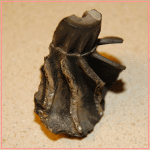
I just finally connected my idle control valve after 1.5 years and 16000 miles of driving without one.
I ran it purely on the idle screw and ~950-1000rpm idle. No AC or PS.
Only had issues with idle after it sat outside in freezing temperatures for a week. The fix for that was to just hold the throttle for a minute and then it was able to idle.
So in my opinion it is completely optional.
I ran it purely on the idle screw and ~950-1000rpm idle. No AC or PS.
Only had issues with idle after it sat outside in freezing temperatures for a week. The fix for that was to just hold the throttle for a minute and then it was able to idle.
So in my opinion it is completely optional.
Reply
0
0


