


Please not another crankcase ventilation thread.





Reply
 0
0

0


Joined: Sep 2005
Posts: 34,428
Total Cats: 7,548
From: Chicago. (The less-murder part.)

Allow me to tell you what to believe:
Lots of people have lots of different opinions with regard to crankcase ventilation. Some are formed on the basis of real-world experience on the racetrack, some on the basis of real-world experiencing building and maintaining street engines, some on the basis of a sound understanding of thermodynamics and fluid-dynamics, some on anecdotal knowledge of "what words" from old-timers, and some on pure idiocy.
Some of these methods work well, some don't, and some are likely to cause harm. Not all of the "don't work / cause harm" methods are restricted to the "pure idiocy" group.
What's perfectly adequate for a street-driven car may be inadequate on the track. What works well on the track will almost certainly cause you to fail a visual inspection in CA.
There is no single, unified answer for what's best in any specific application, however all of the answers that work have a few things in common. They provide a source of filtered air into the engine, and they actively draw contaminated air out of the engine, preferably through the PCV outlet on the valve cover. What happens to the air after that doesn't really matter so long as you're not accidentally pressurizing it, using it to contaminate the inside of your intercooler or MAF sensor, etc.
Lots of people have lots of different opinions with regard to crankcase ventilation. Some are formed on the basis of real-world experience on the racetrack, some on the basis of real-world experiencing building and maintaining street engines, some on the basis of a sound understanding of thermodynamics and fluid-dynamics, some on anecdotal knowledge of "what words" from old-timers, and some on pure idiocy.
Some of these methods work well, some don't, and some are likely to cause harm. Not all of the "don't work / cause harm" methods are restricted to the "pure idiocy" group.
What's perfectly adequate for a street-driven car may be inadequate on the track. What works well on the track will almost certainly cause you to fail a visual inspection in CA.
There is no single, unified answer for what's best in any specific application, however all of the answers that work have a few things in common. They provide a source of filtered air into the engine, and they actively draw contaminated air out of the engine, preferably through the PCV outlet on the valve cover. What happens to the air after that doesn't really matter so long as you're not accidentally pressurizing it, using it to contaminate the inside of your intercooler or MAF sensor, etc.
Last edited by Joe Perez; Oct 29, 2015 at 09:43 AM.
Reply
0
0

Joined: Apr 2014
Posts: 18,643
Total Cats: 1,870
From: Beaverton, USA
Allow me to tell you what to believe:
Lots of people have lots of different opinions with regard to crankcase ventilation. Some are formed on the basis of real-world experience on the racetrack, some on the basis of real-world experiencing building and maintaining street engines, some on the basis of a sound understanding of thermodynamics and fluid-dynamics, some on anecdotal knowledge of "what words" from old-times, and some on pure idiocy.
Some of these methods work well, some don't, and some are likely to cause harm. Not all of the "don't work / cause harm" methods are restricted to the "pure idiocy" group.
What's perfectly adequate for a street-driven car may be inadequate on the track. What works well on the track will almost certainly cause you to fail a visual inspection in CA.
There is no single, unified answer for what's best in any specific application, however all of the answers that work have a few things in common. They provide a source of filtered air into the engine, and they actively draw contaminated air out of the engine, preferably through the PCV outlet on the valve cover. What happens to the air after that doesn't really matter so long as you're not accidentally pressurizing it, using it to contaminate the inside of your intercooler or MAF sensor, etc.
Lots of people have lots of different opinions with regard to crankcase ventilation. Some are formed on the basis of real-world experience on the racetrack, some on the basis of real-world experiencing building and maintaining street engines, some on the basis of a sound understanding of thermodynamics and fluid-dynamics, some on anecdotal knowledge of "what words" from old-times, and some on pure idiocy.
Some of these methods work well, some don't, and some are likely to cause harm. Not all of the "don't work / cause harm" methods are restricted to the "pure idiocy" group.
What's perfectly adequate for a street-driven car may be inadequate on the track. What works well on the track will almost certainly cause you to fail a visual inspection in CA.
There is no single, unified answer for what's best in any specific application, however all of the answers that work have a few things in common. They provide a source of filtered air into the engine, and they actively draw contaminated air out of the engine, preferably through the PCV outlet on the valve cover. What happens to the air after that doesn't really matter so long as you're not accidentally pressurizing it, using it to contaminate the inside of your intercooler or MAF sensor, etc.
Both sides vented to a catch can vented to atmosphere does not draw air out.
Reply
0
0

In the world of force induction race cars removing pressure is the number 1 priority. Oil gets changed often enough to remove concerns of blowby oil contamination. In this case vent both sides of the valve cover and be done with it.
As Joe mentioned SMOG compliance is something all together different.
On the street I would want to draw vapors out to extend oil change intervals. Sucking it into the intake track (through a catch can first) makes the most sense.
As Joe mentioned SMOG compliance is something all together different.
On the street I would want to draw vapors out to extend oil change intervals. Sucking it into the intake track (through a catch can first) makes the most sense.
Reply
0
0
Joined: Sep 2005
Posts: 34,428
Total Cats: 7,548
From: Chicago. (The less-murder part.)
Reply
0
0

That's where I'm coming from. I recognize some of the others are driving street cars and have different needs and priorities.
Reply
0
0

Junior Member
Joined: May 2008
Posts: 488
Total Cats: 17
From: Grants Pass, OR.
Having a vacuum pull which works greatly better with a air intake source is more important on a race engine then street. It decreases pressure on the rings which translates to more hp. You can even run less tension rings with more clearance which both increase hp and that makes me happy.
Last edited by jmann; Oct 28, 2015 at 08:40 PM.
Reply
0
0

Senior Member
Joined: Feb 2009
Posts: 916
Total Cats: 70
From: Philadelphia
In the world of force induction race cars removing pressure is the number 1 priority. Oil gets changed often enough to remove concerns of blowby oil contamination. In this case vent both sides of the valve cover and be done with it.
As Joe mentioned SMOG compliance is something all together different.
On the street I would want to draw vapors out to extend oil change intervals. Sucking it into the intake track (through a catch can first) makes the most sense.
As Joe mentioned SMOG compliance is something all together different.
On the street I would want to draw vapors out to extend oil change intervals. Sucking it into the intake track (through a catch can first) makes the most sense.
I guess if I have issues with the PCV can on the track, I always know what to revert back to for track, and what works best for street

Reply
0
0
Junior Member
Joined: May 2008
Posts: 488
Total Cats: 17
From: Grants Pass, OR.
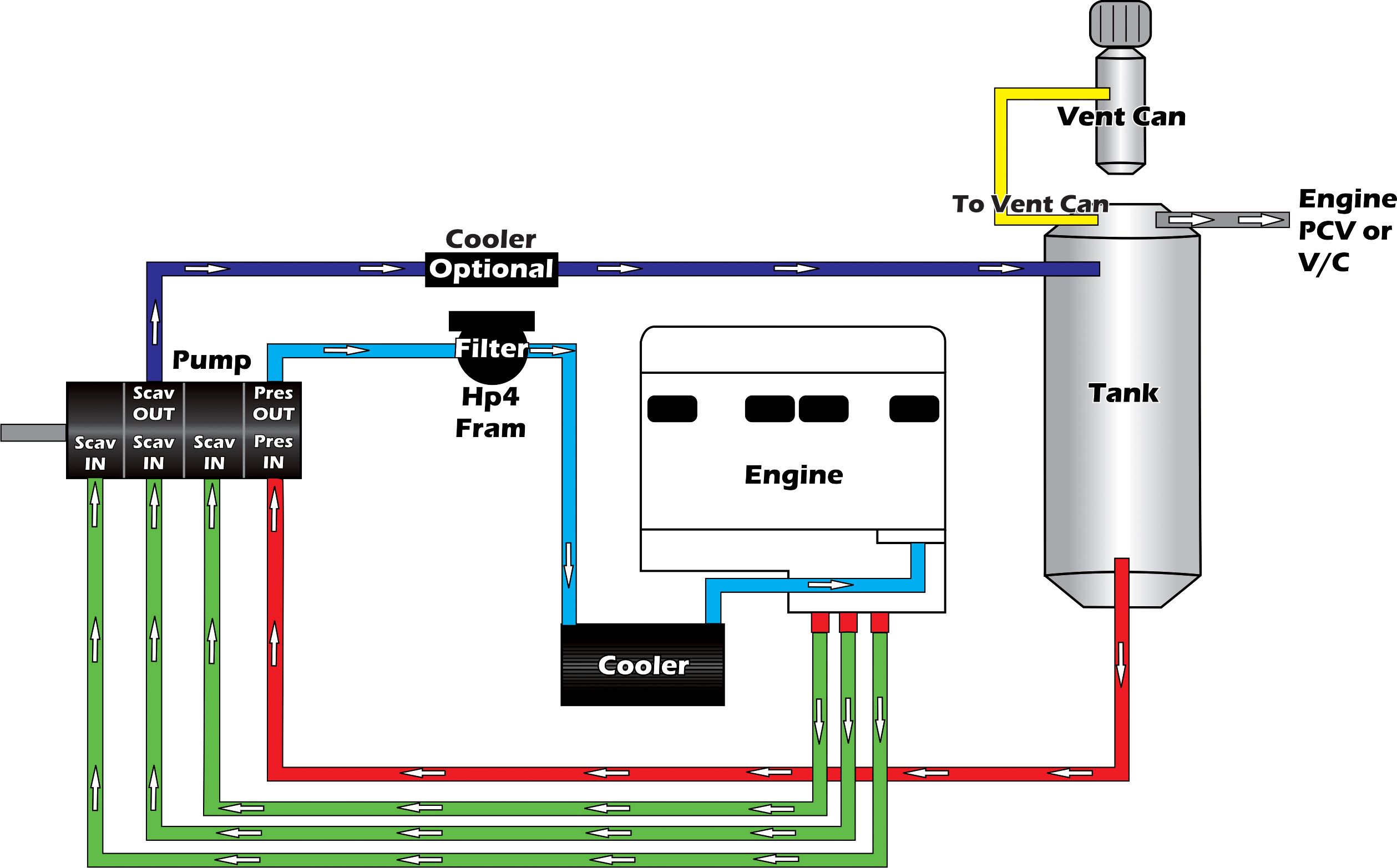
Maybe this well clear the air [pun intended]. Here is something I came up with on a google search. I realize that none of us are going to spend this kinda of money on a track miata but the article should clue some in that running vac. on any type of car is important with or without a PCV, and especially on a race car. It gets pretty tech. and expensive but it still pertains to this thread. I don't know how much vacuum a slash cut produces but it has to be better then not having any vacuum, maybe someone could hook a vac gauge up and find out. It must be decent as I think someone back aways put the hose in a jar of water and it sucked out pretty fast.
http://www.enginelabs.com/engine-tec...d-air-control/
http://www.enginelabs.com/engine-tec...d-air-control/
Reply
0
0
Joined: Sep 2005
Posts: 34,428
Total Cats: 7,548
From: Chicago. (The less-murder part.)
Wet Sump Precautions
If you choose to run vacuum in a wet sump system there are other areas to take note. The oil pump type, pan volume, and pickup location are even more critical under these circumstances. Since you are applying vacuum to the crankcase itself, you would actually be working against the oil pump. In essence, both pumps are applying a type of suction to the same area of the engine. The vacuum pump is trying to draw air, and the oil pump is trying to draw engine oil. Inevitably, this will cause the oil pump to work harder, operate at lower pressure or even cavitate, which could be detrimental to the longevity of your engine.
If you choose to run vacuum in a wet sump system there are other areas to take note. The oil pump type, pan volume, and pickup location are even more critical under these circumstances. Since you are applying vacuum to the crankcase itself, you would actually be working against the oil pump. In essence, both pumps are applying a type of suction to the same area of the engine. The vacuum pump is trying to draw air, and the oil pump is trying to draw engine oil. Inevitably, this will cause the oil pump to work harder, operate at lower pressure or even cavitate, which could be detrimental to the longevity of your engine.
Consider that in a wet-sump design, the oil pump, oil pickup tube, and all of the bearings and squirters which receive oil from the pump, are located entirely within the crankcase / head.
A vacuum which is applied to the crankcase will propagate evenly throughout the interior of the engine*. The ambient pressure inside the crankcase will, at any given time, be the same at the oil pickup tube as it is at all of the locations where the oil comes out. It is therefore impossible for the flow of oil through the system to be influenced positively or negatively by altering the absolute pressure of the atmosphere inside the crankcase. In order for that to happen, you'd have to draw a vacuum at the oil pan (thus influencing the pressure at the oil pickup tube) without changing the ambient pressure at all of the bearing/journal surfaces where the oil comes out. Crankcases don't work that way- they're all hollow and open inside.
* = I'm handwaving over the grammar of physics here a bit by referring to vacuum as a "thing" rather than the absence of a "thing," as this seems easier to conceptualize.
Reply
0
0
Joined: Sep 2005
Posts: 34,428
Total Cats: 7,548
From: Chicago. (The less-murder part.)
Where is this separate oil reservoir? How is it isolated from the interior of the crankcase and vented in such a way that that the ambient pressure surrounding it is different from the ambient pressure in the rest of the crankcase / valvetrain box?
Reply
0
0
Junior Member
Joined: May 2008
Posts: 488
Total Cats: 17
From: Grants Pass, OR.
I didn't post that site to debate their system and its technicalities as none of us well ever go that extreme on our cars. There are some pretty smart people in it though. I posted it to make the point that running any vacuum is the proper way especially on a race motor with more benefits then just keeping your oil cleaner. I'm done
Reply
0
0
Joined: Sep 2005
Posts: 34,428
Total Cats: 7,548
From: Chicago. (The less-murder part.)
Reply
0
0
Joined: Sep 2005
Posts: 34,428
Total Cats: 7,548
From: Chicago. (The less-murder part.)
I didn't post that site to debate their system and its technicalities as none of us well ever go that extreme on our cars. There are some pretty smart people in it though. I posted it to make the point that running any vacuum is the proper way especially on a race motor with more benefits then just keeping your oil cleaner. I'm done
I just can't wrap my head around that excerpt about wet-sumps. Either I'm missing something, or the author doesn't know the difference between a wet-sump and a dry-sump. (Or the author and I have a different definition of what constitutes a wet-sump design.)
Reply
0
0


