


11 to 1 Comp w/ Boost


Interesting Sav. I have a 99 motor now and noticed just as you say. boost is down until I get my clutch in, but at the lower numbers I am running more than the 95 motor liked.
Reply
 0
0

0



Joined: Oct 2007
Posts: 6,029
Total Cats: 305
From: The coal ridden hills of Pennsylvania
Second, the F20c has V-tec.
3rd, you don't need that kind of psi or compression to make 250-270 on a miata engine. I'm positive you could make that easily by 10psi on a big turbo.
I said it a million times and I'll say it again: "It's not about the psi of air you can compress (a.k.a. boost)...it's about the volume of air that you can move."
I.E. Little turbo on 14psi may make 240whp, while big turbo on 8psi might make the same 240whp. If you can understand why that happens, then you can understand how to make power.
Reply
0
0

Ok I'll bite. I don't understand this. How does 8psi going into the same engine at the same RPM make the same power as 14psi. Assuming IAT is intercooled to the same in both cases, I don't see how this works.
Reply
0
0

Joined: Oct 2007
Posts: 6,029
Total Cats: 305
From: The coal ridden hills of Pennsylvania
The higher the psi's (compressed air), the higher your IAT's should also be. Hence, a big turbo will move a higher volume of air (CFM's) with less boost because of turbo size, plus IAT's should be lower.
Reply
0
0

I did 240 on york dyno at 10psi with fm base timing map. Five years ago. Dammmnnn
That was with the 01+ 10:1 pistons. I had no idea what i was doing with tuning back then. Motor never kabloodied.
I lost a lot of races at that psi :(
That was with the 01+ 10:1 pistons. I had no idea what i was doing with tuning back then. Motor never kabloodied.
I lost a lot of races at that psi :(
Reply
0
0

Elite Member
Joined: Jul 2005
Posts: 6,420
Total Cats: 84
All this conjecture LOL.
A well-tuned motor will barely make 72 ft-lbs per L per atmo of MAP at torque peak, at the hubs, on a Dynapack. That may be 80-84 ft-lbs/L/atmo of MAP at the crank, and even F1 and NASCAR motors make 89. It's a number that can't be broken.
And then if the torque only drops 13% (which would be a very good flowing motor) at the power peak, at say, 6500 RPM, that means:
72 * 6500/5252 * .87 = 77 hp per L per atmo of MAP
At 15 psi that's 277 hp
y8s had to be making power peak at 7000 RPM with a 13% drop from peak torque to make 257 hp at 9.5 psi.
High revving Hondas make their hp/L by making their power peak at >7500 RPM.
A well-tuned motor will barely make 72 ft-lbs per L per atmo of MAP at torque peak, at the hubs, on a Dynapack. That may be 80-84 ft-lbs/L/atmo of MAP at the crank, and even F1 and NASCAR motors make 89. It's a number that can't be broken.
And then if the torque only drops 13% (which would be a very good flowing motor) at the power peak, at say, 6500 RPM, that means:
72 * 6500/5252 * .87 = 77 hp per L per atmo of MAP
At 15 psi that's 277 hp
y8s had to be making power peak at 7000 RPM with a 13% drop from peak torque to make 257 hp at 9.5 psi.
High revving Hondas make their hp/L by making their power peak at >7500 RPM.
Reply
0
0

Thread Starter
Senior Member
Joined: Oct 2011
Posts: 646
Total Cats: 62
From: The Race Track & St Pete FL
First off, what turbo were you planning on running?
Second, the F20c has V-tec.
3rd, you don't need that kind of psi or compression to make 250-270 on a miata engine. I'm positive you could make that easily by 10psi on a big turbo.
I said it a million times and I'll say it again: "It's not about the psi of air you can compress (a.k.a. boost)...it's about the volume of air that you can move."
I.E. Little turbo on 14psi may make 240whp, while big turbo on 8psi might make the same 240whp. If you can understand why that happens, then you can understand how to make power.
Second, the F20c has V-tec.
3rd, you don't need that kind of psi or compression to make 250-270 on a miata engine. I'm positive you could make that easily by 10psi on a big turbo.
I said it a million times and I'll say it again: "It's not about the psi of air you can compress (a.k.a. boost)...it's about the volume of air that you can move."
I.E. Little turbo on 14psi may make 240whp, while big turbo on 8psi might make the same 240whp. If you can understand why that happens, then you can understand how to make power.
Reply
0
0
Thread Starter
Senior Member
Joined: Oct 2011
Posts: 646
Total Cats: 62
From: The Race Track & St Pete FL
All this conjecture LOL.
A well-tuned motor will barely make 72 ft-lbs per L per atmo of MAP at torque peak, at the hubs, on a Dynapack. That may be 80-84 ft-lbs/L/atmo of MAP at the crank, and even F1 and NASCAR motors make 89. It's a number that can't be broken.
And then if the torque only drops 13% (which would be a very good flowing motor) at the power peak, at say, 6500 RPM, that means:
72 * 6500/5252 * .87 = 77 hp per L per atmo of MAP
At 15 psi that's 277 hp
y8s had to be making power peak at 7000 RPM with a 13% drop from peak torque to make 257 hp at 9.5 psi.
High revving Hondas make their hp/L by making their power peak at >7500 RPM.
A well-tuned motor will barely make 72 ft-lbs per L per atmo of MAP at torque peak, at the hubs, on a Dynapack. That may be 80-84 ft-lbs/L/atmo of MAP at the crank, and even F1 and NASCAR motors make 89. It's a number that can't be broken.
And then if the torque only drops 13% (which would be a very good flowing motor) at the power peak, at say, 6500 RPM, that means:
72 * 6500/5252 * .87 = 77 hp per L per atmo of MAP
At 15 psi that's 277 hp
y8s had to be making power peak at 7000 RPM with a 13% drop from peak torque to make 257 hp at 9.5 psi.
High revving Hondas make their hp/L by making their power peak at >7500 RPM.
Reply
0
0

Elite Member
Joined: Jul 2005
Posts: 6,420
Total Cats: 84
If he makes 72 ft-lbs per L per atmo, and makes peak hp at 7000, and his torque at 7000 RPM is only 13% down from torque peak...
or put another way ...
if he makes 72 minus 13% ( = 63 ), ft-lbs per L per atmo at 7000, then he will make 257 hp at 9.5 psi.
or put another way ...
if he makes 72 minus 13% ( = 63 ), ft-lbs per L per atmo at 7000, then he will make 257 hp at 9.5 psi.
Reply
0
0
Thread Starter
Senior Member
Joined: Oct 2011
Posts: 646
Total Cats: 62
From: The Race Track & St Pete FL
Reply
0
0
Elite Member
Joined: Jul 2005
Posts: 6,420
Total Cats: 84
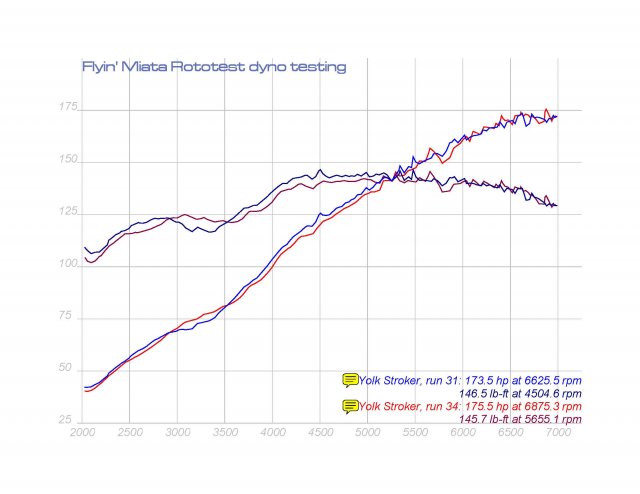
F1 dyno chart http://carpron.com/multisite/v/Uploa...+dyno.gif.html
Reply
0
0

Its BMEP, and yes that is very important, but revs are important too.
An engine at 300 psi BMEP at 4000 RPM and another engine making 300 psi BMEP at 8000 RPM, which one has more stress on it?
Its for this reason that power is typically used as the benchmark for where things like rods are going to fail.
Now if were strictly talking about knock limitations, then yes, between equal engines, the BMEP is going to indicate said limit. The problem is that were not talking about a simple comparison, such as different CR or boost with all else being equal.
Changing boost changes compressor efficiency, and changing compression changes quench.
An engine at 300 psi BMEP at 4000 RPM and another engine making 300 psi BMEP at 8000 RPM, which one has more stress on it?
Its for this reason that power is typically used as the benchmark for where things like rods are going to fail.
Now if were strictly talking about knock limitations, then yes, between equal engines, the BMEP is going to indicate said limit. The problem is that were not talking about a simple comparison, such as different CR or boost with all else being equal.
Changing boost changes compressor efficiency, and changing compression changes quench.
Reply
0
0


well I know he made 246rwhp dynojet at the same boost (maybe less), but i know he was fooling with his tune and vvt stuff.
and he did make peak at 7000, or very close to it.
this all happened 4 years ago so everything is fuzzy.
Reply
0
0


And he does have a baller manifold and baller exhaust setup, with a turbo that is running about as cool as it can, so I guess it all contributes to it.
Reply
0
0


