When you click on links to various merchants on this site and make a purchase, this can result in this site earning a commission. Affiliate programs and affiliations include, but are not limited to, the eBay Partner Network.
You have no idea as to the depths of my laziness and apathy. Hours can pass between the time I click "reply", subsequently get distracted by shiny things, cook dinner, watch some TV, argue a bit with the missus, and finally come back to the PC to find that I forgot to hit the "submit" button.
You have no idea as to the depths of my laziness and apathy. Hours can pass between the time I click "reply", subsequently get distracted by shiny things, cook dinner, watch some TV, argue a bit with the missus, and finally come back to the PC to find that I forgot to hit the "submit" button.
I consider this a superpower.
It's only a super power if you can subsequently get the security token error and lose all of your post.
For the record I was never intending to use a fuel filter for my oil. I was curious if 2manyhobyz ((or anyone else) had any luck good or bad with the 551318. *EDIT I guess I did say I'd like to try the larger filter. I should have said A larger filter before digging into that 551318 filter specs as a sidenote*
I couldn't tell you. I would assume so since you have a picture of the filter I had posted installed? I was under the impression you had run that filter. EDIT I realize that a P551318 and napa 551318 (now 1318) are two very different filters.
I did have the napa 551318 on the car and it was only about a half inch of clearance. I would have continued to use it but I wanted to upgrade to their silver or gold line which is a better filter, but it is a bit of an odd ball and they didn't produce in their better lines. So the Purlator ended up the best compromise for me.
When the new high pressure diesel injection (common rail or whatever terminology you prefer) arrived on the scene, the particulate size the filters allowed to pass was significantly less and new machines would stop working and the older ones would keep going. Most of my customers have lousy fuel handling practices and had problems with mechanical injection engines anyway.
When the new high pressure diesel injection (common rail or whatever terminology you prefer) arrived on the scene, the particulate size the filters allowed to pass was significantly less and new machines would stop working and the older ones would keep going. Most of my customers have lousy fuel handling practices and had problems with mechanical injection engines anyway.
The solution for that was adding a prefilter/water separator/fuel heater. It had to be done on Dozers and excavators since those machines get filled from a slip tank in the operators pickup and they don't always keep them clean. Filters out rocks, dirt clumps and small children. Helps to keep the fuel in good shape when its -40 below too.
I've used the Donaldson P551318...well for its intended purpose as a fuel filter. Never considered using it as an oil filter. It lists as a 9 micron filter per Donaldson's specs https://dynamic.donaldson.com/WebSto...63&item=742494
My UWAG (uneducated wild *** guess) is that if a filter can catch particles down to 9 or 10 microns it would have a shorter service life vs a filter of the same size that can filter to 21 or even 40 microns. It would be interesting to see the particle count in the oil between 21 micron and 9 micron. My bet is there many more 9 micron particles and the larger 551318 filter might not have a much longer service life over the stock filter. The oil will stay much cleaner. I would love to do oil samples back to back with the same oil, change interval and driving conditions between a stock filter and the 551318. Then again I'm sure I will burn it off faster than anything to really matter.
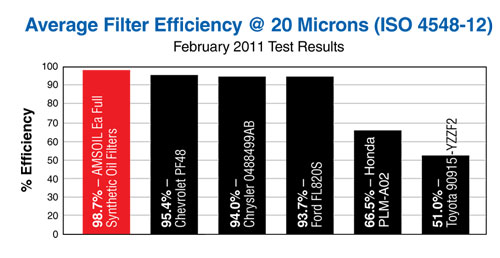
I wouldn't put too much stock in manufacturer "micron" specs unless there is a first pass efficiency attached. Amsoil is one of the few I have seen that provide that data:
Technically a manufacturer can advertise a filter as "10 micron" even if it only catches 10% of particles that size.
I've always just used the Purolator Pure One PL14459. It's the one specified for the B6t and BPt motors found in mazda 323 GTX's. slightly bigger than the non turbo version specified in the Miata.
I've always just used the Purolator Pure One PL14459. It's the one specified for the B6t and BPt motors found in mazda 323 GTX's. slightly bigger than the non turbo version specified in the Miata.
Ive used the PL14449 for years its also used on the Honda S2000 and is a typical upgrade for most honda engines that use a smaller filter.
With my sandwich plate and half cut intake manifold brace a larger filter is easily added to my setup. I did some research using WIX's nice customizable database and found a filter that would better match the larger aftermarket sandwich plate.
The WIX 51347 was the clear winner. NAPA calls it a 1347 in the Gold brand. It's huge compared to the OEM with almost twice the media area.
Increasing the bypass pressure is more important than capacity. Historically Honda specified a very low micron rating for their engines which is a move in the wrong direction for this application. It may actually offset any increase in flow rate from a larger element. For a high performance low service life application it would be desirable to have a high flow element in a sturdy canister with a reliable bypass design that is at a higher pressure.
I figure I'll bump the thread too since it was useful information to me.
I just rebuilt my engine and wanted the largest possible oil filter during break in to minimize the amount of oil that was bypassed, carrying all the metal flake from ring seating along with it. I ordered 3 of the Wix 1347 off of rockauto. Two were identical with normal, new looking Wix stickers for all their info, one had an ink printing on it and there was visible goo on the threaded plate portion. When I wiped it off, I saw metal flakes, so I decided to not run that filter.
Prior to rebuilding my own engine, I bought a JDM import engine that wound up being worse than my own engine, leading to the rebuild. It came with the normal Miata sized filter on it that I haven't used in years. I cut the filter open to inspect it months ago, threw out the case, but saved the cartridge.
Here is a comparison of the three - Stock Miata sized (unknown brand), a Bosch or Purolator Millenia/Honda sized filter, and the Wix 1347.
Comparison of the media width
As a bonus for reading this, here's two filter media sections laid side by side. Can you guess which one was used for the first start and ring seating?
Here's the media area of each filter. I imagine there could be minor differences in filter area from brand to brand.
I'm happy I ran the 1347 on break in, but will probably stick with the Millenia/Honda going forward. It's the same filter Nissan uses on the Titan 5.6L V8. The 1347's only application appears to be a 70's Mazda 4 cylinder, making me wonder just how low its production volumes are and if it is held to the same standards as a filter that's used every day in millions of different cars.
A 5.6L V8 using a smaller filter than a 1.8L 4 cylinder shows just how far engine build quality, oil, and filtration technology advanced in the 30 years between when they were produced.
The Millenia filter that you’re referring to is the wix 1356 which is the original Miata filter for the NA years. The filter should not bypass during break in unless your doing something extraordinary.






 0
0