


Umm...Does this mean my turbo's F**ked


I blew a turbo a while back being the idiot that i am, i tightened my steel braided return line and it kinked right behind my charge pipe so i couldn't see it without really looking hard. It restricted flow enough and oil passed the seals. Poured out the tail pipe just like the OPers charge pipes look, my charge pipes looked identical to his at the time of fail. Granted this was on a journal bearing turbo so im not sure the strength of the BB turbos, but i blew mine in a long 25 seconds.
Reply
 0
0

0

Thread Starter
Junior Member
iTrader: (10)
Joined: Jan 2008
Posts: 291
Total Cats: 0
From: SF Bay Area
Ok, it isn't the turbo. There's no external restrictor, but it's a brand new turbo so I think it has one built in. And the drain line is pretty straight. It's as straight as I could get it and there are no kinks.
My experiment with the makeshift catch can was very telling.
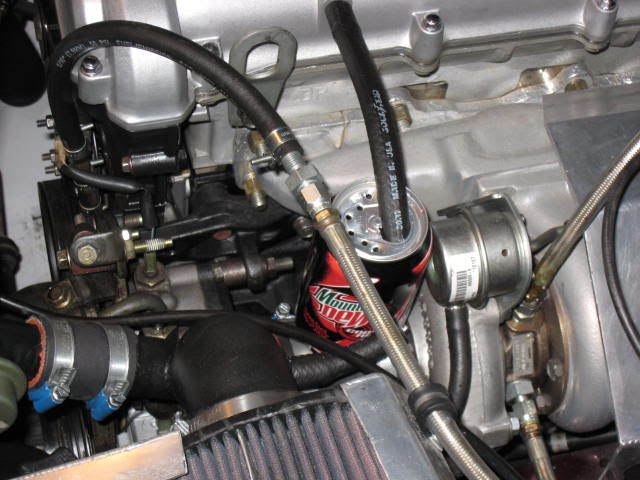
Don't ever do this!
After driving about 30mi. it started smoking again. I stopped to check it out and the can was full and spilling out onto the exhaust. That's a full 12oz of oil! Short length of hose and a downward slope--not a good idea. Strangely the breather I put on the pcv valve never showed signs of oil. So I figured the valve is staying shut and forcing all of the crankcase gasses out the other vent. I think the increased velocity may have been aerosolizing the oil and helping it escape as well.
So I gutted the pcv and drilled out the orifice to a decent size then connected both vents with a tee to the can. Like this:
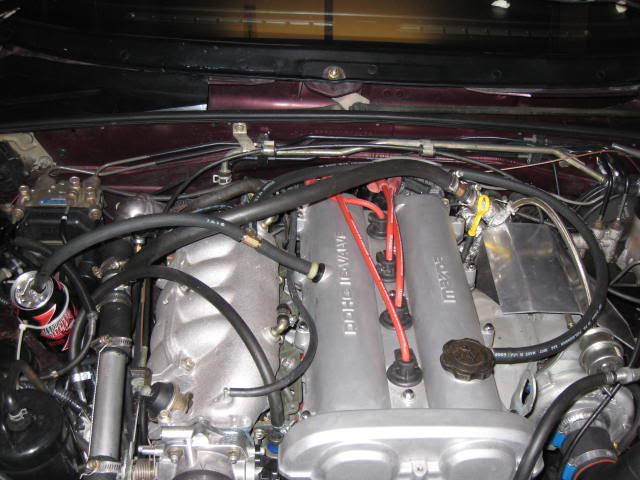
The longer length of hose and an upward slope of the runs help with oil recovery. So far so good. I've only got a couple of drops in the can after 10 mi.
My experiment with the makeshift catch can was very telling.
Don't ever do this!
After driving about 30mi. it started smoking again. I stopped to check it out and the can was full and spilling out onto the exhaust. That's a full 12oz of oil! Short length of hose and a downward slope--not a good idea. Strangely the breather I put on the pcv valve never showed signs of oil. So I figured the valve is staying shut and forcing all of the crankcase gasses out the other vent. I think the increased velocity may have been aerosolizing the oil and helping it escape as well.
So I gutted the pcv and drilled out the orifice to a decent size then connected both vents with a tee to the can. Like this:
The longer length of hose and an upward slope of the runs help with oil recovery. So far so good. I've only got a couple of drops in the can after 10 mi.
Reply
0
0

I had the vent hooked up directly to the intake like they recommend on my 90' when it had the turbo setup and I never had that problem. I had a bit of oil in the intake, but just a little coating on the pipes.
Reply
0
0



OKAY.
 <----that's sarcasm.
The breather line back into the intake is one of the better way of relieving excess crankcase pressure. While it may get some oil vapors/mist into your intake, it's of no concern.
The problem is:
- too much oil pressure.
- this causes the oil to push past the turbo's dynamic seals
- can be caused from a number of things, typically poor drainage.
- pressurized crankcase.
- boost pushes oil form the pcv out the breather line.
- bad rings.
- blow by is forced out the breather line through the compression loss of the rings.
The fact that without a pcv hooked up and you filled the catch can, I'm suggesting you check your wet/dry compression asI believe you have condition #3.
Reply
0
0

Thread
Thread Starter
Forum
Replies
Last Post


