


How to test a relay


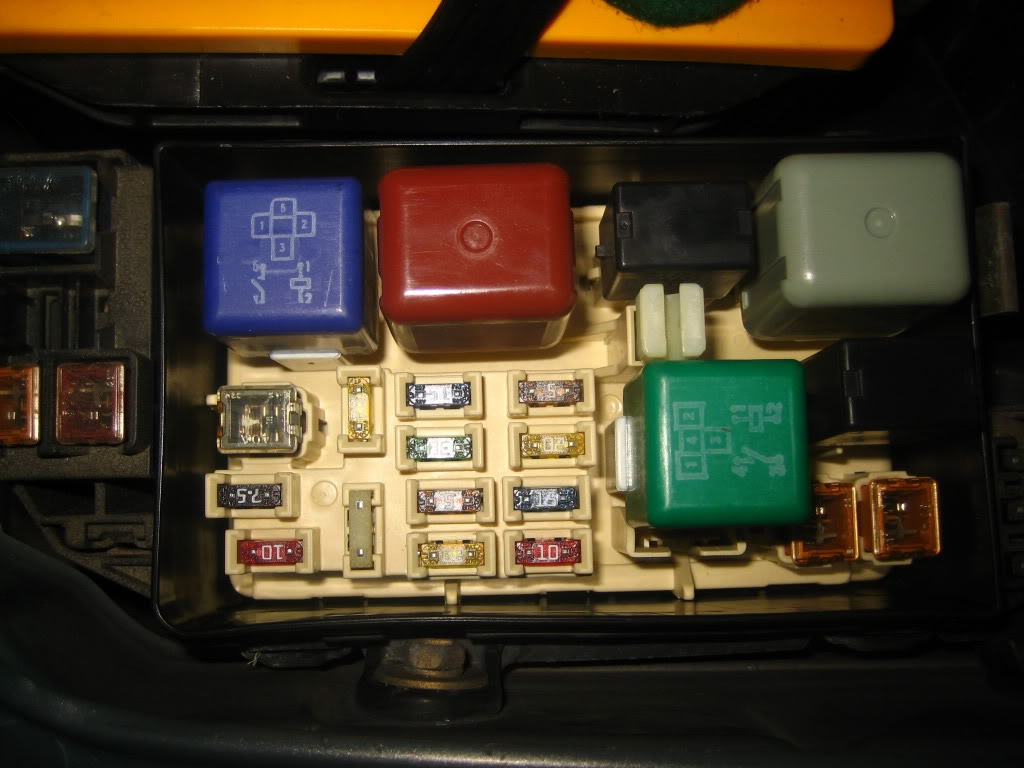




Remove the relay.
Measure the resistance between pins 1 and 2. It should be more than 10 Ohms and less than 300.
Measure the resistance between pins 3 and 5. It should be infinite.
Apply 12V on pin 1 and ground on pin 2. The relay should click. Now measure the resistance between pins 3 and 5, with the power still applied to pins 1 and 2. It should be less than 1 Ohm.
Measure the resistance between pins 1 and 2. It should be more than 10 Ohms and less than 300.
Measure the resistance between pins 3 and 5. It should be infinite.
Apply 12V on pin 1 and ground on pin 2. The relay should click. Now measure the resistance between pins 3 and 5, with the power still applied to pins 1 and 2. It should be less than 1 Ohm.
Reply
 3
3

3

Joined: Jun 2006
Posts: 29,085
Total Cats: 375
From: Republic of Dallas
Remove the relay.
Measure the resistance between pins 1 and 2. It should be more than 10 Ohms and less than 300.
Measure the resistance between pins 3 and 5. It should be infinite.
Apply 12V on pin 1 and ground on pin 2. The relay should click. Now measure the resistance between pins 3 and 5, with the power still applied to pins 1 and 2. It should be less than 1 Ohm.
Measure the resistance between pins 1 and 2. It should be more than 10 Ohms and less than 300.
Measure the resistance between pins 3 and 5. It should be infinite.
Apply 12V on pin 1 and ground on pin 2. The relay should click. Now measure the resistance between pins 3 and 5, with the power still applied to pins 1 and 2. It should be less than 1 Ohm.
Reply
0
0
Thanks Reverant. ^Agreed Huslter.
Remove the relay.
Measure the resistance between pins 1 and 2. It should be more than 10 Ohms and less than 300.
Measure the resistance between pins 3 and 5. It should be infinite.
Apply 12V on pin 1 and ground on pin 2. The relay should click. Now measure the resistance between pins 3 and 5, with the power still applied to pins 1 and 2. It should be less than 1 Ohm.
Measure the resistance between pins 1 and 2. It should be more than 10 Ohms and less than 300.
Measure the resistance between pins 3 and 5. It should be infinite.
Apply 12V on pin 1 and ground on pin 2. The relay should click. Now measure the resistance between pins 3 and 5, with the power still applied to pins 1 and 2. It should be less than 1 Ohm.
Reply
0
0


Joined: Sep 2005
Posts: 34,402
Total Cats: 7,523
From: Chicago. (The less-murder part.)
As a general tip, there is no such thing as "too much current."
You can apply too much voltage to something, however the amount of current that any given device will draw is self-limited. Specifically, the formula is I = E / R, where E is the voltage which you supply to the device, R is the internal resistance of the device (or impedance, in the case of inductive AC loads), and I is the amount of current that will pass.
A hypothetical device with a coil resistance of 500 ohms will thus draw 24 milliamps when 12 volts is applied to it (12 / 500).
When speaking of source current (such as from a battery, alternator, or other power supply) we mean only the maximum amount of current which you are permitted to draw from the supply before it either explodes or falls below rated voltage. So a power supply which is rated at 10 amps can supply any load (or combination of loads) whose total current requirement (as I=E/R) is any arbitrary value between 0 and 10 amps.
(Yes, for the EEs in the crowd, I'm aware that some supplies have a minimum load for guaranteed stability.)
You can apply too much voltage to something, however the amount of current that any given device will draw is self-limited. Specifically, the formula is I = E / R, where E is the voltage which you supply to the device, R is the internal resistance of the device (or impedance, in the case of inductive AC loads), and I is the amount of current that will pass.
A hypothetical device with a coil resistance of 500 ohms will thus draw 24 milliamps when 12 volts is applied to it (12 / 500).
When speaking of source current (such as from a battery, alternator, or other power supply) we mean only the maximum amount of current which you are permitted to draw from the supply before it either explodes or falls below rated voltage. So a power supply which is rated at 10 amps can supply any load (or combination of loads) whose total current requirement (as I=E/R) is any arbitrary value between 0 and 10 amps.
(Yes, for the EEs in the crowd, I'm aware that some supplies have a minimum load for guaranteed stability.)
Reply
0
0
Joined: Sep 2005
Posts: 34,402
Total Cats: 7,523
From: Chicago. (The less-murder part.)
As an aside, this was the first thing that came to my mind when I saw this thread: http://jalopnik.com/5198663/advances...sch-relay-race
Advances In LeMons Cruelty: The Bobby Bosch Relay Race
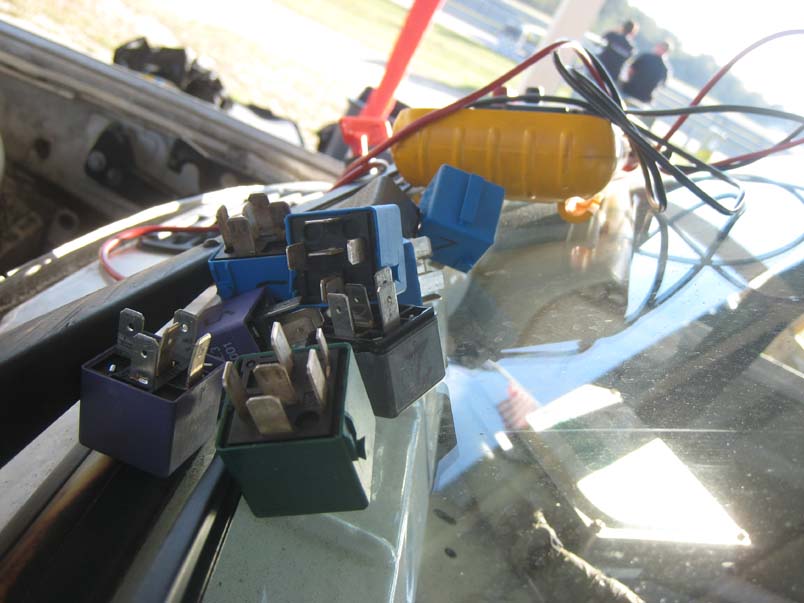
The Taiwanese National Anthem wasn't the only new penalty for the 24 Hours Of LeMons South Spring; though the TNA turned out to be quite spectacular in practice, it isn't the most diabolical new penalty.
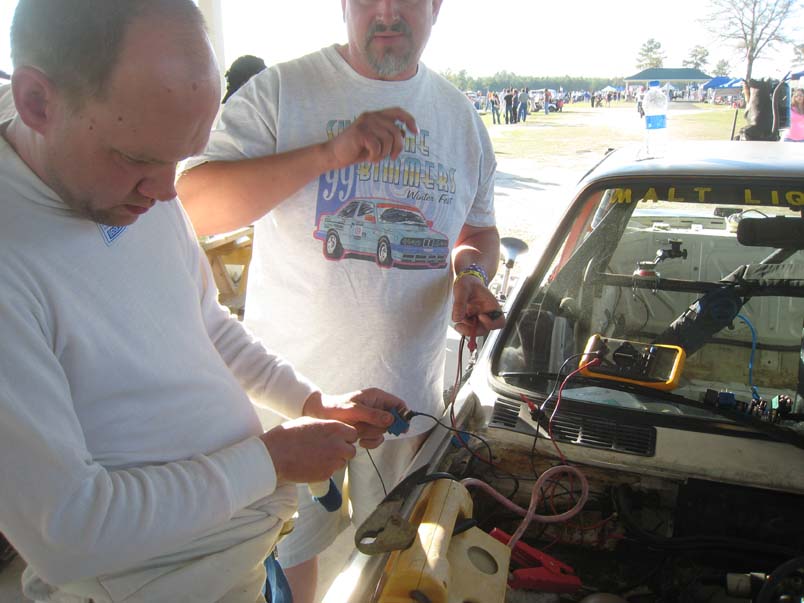
Welcome to German Electrical System Hell! The Bobby Bosch Relay Race is pretty simple, and it really separates the real BMW, Porsche, VW, and Audi mechanics from the pretenders: you take ten standard Bosch SPDT relays (pocketed at the junkyard, of course) and intentionally garboon one of them. When you've found it, the car can rejoin the race. Maybe the coil is bad, maybe the normally-open contacts are bad, or maybe I've been a total bastard and permanently jumped the normally-closed contacts. Whatever, because Bobby prints the schematic right on the relay cover, so picking out one bad one in a bucket of ten should take about five minutes, max. Sadly, some teams don't understand Relay Testing 101, and so it takes them a bit longer than that... and you'd think an E30 team would be really, really skilled at this, eh?
The Taiwanese National Anthem wasn't the only new penalty for the 24 Hours Of LeMons South Spring; though the TNA turned out to be quite spectacular in practice, it isn't the most diabolical new penalty.
Welcome to German Electrical System Hell! The Bobby Bosch Relay Race is pretty simple, and it really separates the real BMW, Porsche, VW, and Audi mechanics from the pretenders: you take ten standard Bosch SPDT relays (pocketed at the junkyard, of course) and intentionally garboon one of them. When you've found it, the car can rejoin the race. Maybe the coil is bad, maybe the normally-open contacts are bad, or maybe I've been a total bastard and permanently jumped the normally-closed contacts. Whatever, because Bobby prints the schematic right on the relay cover, so picking out one bad one in a bucket of ten should take about five minutes, max. Sadly, some teams don't understand Relay Testing 101, and so it takes them a bit longer than that... and you'd think an E30 team would be really, really skilled at this, eh?
Reply
0
0
I had to get the Porsche towed because I didn't have a multimeter onboard. Had I known the info in this thread, I would've known to swap the FP relay for the 'something else' relay to drive home, looking like a bauce.
Reply
0
0

Thread
Thread Starter
Forum
Replies
Last Post


