


Why are all throttle bodies butterfly valves?


Thread Starter
Elite Member
iTrader: (12)
Joined: Jan 2007
Posts: 2,573
Total Cats: 12
From: Hermosa Beach, CA
 Why are all throttle bodies butterfly valves?
So I am desiging the throttle body for Pitts FSAE car, and I was thinking of making a rotary valve throttle body (like a ball valve just with a cylinder) because it would be eaiser to make on the mill if I cannot get a throttle plate waterjetted.
And it made me think, why does every OEM use butterfly valves? So I searched... and nothing. There are a lot of different types of valves, and I cannot find one OEM that doesent use a butterfly. Maybe butterfly valves have better flow at mid throttle? Or at idle? IDK, anyone have any input? I mean it sure seems a rotary/ball valve would have much nicer flow at WOT.
And it made me think, why does every OEM use butterfly valves? So I searched... and nothing. There are a lot of different types of valves, and I cannot find one OEM that doesent use a butterfly. Maybe butterfly valves have better flow at mid throttle? Or at idle? IDK, anyone have any input? I mean it sure seems a rotary/ball valve would have much nicer flow at WOT.
Reply
 0
0

0





Junior Member
Joined: Jun 2007
Posts: 407
Total Cats: 2
From: Grayslake IL
Reply
0
0



Joined: Sep 2005
Posts: 34,402
Total Cats: 7,523
From: Chicago. (The less-murder part.)
It's cheap and easy to build them so that they seal well.
Racers in the past have experimented with slide throttles, which give you that obstruction-free opening. It's very difficult to make them seal up well.
Ball valves are common in pneumatic and hydraulic applications, however the tight fit and teflon seals mean that they require a lot of force to operate. Go to the hardware store and find a 2.5" ball valve. Open and close it. Compare this to a throttle plate which, with the spring removed, require virtually no force at all to open and close.
Racers in the past have experimented with slide throttles, which give you that obstruction-free opening. It's very difficult to make them seal up well.
Ball valves are common in pneumatic and hydraulic applications, however the tight fit and teflon seals mean that they require a lot of force to operate. Go to the hardware store and find a 2.5" ball valve. Open and close it. Compare this to a throttle plate which, with the spring removed, require virtually no force at all to open and close.
Reply
0
0



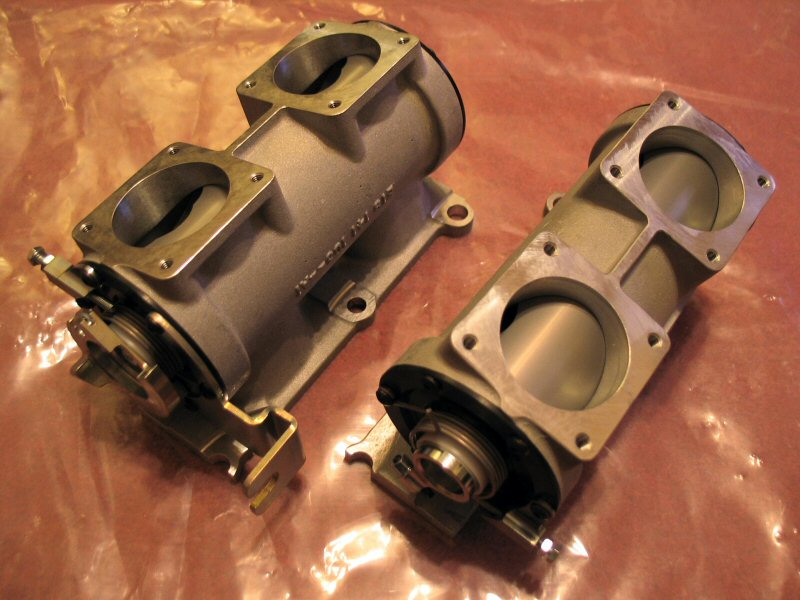
Any interesting ideas for improving flow through a butterfly valve? Dimpled surface on the disc perhaps? I have no idea if that makes any sense or not (other than in a completely amateur Mythbusters kind of way).
Reply
0
0
Joined: Sep 2005
Posts: 34,402
Total Cats: 7,523
From: Chicago. (The less-murder part.)

Ok, serious-hat time.
Is there an actual problem with butterfly valves that merits doing something more exotic? Would increasing the diameter of the orifice by 2% provide equivalent flow capability to removing the shaft? Would you be able to actually quantify the difference?
Reply
0
0


Junior Member
Joined: Feb 2010
Posts: 279
Total Cats: 4
Reply
0
0


