


Using a fuel injector as a nozzle





Back when I used to have carburetors it eCooled the charge so much we used to put the beer on top of the engine coming back from the store. But you had to be careful. With a really big carburetor the beer would sometimes freeze.
Reply
 0
0

0

Thread Starter
Junior Member
Joined: Mar 2012
Posts: 110
Total Cats: 13
Right.
Reading the NACA papers was encouraging, a possible 70% increase in BMEP sounded bloody marvellous until i realised that their test engine was initially knock limited and the IAT's were held constant throughout the whole test. I am looking to lower IATs, knock is not (yet) a concern.
Reading further echo's the comments in this thread; water isnt a great intake charge cooler.
After this i started looking into meth/alky/water mixes, which DO cool the intake charge better than water but these solvents only do an average job (at best) of cooling the intke charge. They also screw up AFR's, are more expensive, require mixing, and generally still have nothing on a good intercooler.
Im not sure why i was so stuck on water injection to be honest. Too much time reading vendor websites and hoping for a magic bullet. I think i was also getting confused between IAT reduction and knock supression. Sure you can supress the knock and advance the timing, but as 18psi put it, I wont get any extra power with all that hot air going into the engine.
SO...
Looks like im getting an intercooler. Ill delve into that thread aidandj, thanks for the head start. Triple J, looks like you need to buy me a curry.
Reading the NACA papers was encouraging, a possible 70% increase in BMEP sounded bloody marvellous until i realised that their test engine was initially knock limited and the IAT's were held constant throughout the whole test. I am looking to lower IATs, knock is not (yet) a concern.
Reading further echo's the comments in this thread; water isnt a great intake charge cooler.
After this i started looking into meth/alky/water mixes, which DO cool the intake charge better than water but these solvents only do an average job (at best) of cooling the intke charge. They also screw up AFR's, are more expensive, require mixing, and generally still have nothing on a good intercooler.
Im not sure why i was so stuck on water injection to be honest. Too much time reading vendor websites and hoping for a magic bullet. I think i was also getting confused between IAT reduction and knock supression. Sure you can supress the knock and advance the timing, but as 18psi put it, I wont get any extra power with all that hot air going into the engine.
SO...
Looks like im getting an intercooler. Ill delve into that thread aidandj, thanks for the head start. Triple J, looks like you need to buy me a curry.
Last edited by sparkybean; Jul 30, 2015 at 03:36 PM. Reason: spell
Reply
0
0
Thread Starter
Junior Member
Joined: Mar 2012
Posts: 110
Total Cats: 13
...Is it even worth me hanging onto my water injection setup for my power goals? While tuning for MBT sounds nice im sure i could be conservitive with the timing and run more boost.
Shame, im £250 down from this little excursion.
Shame, im £250 down from this little excursion.
Reply
0
0
In my experience, pure WI isn't going to help much. I've read way to many WI papers that say they will. If you run water/meth, then it could help, many have dyno graphs to prove it.
If I could do it over, and had the budget, I'd run dual fuel systems, gasoline for driving, something else for boost (E85 most likely). More weight and complexity, it's obvious, but it's the best of both worlds then.
If I could do it over, and had the budget, I'd run dual fuel systems, gasoline for driving, something else for boost (E85 most likely). More weight and complexity, it's obvious, but it's the best of both worlds then.
Reply
0
0


Reply
0
0


Joined: Sep 2005
Posts: 34,422
Total Cats: 7,542
From: Chicago. (The less-murder part.)
5 or 6 years ago, I became hugely interested in the old NACA research papers which explored the injection of various liquids into piston engines at various locations. Got a whole 3-ring binder somewhere full of those articles.
Lots of different papers came to various conclusions based on differing methodologies. Some injected liquid directly into the combustion chamber at various timings, some metered liquid into the intake manifold at ratios varying with fuel, some explored the relationship of water-injection to power in the presence of varying IAT, etc. Some of the tests focused specifically on increasing ignition advance and MAP for maximum power on a turbosupercharged engine. Some focused on attaining maximum fuel economy. Some focused on allowing the use of lower-octane fuel.
All tests generally agreed that the use of water injection permitted great increases in knock-limited power, a result which I was never able to consistently replicate on my own car mostly because I'd run out of airflow (Greddy) and was already intercooled. That engine just refused to make much past 210 WHP no matter what I did.
From what I gather, the blending of alcohol with water was done principally to prevent the water from freezing solid. At 20,000 feet over Germany, this is a concern even during the summertime. Which brings me to this point:
I'm slightly curious about your statement here.
While decreasing IAT is generally desirable, isn't the primary goal of IAT reduction in a turbocharged engine to eliminate knock?
Lots of different papers came to various conclusions based on differing methodologies. Some injected liquid directly into the combustion chamber at various timings, some metered liquid into the intake manifold at ratios varying with fuel, some explored the relationship of water-injection to power in the presence of varying IAT, etc. Some of the tests focused specifically on increasing ignition advance and MAP for maximum power on a turbosupercharged engine. Some focused on attaining maximum fuel economy. Some focused on allowing the use of lower-octane fuel.
All tests generally agreed that the use of water injection permitted great increases in knock-limited power, a result which I was never able to consistently replicate on my own car mostly because I'd run out of airflow (Greddy) and was already intercooled. That engine just refused to make much past 210 WHP no matter what I did.
From what I gather, the blending of alcohol with water was done principally to prevent the water from freezing solid. At 20,000 feet over Germany, this is a concern even during the summertime. Which brings me to this point:
Originally Posted by sparkybean
Reading the NACA papers was encouraging, a possible 70% increase in BMEP sounded bloody marvellous until i realised that their test engine was initially knock limited and the IAT's were held constant throughout the whole test. I am looking to lower IATs, knock is not (yet) a concern.
While decreasing IAT is generally desirable, isn't the primary goal of IAT reduction in a turbocharged engine to eliminate knock?
Reply
0
0
Thread Starter
Junior Member
Joined: Mar 2012
Posts: 110
Total Cats: 13
Very bad wording on my part. I am now looking to raise power by lowering IAT's (and thus reducing probability of knock) rather than just reducing knock with water injection while still having high IAT's.
Thanks for your input.
Thanks for your input.
Reply
0
0
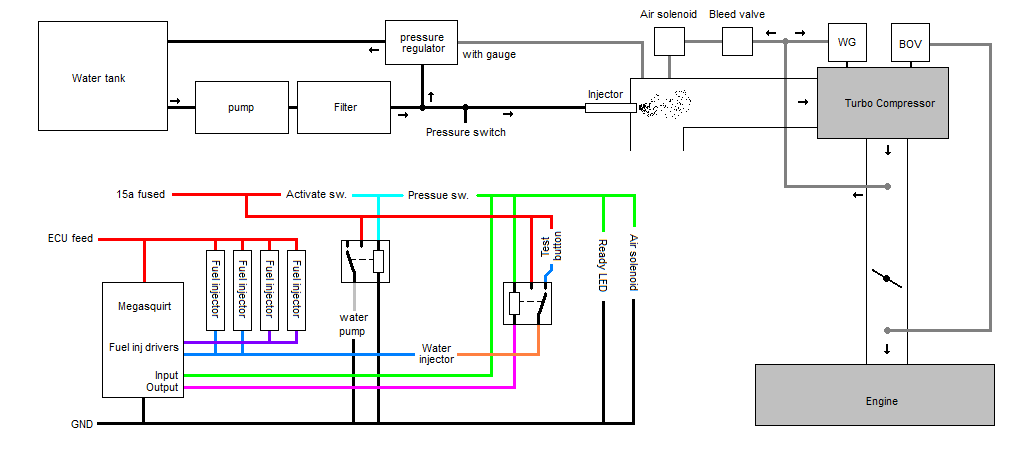
Then you need an intercooler. Good call on that, it's the better solution. If you try to push the absolute limits on pump gas, then water/meth injection could helpful.
Reply
0
0

Junior Member
Joined: Jun 2009
Posts: 128
Total Cats: 0
From: Naka, Japan & Georgetown, Texas
Injecting water pre-turbo will cool the charge coming out of the turbo. It will work better than an alcohol. Depending on your IC location, and average speed, an IC might not be the best route.
Reply
0
0

Reply
0
0
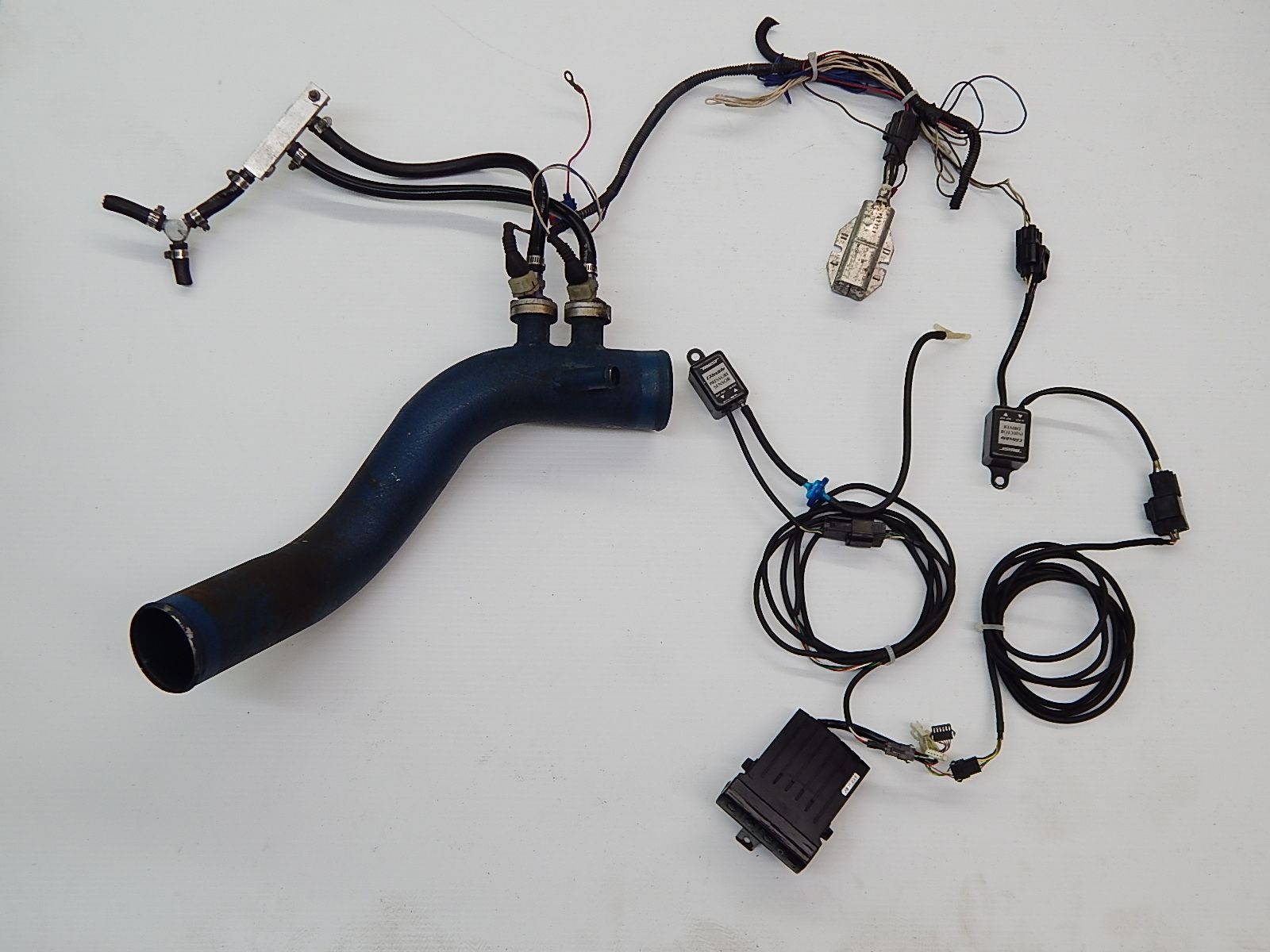
No, what you saw was a Skyline running an HKS AIC or Greddy REBIC with a bunch of extra injectors put in for fueling under boost. Didn't have anything to do with "intercooling."
Reply
0
0


Thread
Thread Starter
Forum
Replies
Last Post
Faeflora
Methanol/Water Injection
4
Sep 18, 2011 08:07 PM
cueball1
Methanol/Water Injection
8
Feb 18, 2007 09:30 AM


