


Elusive fuel


Thread Starter
Former Vendor
Joined: Dec 2007
Posts: 271
Total Cats: 11
From: Texas Hill Country

Good data presented by Sav.
Agreed, 235 is stretching stock injectors. The AO has been shipped with a recommended 200 rwhp max unless the injectors are drilled out. (figure of speech)
My objective in asking the questions was to let this thread figure out the answers. The example was made for convenient arithmetic.
It appears to be established that there is useable fuel available past 100% dc because/when the VE falls off.
Agreed, it is risky unless you have your hands on the particular machine.
I seem to be able to see this stuff better when I think of one putt at a time. I know its a transient system, but IT IS a transient system composed of a series of individual putts hooked together.
Thanks Dann.
corky
Agreed, 235 is stretching stock injectors. The AO has been shipped with a recommended 200 rwhp max unless the injectors are drilled out. (figure of speech)
My objective in asking the questions was to let this thread figure out the answers. The example was made for convenient arithmetic.
It appears to be established that there is useable fuel available past 100% dc because/when the VE falls off.
Agreed, it is risky unless you have your hands on the particular machine.
I seem to be able to see this stuff better when I think of one putt at a time. I know its a transient system, but IT IS a transient system composed of a series of individual putts hooked together.
Thanks Dann.
corky
Reply
 0
0

0

And yet, I posted actual logs, and neither you, nor Dann, nor Sav have commented on the data that shows PW not dropping or dropping very insignificantly past peak torque.
I guess it was a waste to post actual data.
...I obviously agree with you about the fuel available past 100% part
I guess it was a waste to post actual data.
...I obviously agree with you about the fuel available past 100% part
Reply
0
0




OK, Scott, you pulled me back in (not that anyone should care).
Those graphs and Dyno make total sense. VE drop is nullified because you let boost rise from 9 to 11 psi. Rising HP requires rising fuel.
Duty cycle climbs more than PW due to RPM. All this makes sense.
For flat or falling torque, PW still climbs, likely due to AFR falling, and, perhaps, as Savington suggests, efficiency is less.
There is no more fuel past 100%DC. There may be less required fuel, so that the 100% duty cycle can supply it, as in falling HP. In fact, at 100%, you are even using up the "dead time", as there is no open and close.
Now it is being said that the A-O should be limited to about 200WHP. That is something that MSM guys have been saying is possible on stock MSM injectors for some time now. I don't know what the curves look like (as in where the peak HP occurs RPM wise).
What size injectors were you using at only 64% DC?
Those graphs and Dyno make total sense. VE drop is nullified because you let boost rise from 9 to 11 psi. Rising HP requires rising fuel.
Duty cycle climbs more than PW due to RPM. All this makes sense.
For flat or falling torque, PW still climbs, likely due to AFR falling, and, perhaps, as Savington suggests, efficiency is less.
There is no more fuel past 100%DC. There may be less required fuel, so that the 100% duty cycle can supply it, as in falling HP. In fact, at 100%, you are even using up the "dead time", as there is no open and close.
Now it is being said that the A-O should be limited to about 200WHP. That is something that MSM guys have been saying is possible on stock MSM injectors for some time now. I don't know what the curves look like (as in where the peak HP occurs RPM wise).
What size injectors were you using at only 64% DC?
Reply
0
0
What about my plots where boost falls and commanded afr actually tapers leaner and PW still climbs?
Since corky mentioned that this is "just a discussion" I won't keep referring to the AO, but the fact remains: PW still doesn't drop much, if at all.
Since corky mentioned that this is "just a discussion" I won't keep referring to the AO, but the fact remains: PW still doesn't drop much, if at all.
Reply
0
0
Vlad, not sure I'm following the question. The first dyno / log you posted had the boost falling, but it does not show AFR or PW (but does show DC).
If the efficiency plots that Savington showed holds for boosted engines (why not), then the fall off of efficiency would require more fuel and more air for same HP output. Yes, it would seem that as RPM goes up, more, not less fuel would be needed, for same HP.
If the efficiency plots that Savington showed holds for boosted engines (why not), then the fall off of efficiency would require more fuel and more air for same HP output. Yes, it would seem that as RPM goes up, more, not less fuel would be needed, for same HP.
Reply
0
0
Oh I actually found one of mine:


460cc injectors, 1.6L fuel rail, so about ~50psi. PW was pretty flat from ~6-7K.
460cc injectors, 1.6L fuel rail, so about ~50psi. PW was pretty flat from ~6-7K.
Last edited by Braineack; Dec 23, 2014 at 01:30 PM.
Reply
0
0
More perfect examples of PW not dropping past peak torque
You wanna go ahead and explain this to me again based on the plots posted or you want to shut your big fat yap now?
You wanna go ahead and explain this to me again based on the plots posted or you want to shut your big fat yap now?
Reply
0
0
Vlad, yours show: 55, PW falls at end; 57, rises; 58, pretty flat, though you note it falls from 15.1 to 14.4. But no dyno with that.
I think you are right that Scott's posted pics have the best info and show what is typical.
WHAT? the FPR was set higher on the 1.6's than the 1.8's? I thought both were 43, but only the shape of the vacuum port was different.
I think you are right that Scott's posted pics have the best info and show what is typical.
WHAT? the FPR was set higher on the 1.6's than the 1.8's? I thought both were 43, but only the shape of the vacuum port was different.
Reply
0
0

Elite Member
Joined: Apr 2010
Posts: 2,826
Total Cats: 66
From: Newcastle, Australia
Reply
-1
-1

To be honest, I'm actually a little surprised that PW rises the entire time there - I would expect PW to sit flat or slightly decline on engines that are more heavily boosted (i.e. more torque drop from peak to redline), but I would never expect IDC to decrease unless you rev the engine way, way past peak power (and even then, it would surprise me).
Reply
0
0
Elite Member

Joined: Mar 2007
Posts: 5,298
Total Cats: 884
From: Santa Clara, CA
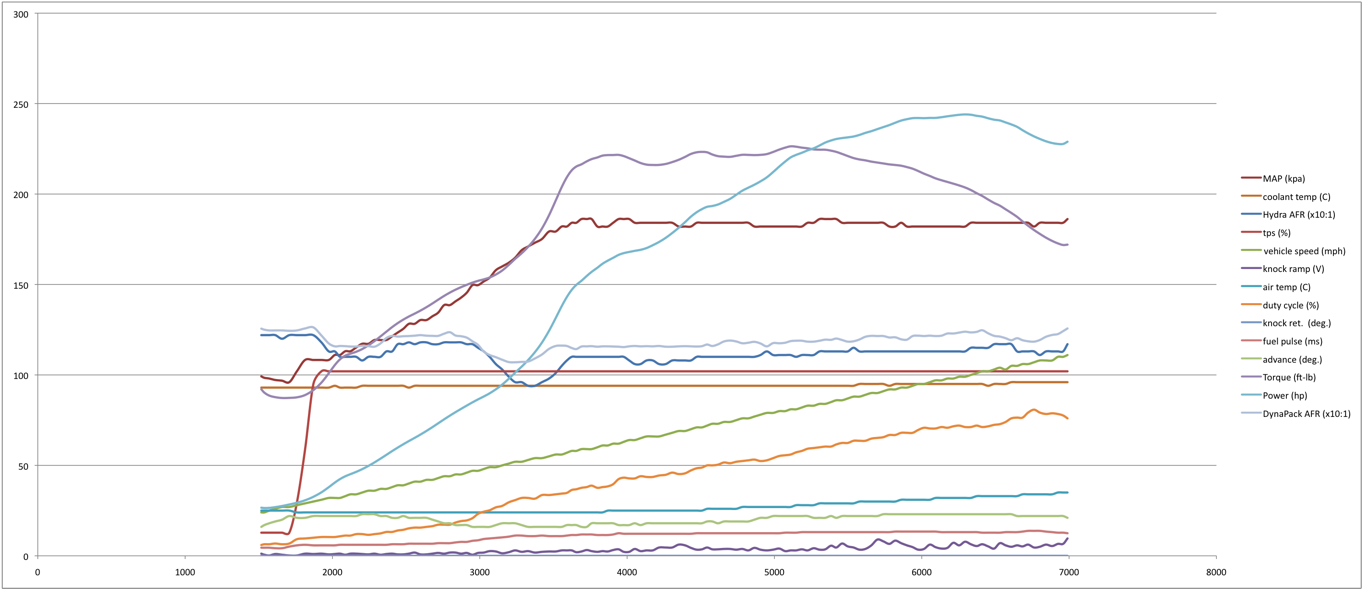
Power (light blue) drops after 6000, but DC only tails off very slightly.
Frictional losses go up a lot as the RPMs climb. This is really obvious if you get a dataloggable MAF-based car and compare the MAF/RPM and power/RPM curves. I did this on my Audi once, but I don't have the data logs any more.
--Ian
Reply
0
0

Reply
0
0


