


MINI 11" rotor instead of Corrado


Reply
 0
0

0

Thread Starter
Senior Member
iTrader: (9)
Joined: Oct 2006
Posts: 1,176
Total Cats: 36
From: Lexington SC

I couldn’t sleep last night and was really wondering about the 11.5” rotors. I ended up playing in the garage and stuck some 1/4” (~6mm) plate between the rotor and wheel to act as a spacer, hoping this would give me enough clearance to make it worth messing with.
Adding the spacer might have increased the radial clearance from 1/16” to 3/32” or just shy of 1/8”, still very tight under the factory wheel. I haven’t had a chance to go do some research to see what the clearances are on the big boy brakes, but this just looks too tight to me (not engineering answer, I know). Adding the spacer does remove any interference with the spokes and I would guess that even a 3mm spacer would be more than enough to take care of that. If 1/16” radial clearance would be enough I am sure this setup would be perfect with only 3mm spacer.
Once again, I just don’t feel comfortable cutting it that close. Any debris getting in-between the wheel and caliper will cause serious issues. I am not sure if that is something that actually is an issue on track. I can just see a loose nut, bolt, hell even thin *** washer getting picked up on track and getting jammed in there.
Looks like the 11.5” rotor is going back to the store for now.
Adding the spacer might have increased the radial clearance from 1/16” to 3/32” or just shy of 1/8”, still very tight under the factory wheel. I haven’t had a chance to go do some research to see what the clearances are on the big boy brakes, but this just looks too tight to me (not engineering answer, I know). Adding the spacer does remove any interference with the spokes and I would guess that even a 3mm spacer would be more than enough to take care of that. If 1/16” radial clearance would be enough I am sure this setup would be perfect with only 3mm spacer.
Once again, I just don’t feel comfortable cutting it that close. Any debris getting in-between the wheel and caliper will cause serious issues. I am not sure if that is something that actually is an issue on track. I can just see a loose nut, bolt, hell even thin *** washer getting picked up on track and getting jammed in there.
Looks like the 11.5” rotor is going back to the store for now.
Reply
0
0



You're trying to make a pretty hefty rotor fit in a factory wheel, that's half your problem. I'm guessing if you went to a number of aftermarket wheels, a 11.5" rotor would fit fine. I'm not too familiar with anyone running even an 11" wilwood kit on factory wheels.
I know TSE's 11.75" requires a 1/4"(?) spacer to fit with 15x9 6uls, so I'm sure it'd be fine with an 11.5" rotor. And if I'm not mistaken the 15x10s were designed to fit TSE's kit, or were designed to have more brake clearance in general. Either way, they don't require a spacer.
I know TSE's 11.75" requires a 1/4"(?) spacer to fit with 15x9 6uls, so I'm sure it'd be fine with an 11.5" rotor. And if I'm not mistaken the 15x10s were designed to fit TSE's kit, or were designed to have more brake clearance in general. Either way, they don't require a spacer.
Reply
0
0
Thread Starter
Senior Member
iTrader: (9)
Joined: Oct 2006
Posts: 1,176
Total Cats: 36
From: Lexington SC
I have been using 6061 for my mockup brackets and according to my calculations the bracket will be more than strong enough. Now I am wondering if I need to make the brackets out of 7075 instead since it is significantly stronger. I am not a fan of brake failures, so more seems to be better. What are the brackets made out of in the other kits? 6061 0r 7075? I have not been able to find any details online.
I am sure that 7075 will be strong enough that the caliper lugs will break off before the bracket lets go. Any input is appreciated! Especially from the engineers.
I am sure that 7075 will be strong enough that the caliper lugs will break off before the bracket lets go. Any input is appreciated! Especially from the engineers.
Reply
0
0

What's the cost delta between the two?
In general 7075 is more sensitive to heat treatment than 6061. If the heat treatment isn't done correctly you can have issues with SCC (Stress Corrosion Cracking) which with the environment the brackets would be in (exposed to water, dirt, other crap) may or may not be an issue. I would guess that as long as the 7075 material is heat treated correctly (T7 I think) it should work fine, but......but in the brake caliper bracket environment (may reach highish temperatures? 200F?) the material might continue to overage as it sees higher temps from the brake caliper which will lead to lowering of strength throughout the life of the part.
6061 should be less sensitive to these same issues and might be the safer bet. Unless you really need the strength of 7075 and you really want to spend twice? the amount of money I would just stick with 6061.
One other thing to consider is the part design and use itself. Is the part strength limited or stiffness limited? Stiffness is generally limited by the shape and design of the part, and since 6061 and 7075 have basically the same Young's Modulus ("stiffness") they will have the same stiffness. In other words, if the design is stiffness limited than there is no benefit going to 7075, however, if it is strength limited than there is a benefit.
Hope that helps.
In general 7075 is more sensitive to heat treatment than 6061. If the heat treatment isn't done correctly you can have issues with SCC (Stress Corrosion Cracking) which with the environment the brackets would be in (exposed to water, dirt, other crap) may or may not be an issue. I would guess that as long as the 7075 material is heat treated correctly (T7 I think) it should work fine, but......but in the brake caliper bracket environment (may reach highish temperatures? 200F?) the material might continue to overage as it sees higher temps from the brake caliper which will lead to lowering of strength throughout the life of the part.
6061 should be less sensitive to these same issues and might be the safer bet. Unless you really need the strength of 7075 and you really want to spend twice? the amount of money I would just stick with 6061.
One other thing to consider is the part design and use itself. Is the part strength limited or stiffness limited? Stiffness is generally limited by the shape and design of the part, and since 6061 and 7075 have basically the same Young's Modulus ("stiffness") they will have the same stiffness. In other words, if the design is stiffness limited than there is no benefit going to 7075, however, if it is strength limited than there is a benefit.
Hope that helps.
Reply
0
0

For the lulz, I just called Wilwood and asked them what their brackets were made of. They of course said it was proprietary and then asked me why. I told them my boss wanted me to weld something to one and I'd prefer not to ruin the part. The tech kinda freaked out and recommended that I NOT do that  So I asked if I should treat it like 6061 or 7075 and he made some comment about "yeah,more like 6066. 7075 would be too brittle for caliper mounts." Sounds like 6000 series to me.
So I asked if I should treat it like 6061 or 7075 and he made some comment about "yeah,more like 6066. 7075 would be too brittle for caliper mounts." Sounds like 6000 series to me.
Reply
0
0
Thread Starter
Senior Member
iTrader: (9)
Joined: Oct 2006
Posts: 1,176
Total Cats: 36
From: Lexington SC
What's the cost delta between the two?
In general 7075 is more sensitive to heat treatment than 6061. If the heat treatment isn't done correctly you can have issues with SCC (Stress Corrosion Cracking) which with the environment the brackets would be in (exposed to water, dirt, other crap) may or may not be an issue. I would guess that as long as the 7075 material is heat treated correctly (T7 I think) it should work fine, but......but in the brake caliper bracket environment (may reach highish temperatures? 200F?) the material might continue to overage as it sees higher temps from the brake caliper which will lead to lowering of strength throughout the life of the part.
6061 should be less sensitive to these same issues and might be the safer bet. Unless you really need the strength of 7075 and you really want to spend twice? the amount of money I would just stick with 6061.
In general 7075 is more sensitive to heat treatment than 6061. If the heat treatment isn't done correctly you can have issues with SCC (Stress Corrosion Cracking) which with the environment the brackets would be in (exposed to water, dirt, other crap) may or may not be an issue. I would guess that as long as the 7075 material is heat treated correctly (T7 I think) it should work fine, but......but in the brake caliper bracket environment (may reach highish temperatures? 200F?) the material might continue to overage as it sees higher temps from the brake caliper which will lead to lowering of strength throughout the life of the part.
6061 should be less sensitive to these same issues and might be the safer bet. Unless you really need the strength of 7075 and you really want to spend twice? the amount of money I would just stick with 6061.
Thanks for doing the research EO2K. I was looking through every Willwood document I could find online and could not get an answer.
I have been waiting on a quote from our local aluminum supplier to see how much the 7075 would be. I just looked at some online suppliers and 7075 costs almost 3 times as much as 6061. So final answer, 6061 it is!
Reply
0
0

Junior Member
Joined: Oct 2009
Posts: 200
Total Cats: 1
From: The Netherlands
How does the stock caliper compare to the Wilwood caliper in terms of fitment ?
Why use 1.8 brackets if you have to make an adapter anyway ? Is the 1.8 bracket needed for the bigger brake pads ? I did refurbish the front brakes a while ago (cleaning and all new rubbers), but I can't remember.
<edit>Checked that. Right. That is the case why you "should" have 1.8 brackets.</edit>
So, would the 11.0 or 11.5 rotor work with the stock caliper in a 15" wheel you think ?
I am just thinking of ripping the 1.6 disc out, placing the 11" mini rotor on, install the bracket between the hub and the 1.6 bracket and go.. That would leave me some fabwork, but that's just fine.
I would do it partly for the looks but also the enlarged diameter would enhance the braking performance quite a bit. I know it wouldn't be the best kit. I don't care too much. I don't need the best kit.
Here is a 1.8 caliper (front)

The Wilwood seems to be the larger one.
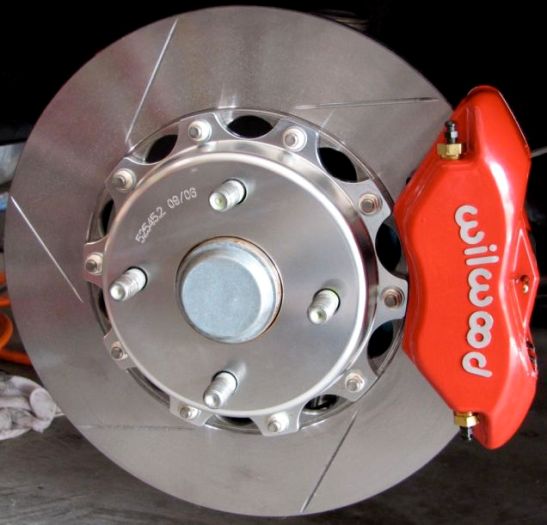
Looking at it this way, I think the 11.5" rotor would fit the wheel with the stock caliper, where the Wilwood caliper would rub the rim.
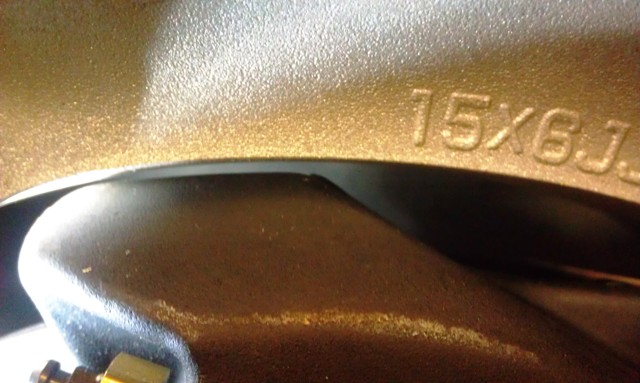
By the way, I have these wheels:

These are Phoenix wheels (Enkei, OEM Mazda). I wonder if they give about the same room for brakes inside as other wheels.
Why use 1.8 brackets if you have to make an adapter anyway ? Is the 1.8 bracket needed for the bigger brake pads ? I did refurbish the front brakes a while ago (cleaning and all new rubbers), but I can't remember.
<edit>Checked that. Right. That is the case why you "should" have 1.8 brackets.</edit>
So, would the 11.0 or 11.5 rotor work with the stock caliper in a 15" wheel you think ?
I am just thinking of ripping the 1.6 disc out, placing the 11" mini rotor on, install the bracket between the hub and the 1.6 bracket and go.. That would leave me some fabwork, but that's just fine.
I would do it partly for the looks but also the enlarged diameter would enhance the braking performance quite a bit. I know it wouldn't be the best kit. I don't care too much. I don't need the best kit.
Here is a 1.8 caliper (front)
The Wilwood seems to be the larger one.
Looking at it this way, I think the 11.5" rotor would fit the wheel with the stock caliper, where the Wilwood caliper would rub the rim.
By the way, I have these wheels:
These are Phoenix wheels (Enkei, OEM Mazda). I wonder if they give about the same room for brakes inside as other wheels.
Last edited by IHI; Nov 4, 2012 at 07:25 AM.
Reply
0
0
Thread Starter
Senior Member
iTrader: (9)
Joined: Oct 2006
Posts: 1,176
Total Cats: 36
From: Lexington SC
The 1.8 pads are significantly bigger. Search here or m.net for 1.6 to 1.8 conversion to see pictures of what i am talking about. A bracket for the 1.6 caliper on 11" rotors is not the same as 1.8 and would require different dimensions. When adding say a m-tuneWillwoods kit, the adapter moves the whole bracket and caliper out further to fit the bigger rotor. The factory caliper bracket is still needed since it holds the pads in place as well as the slider pins. When upgrading to 1.8 rotors you retain the same 1.6 calipers.
I hope this makes sense.
How to Go Slow Fast
Album Index for album 0003: '90-93 Bigger Brake Upgrade
Just search miata.net
I don't have the picures on my phone but will post some later that show the Willwoods are actually 2-3 mm smaller in the radial direction (fits under wheel) the facory calipers do not stick out as far and have more room to the back of the wheel spokes than the Willwoods. The Willwoods have pisons on the outside of the rotor so they have to stick out further, that is why they look bigger. Sounds like you will be fine on factory calipers, i doubt anyone makes an upgrade kit to 11" rotors using 1.6 brackets, sorry.
I hope this makes sense.
How to Go Slow Fast
Album Index for album 0003: '90-93 Bigger Brake Upgrade
Just search miata.net
I don't have the picures on my phone but will post some later that show the Willwoods are actually 2-3 mm smaller in the radial direction (fits under wheel) the facory calipers do not stick out as far and have more room to the back of the wheel spokes than the Willwoods. The Willwoods have pisons on the outside of the rotor so they have to stick out further, that is why they look bigger. Sounds like you will be fine on factory calipers, i doubt anyone makes an upgrade kit to 11" rotors using 1.6 brackets, sorry.
Last edited by Rallas; Nov 4, 2012 at 04:59 PM.
Reply
0
0
Thread Starter
Senior Member
iTrader: (9)
Joined: Oct 2006
Posts: 1,176
Total Cats: 36
From: Lexington SC
I finally got something on the car! It is not the pretiest, but it is 100% functional. Work has slowed down a little and I am only having to do ~40 hrs worth of nights a week, so I am getting a little more time in the shop. This is my first attempt made from ¾” 6061. With the required offset it leaves just less than 3/8” of material for the caliper mounting lugs. I made these lugs as large as I could fit and per my calculations can handle over 10kips so it should be ok. Looks real nice and the 11” Mini rotor fits with lots of radial room and no less than 1/8” clearance to the 15” NB wheel. I tried to fit a set of 96 M-ed 15” wheels my dad has, but they rubbed on the spokes. They would be fine with a 1/8” spacer. My goal was to get the 15” NB wheels on there with no spacers and it seems like it will work. I was hoping to get the heat shields off without taking the hubs out , but the ABS rings won't allow the bolts to come out. I managed to get these bolts out last time I had to mess with it, but that was before I installed these ABS hubs. Will be a good excuse to clean and grease the bearings.
I hope to get the other side on and do some test driving by this weekend. Now I just have to decide what to do with the rear. Not that there really is any decision to be made, I know it will be the Sport rear rotor. Would it be completely nuts to just add the front upgrade and test it for a few days without any rear upgrades? I figured it would just make the fronts lock up easier and not get me into the dangerous stuff that can happen when the rears lock up first. I am just dying to test these front upgrades.
I now have my brother hooked on the brake upgrades as well and we are looking at adapting a set of Wilwood 4 pistons to his FFR roadster front and rear. It will be fun to make the dual caliper rear setup so we can maintain the parking brake.
I am going to make another set of brackets with a 1/8” thick heavy washer/spacer between the hub lugs and bracket. This will space the whole bracket out some and reduce the offset I have to mill into the bracket. This will make the caliper mounting lugs 1/8” thicker as well. I looked into making the bracket out of 1” 6061, but would still have to remove close to 0.150” to allow for some clearance between the rotor and the caliper bracket. The resulting lug thickness would be close to what I would get with the ¾” thick material and an 1/8” thick spacer washer.
As for the 11.5” with factory calipers. No, they will not fit under factory 15” wheels. They hit radially, so no spacer in the world can fix that issue. You might be able to modify the caliper and bracket to gain some clearance, but it would weaken the bracket in areas that are pretty important. If you run 16” wheels you might be golden!
I hope to get the other side on and do some test driving by this weekend. Now I just have to decide what to do with the rear. Not that there really is any decision to be made, I know it will be the Sport rear rotor. Would it be completely nuts to just add the front upgrade and test it for a few days without any rear upgrades? I figured it would just make the fronts lock up easier and not get me into the dangerous stuff that can happen when the rears lock up first. I am just dying to test these front upgrades.
I now have my brother hooked on the brake upgrades as well and we are looking at adapting a set of Wilwood 4 pistons to his FFR roadster front and rear. It will be fun to make the dual caliper rear setup so we can maintain the parking brake.
I am going to make another set of brackets with a 1/8” thick heavy washer/spacer between the hub lugs and bracket. This will space the whole bracket out some and reduce the offset I have to mill into the bracket. This will make the caliper mounting lugs 1/8” thicker as well. I looked into making the bracket out of 1” 6061, but would still have to remove close to 0.150” to allow for some clearance between the rotor and the caliper bracket. The resulting lug thickness would be close to what I would get with the ¾” thick material and an 1/8” thick spacer washer.
As for the 11.5” with factory calipers. No, they will not fit under factory 15” wheels. They hit radially, so no spacer in the world can fix that issue. You might be able to modify the caliper and bracket to gain some clearance, but it would weaken the bracket in areas that are pretty important. If you run 16” wheels you might be golden!
Reply
0
0
Thread Starter
Senior Member
iTrader: (9)
Joined: Oct 2006
Posts: 1,176
Total Cats: 36
From: Lexington SC
No abs, I just swapped in hubs and axles with abs rings from my 1.8 donor car. I have all the electronics if i ever want to add a tire saver system. I made a mental note yesterday to make sure those cotter pins are properly installed before the tires go on for good. I need to put a sticky on the steering whee as a reminderl. Actually i need to get the spring clips that 949 sell.
Reply
0
0

You don't need two calipers for the parking brake in the rear. Just add a line lock to the rear circuit (similar to the ones used by drag racers to hold pressure on the fronts for burnouts).
Reply
0
0
Thread Starter
Senior Member
iTrader: (9)
Joined: Oct 2006
Posts: 1,176
Total Cats: 36
From: Lexington SC
That defeats the purpose of having a mechanical backup when you have a hydraulic failure. I was thinking the same thing though, thats what you do in most small aircraft. Push the pedal and close the valve to lock in brake pressure.
Reply
0
0

good luck trying to stop your car with only the rear brakes in any case that you couldnt use engine braking.
It will slow you down, but not THAT fast. You should be more scared of hydraulic bleed off through the solinoid (over long times) more than stopping.
The cable brake is designed and should only be used for parking.
It will slow you down, but not THAT fast. You should be more scared of hydraulic bleed off through the solinoid (over long times) more than stopping.
The cable brake is designed and should only be used for parking.
Reply
0
0

So how do you stop a car that's lost all its fluid? The mechanical brake is not just there for parking it will stop the car. After losing a caliper seal on my way to work there is no way I won't have a functioning mechanical brake.
If you look at the rear brakes of a Gallardo they use a separate mechanical spot brake on the rear rotor.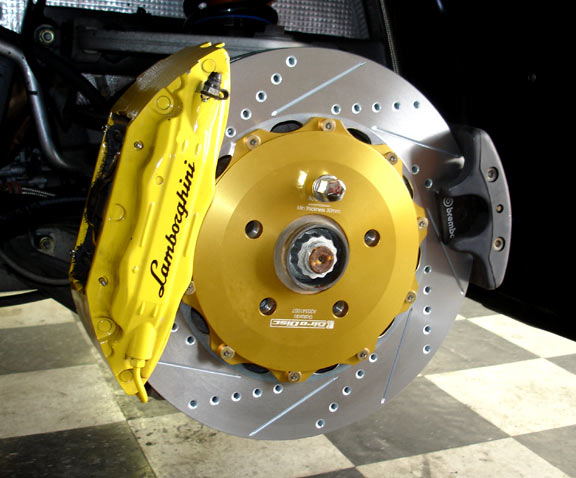
If you look at the rear brakes of a Gallardo they use a separate mechanical spot brake on the rear rotor.
Reply
0
0
No kidding.
My first car was a 1965 Mustang and it had a single circuit single reservoir master cylinder and an automatic transmission. I popped a brake line heading down a hill toward an intersection at a highway. I tried to shift into a lower gear but it wouldn't engage at that speed. Parking brake had never worked in that car. Its an auto, who needs a parking break? At the last second, the light turned green for the left turn so I took it wide and hung on for dear life. I made it through the intersection and coasted to a stop on the shoulder gravel. The next weekend I retrofitted a 1967 dual circuit master cylinder into the car, replaced all the rubber brake lines with stainless braid and replaced the parking brake cables.
Never Again.
My first car was a 1965 Mustang and it had a single circuit single reservoir master cylinder and an automatic transmission. I popped a brake line heading down a hill toward an intersection at a highway. I tried to shift into a lower gear but it wouldn't engage at that speed. Parking brake had never worked in that car. Its an auto, who needs a parking break?
At the last second, the light turned green for the left turn so I took it wide and hung on for dear life. I made it through the intersection and coasted to a stop on the shoulder gravel. The next weekend I retrofitted a 1967 dual circuit master cylinder into the car, replaced all the rubber brake lines with stainless braid and replaced the parking brake cables.Never Again.
Reply
0
0


