


The Better Bilstein Ebay Coilover Thread


A couple coil spring questions:
1) My plans for my DD are for stock ride height or possibly a little bit lower (probably no more than an inch), 300/200 lb/in rates. From reading the thread it sounds like 7" is the sweet spot for spring length, but I'm not sure if this only applies to folks with really high rates and/or really low cars. Would 7" springs still apply to a situation like mine?
2) What's the difference between QA1's "high travel" coil springs and their regular springs, and is there any benefit/disadvantage using the former in this application?
Thanks!
1) My plans for my DD are for stock ride height or possibly a little bit lower (probably no more than an inch), 300/200 lb/in rates. From reading the thread it sounds like 7" is the sweet spot for spring length, but I'm not sure if this only applies to folks with really high rates and/or really low cars. Would 7" springs still apply to a situation like mine?
2) What's the difference between QA1's "high travel" coil springs and their regular springs, and is there any benefit/disadvantage using the former in this application?
Thanks!
Reply
 0
0

0



1) With rates that low and a ride height up close to stock 7 or 8 inches will work. With a taller ride height greater compression travel is possible before contacting the bump stops so spring coil bind can be a concern if the springs are too short.
Reply
0
0

Senior Member
Joined: Aug 2014
Posts: 765
Total Cats: 257
From: North Carolina
QA1 High Travel springs have a lower fully compressed height (block height) than previous QA1 springs. Basically, more travel out of the same length spring. Compared to springs that aren't the cheapest you can buy from Summit, they probably still have a taller block height.
Reply
0
0
Senior Member
Joined: Aug 2014
Posts: 765
Total Cats: 257
From: North Carolina
Yes, you get more compression distance out of the same free length spring before coil bind. They're "High Travel" compared to previous QA1 designs, I have no doubt Eibachs or Hypercos are better in this regard.
Reply
0
0

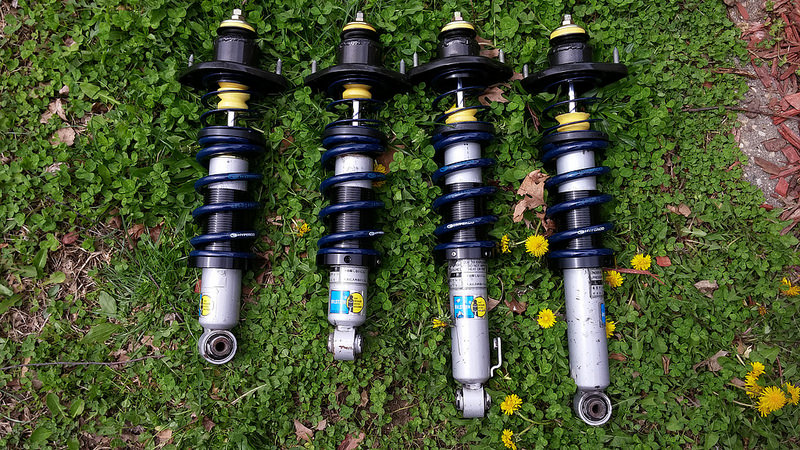
Finally assembled mine today, will install this weekend hopefully. They look hilariously legit, pics to follow in morning.
Only question: Helper/tender springs on top or bottom? Noticed hhammerly had his on top, didn't notice anyone else using them in this thread. At least not with pictures.
Only question: Helper/tender springs on top or bottom? Noticed hhammerly had his on top, didn't notice anyone else using them in this thread. At least not with pictures.
Reply
0
0

Finally assembled mine today, will install this weekend hopefully. They look hilariously legit, pics to follow in morning.
Only question: Helper/tender springs on top or bottom? Noticed hhammerly had his on top, didn't notice anyone else using them in this thread. At least not with pictures.
Only question: Helper/tender springs on top or bottom? Noticed hhammerly had his on top, didn't notice anyone else using them in this thread. At least not with pictures.
Helper Springs = used to maintain load on the main spring at full travel, placed at the bottom of the spring stack.
Tender Springs = are part of a dual rate spring system. The tender spring is open at normal load, and therefore it is still active, and closes at a predetermined load, are placed at the top of the spring pack.
You and I have the same Hyperco helper springs to keep the main coil seated. I have mine at the bottom.
Reply
0
0
Senior Member
Joined: Aug 2014
Posts: 765
Total Cats: 257
From: North Carolina
I don't see why there would be a difference in position based on spring rate. That said, I'd put them at the top. Once the helper/tender is inactive, it just is dead weight. It doesn't need to be dead unsprung weight.
Reply
0
0
As long as those rings in between have a shoulder to keep the springs aligned I don't really see it mattering which is on top. Do you have thrust bearings? I know the upper springs are short and wouldn't have a lot of rotation on compression, but it'd be much more frequent.
Reply
0
0
No thrust bearings. I do have ES poly isolators installed up top, and they're fairly slippery.  That's part of why i put them up there, so i wouldn't wear away anything metal on metal.
That's part of why i put them up there, so i wouldn't wear away anything metal on metal.
Reply
0
0
As long as those rings in between have a shoulder to keep the springs aligned I don't really see it mattering which is on top. Do you have thrust bearings? I know the upper springs are short and wouldn't have a lot of rotation on compression, but it'd be much more frequent.
Reply
0
0
^What he said.
To clarify, i haven't set height or anything on that setup. Those perches are going to come WAY up. The circlip has been dropped, and i don't even think that setup is installable as you see it pictured. If it WAS, it'd be a new Clubroadster legend due to ride height. Those little springs will be at least half compressed or more at full droop.
To clarify, i haven't set height or anything on that setup. Those perches are going to come WAY up. The circlip has been dropped, and i don't even think that setup is installable as you see it pictured. If it WAS, it'd be a new Clubroadster legend due to ride height.
Those little springs will be at least half compressed or more at full droop.
Reply
0
0
If they're helper springs, I agree. If they're tender springs, they won't always be in full compression.
Reply
0
0

Reply
0
0

I have helpers, the the rears are not fully compressed at static load to give me a more compliant dual rate setup, the rears where originally mounted on top of the main spring but were making noise as the ring that lines up he main to the helper spring was going over the top of the threaded perch so i flipped the spring so that the helper is on the bottom and that took care of the noise, i do not see a change in performance with this change.
Reply
0
0
I don't think my setup will ever compress far enough to bring that tender slider over the sleeves, but i could see it maybe making noise as it goes past the top of the shock, depending on how low i run the car. 
Reply
0
0
Like the ones I use; Ground Control - ERS coupler, 2.50 springs (Each)
Reply
0
0


