


Coilover Theory 101: Coil Spring Comparison


Thread Starter
Former Vendor
Joined: Feb 2017
Posts: 96
Total Cats: 49
 Coilover Theory 101: Coil Spring Comparison
Hey guys,
we get asked questions about coilovers, how they work, how they are manufactured, valving theory etc etc on a daily basis, so this gave me an idea; why not make a 101 separated into several, easy-to-read parts?
If you like where I am going with this, please do let me know and what "topics" you would like me to cover, and I'll see what I can do
one of the questions that we get asked quite often by our customers is what is the difference between Swift Springs and the generic Taiwan springs (found on nearly all non-European coilover kits), and what makes them so much more expensive?
to answer these questions, we decided to do a comparison test, and the results are below. What you make of these results, that's for you to decide:
Side-by-side comparison - Swift 7" 10K on the left, generic Taiwan 7" 10K on the right. Notice the difference?

Testing the Spring Rate accuracy on our Intercomp Spring Rate Tester, the Swift is exactly 10K:

And for the generic Taiwan spring, it comes in at 10.25K (15lbs stiffer than rated):

Both are pre-loaded 1" then compressed 1" to get the measurements. Can you say "coil-bind"?
Some have questioned us about the accuracy of the Intercomp Spring Rate Tester, so instead here is a dyno graph of a 100lb sample Swift Spring from our Roehrig Spring Rate Tester, showing the Spring Rate (lbs/in) over an increasing compression force (lbs):

For the weight test, the Swift comes in at 1.1kg:

And the generic Taiwan spring comes in at 1.6kg:

The conclusion from all of these tests? Not only are Swift Springs 50% lighter and extremely accurate (you ask for 10K, you get exactly 10K), they also help reduce coil-bind (i.e the coils hitting each other over large bumps). The Taiwan spring? Maybe after 6 months of driving, it will finally be 10K, then 6 months later, 9K!
I've deliberately made this post short and sweet, so as to encourage questions, so if you have any, please feel free to ask!
we get asked questions about coilovers, how they work, how they are manufactured, valving theory etc etc on a daily basis, so this gave me an idea; why not make a 101 separated into several, easy-to-read parts?
If you like where I am going with this, please do let me know and what "topics" you would like me to cover, and I'll see what I can do
one of the questions that we get asked quite often by our customers is what is the difference between Swift Springs and the generic Taiwan springs (found on nearly all non-European coilover kits), and what makes them so much more expensive?
to answer these questions, we decided to do a comparison test, and the results are below. What you make of these results, that's for you to decide:
Side-by-side comparison - Swift 7" 10K on the left, generic Taiwan 7" 10K on the right. Notice the difference?
Testing the Spring Rate accuracy on our Intercomp Spring Rate Tester, the Swift is exactly 10K:
And for the generic Taiwan spring, it comes in at 10.25K (15lbs stiffer than rated):
Both are pre-loaded 1" then compressed 1" to get the measurements. Can you say "coil-bind"?
Some have questioned us about the accuracy of the Intercomp Spring Rate Tester, so instead here is a dyno graph of a 100lb sample Swift Spring from our Roehrig Spring Rate Tester, showing the Spring Rate (lbs/in) over an increasing compression force (lbs):
For the weight test, the Swift comes in at 1.1kg:
And the generic Taiwan spring comes in at 1.6kg:
The conclusion from all of these tests? Not only are Swift Springs 50% lighter and extremely accurate (you ask for 10K, you get exactly 10K), they also help reduce coil-bind (i.e the coils hitting each other over large bumps). The Taiwan spring? Maybe after 6 months of driving, it will finally be 10K, then 6 months later, 9K!
I've deliberately made this post short and sweet, so as to encourage questions, so if you have any, please feel free to ask!
Reply
 7
7

7


Thread Starter
Former Vendor
Joined: Feb 2017
Posts: 96
Total Cats: 49

I'll be doing some tests on older/used springs, as well as other brands, so I can post those up as and when as well, if the community wants me to
We're an official Ohlins service centre, so get quite a lot in to rebuild, although the results would just be the same as either the Eibach or Eibach Pro's that they use/re-brand.
We're an official Ohlins service centre, so get quite a lot in to rebuild, although the results would just be the same as either the Eibach or Eibach Pro's that they use/re-brand.
Reply
0
0




Joined: Sep 2005
Posts: 34,430
Total Cats: 7,548
From: Chicago. (The less-murder part.)
1 lb = .454 kg, and 1 in = 25.4 mm.
Beyond that, it's just math. Several online calculators and charts exist to ease the conversion. Example: https://www.redline360.com/garage/sp...-kgmm-to-lbsin
kg/mm to lbs/in
-----------------------------
16 = 896
15 = 840
14 = 784
13 = 728
12 = 672
11 = 616
10 = 560
9.0 = 504
8.5 = 476
8.0 = 448
7.5 = 420
7.0 = 392
6.5 = 364
6.0 = 336
5.5 = 308
5.0 = 280
4.5 = 252
4.0 = 224
3.0 = 168
2.0 = 112
From the above chart, 557 lbs / in equals 10 kg / mm for all practical purposes.
Reply
2
2

Junior Member
Joined: Jan 2015
Posts: 190
Total Cats: 20
Reply
0
0
Thread Starter
Former Vendor
Joined: Feb 2017
Posts: 96
Total Cats: 49
We will be testing different rates, different brands and different degrees of mileage, which will provide more data for you guys to ponder over. Again, any conclusions from the data provided in this thread is done by you, not by me; I'm just providing the data (which is still under question whether you guys want me to continue or not)
Reply
0
0


Great Thread. Thanks for doing this. Perhaps some comparison between the various springs used between the DIY bilstein crowd. A lot of these builds have everything from "ebay specials" to summit brand, qa1, hyperco and even swift springs. Would probably be helpful for us in determining which springs to go with there.
Reply
1
1
Thread Starter
Former Vendor
Joined: Feb 2017
Posts: 96
Total Cats: 49
Great Thread. Thanks for doing this. Perhaps some comparison between the various springs used between the DIY bilstein crowd. A lot of these builds have everything from "ebay specials" to summit brand, qa1, hyperco and even swift springs. Would probably be helpful for us in determining which springs to go with there.
Reply
0
0



That was a 15lb difference which is a 2.7% difference. But you raise a very good point, exactly at what point does the margin of error result in a slower race car or at least noticable handing issues?
Reply
0
0
Thread Starter
Former Vendor
Joined: Feb 2017
Posts: 96
Total Cats: 49
The point that hopefully was being made here was that it isn't about the actual difference in this particular test, but more about "consistency". Of course, I would need to run more tests to prove that point. It's coming, I just need to find the spare time to do it.
If the spring rate is consistent between springs (which Swift themselves guarantee), then you don't have to worry about your dampers/springs not being matched. Basically, you have 4 springs on your vehicle and if they are all slightly different rates, that is never a good thing. Also, your dampers are valved to your vehicle setup and spring rate (well, they should be anyway. That is what I'm planning on writing up in the 2nd part of the 101)
If the spring rate is consistent between springs (which Swift themselves guarantee), then you don't have to worry about your dampers/springs not being matched. Basically, you have 4 springs on your vehicle and if they are all slightly different rates, that is never a good thing. Also, your dampers are valved to your vehicle setup and spring rate (well, they should be anyway. That is what I'm planning on writing up in the 2nd part of the 101)
Reply
1
1
Elite Member

Joined: Sep 2015
Posts: 1,654
Total Cats: 887
From: Seattle, WA
That's awesome that you'll be doing some of the other brands. (I have summit brand springs on my budget bilsteins because I was being as cheap as possible on my daily) I'm looking forward to your results and how they all measure up. I wasn't very surprised but Swift being right on the spring rate, I was surprised by the .5kg lighter, that's a pretty decent difference
Reply
0
0

Joined: Jun 2005
Posts: 19,338
Total Cats: 574
From: Fake Virginia
While you're educating, why not delve into why the swift is fewer coils and the taiwan is more coils. Is it material? wire diameter (hard to see a difference, but paint thickness may be different too)? or both?
Reply
0
0
Thread Starter
Former Vendor
Joined: Feb 2017
Posts: 96
Total Cats: 49
Sorry if that wasn't the reply you wanted. I've just been blasted on another forum, accusing me of blatantly advertising Swift Springs...
Reply
0
0
Thread Starter
Former Vendor
Joined: Feb 2017
Posts: 96
Total Cats: 49
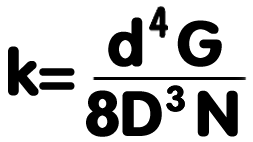
So from that formula, with "k", "d" and "D", being equal, in order to get the same "k", a spring with a lower "G" will require a higher number of "N"? Or the other way around?
Reply
0
0

Lower shear modulus (lower G) = less torsionally stiff wire = fewer wraps to match spring rate (lower N), all else being equal.
Reply
0
0


