


Tell me if this DIY spring rate tester will work





Having said all this, I still need to come up with data such as number of coils and coil spacing for an 8" spring with an inside diameter of 2.5".
Desired spring rate is 300, 275 and 225 lbs, respectively.
Available wire diameters are 8, 8.5, 9, 9.5, 10 and 10.5 mm. (Al spring steel)
Desired spring rate is 300, 275 and 225 lbs, respectively.
Available wire diameters are 8, 8.5, 9, 9.5, 10 and 10.5 mm. (Al spring steel)
Reply
 0
0

0

Thread Starter
Joined: Jun 2009
Posts: 3,227
Total Cats: 1,707
From: Istanbul, Turkey
But seriously. I think that the mathematical approach is probably going to yield more accurate answers than something involving a bathroom scale. The basic idea behind the scale contraption is a sound one, but I don't think I'd go that way myself from a practical standpoint.
Reply
0
0
Thread Starter
Joined: Jun 2009
Posts: 3,227
Total Cats: 1,707
From: Istanbul, Turkey
Reply
0
0



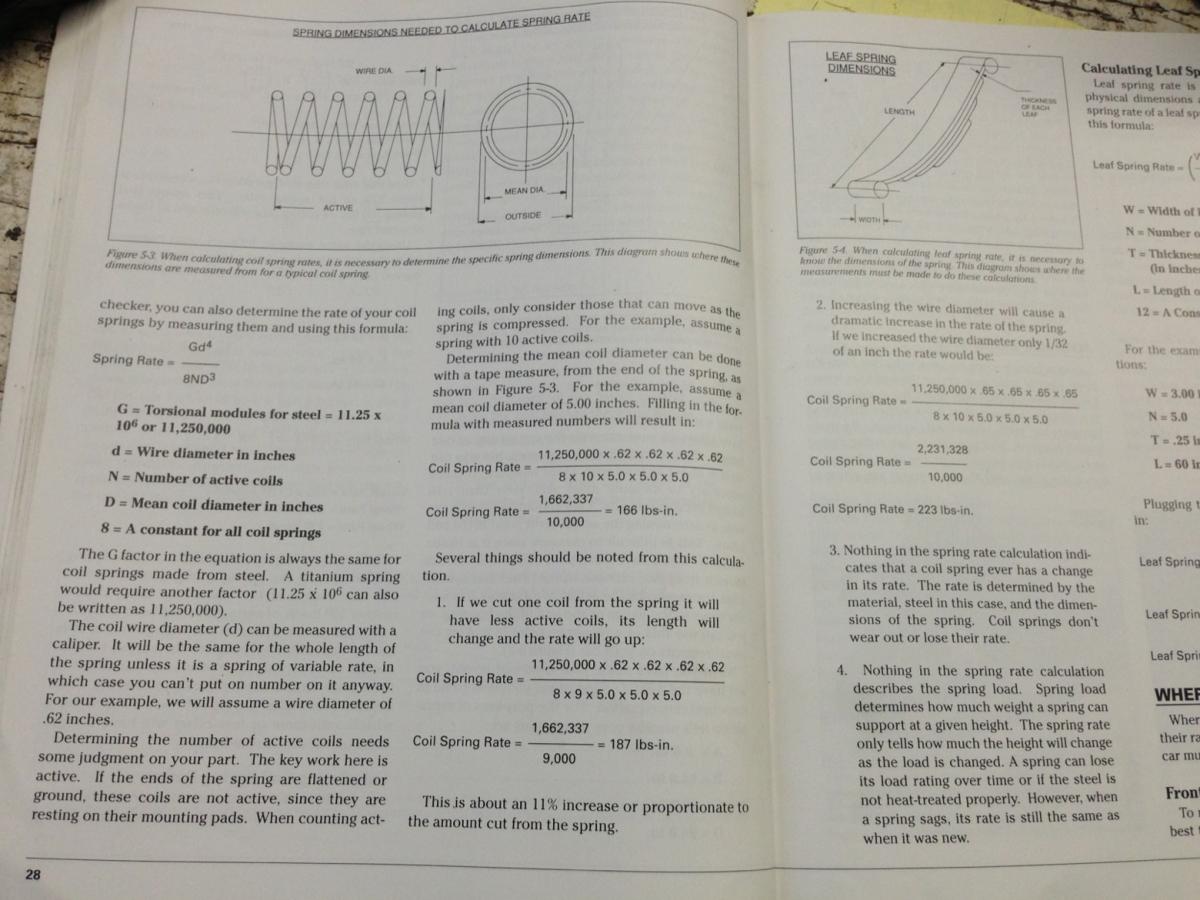
I have a better idea. Use mathematics and a set of dial calipers to do it the right way. A formula exists for determining spring rates. I've seen it published a number of times, including in the book by Herb Adams called "Chassis Engineering". I'm sure it is on teh interwebz somewhere.
Suspension Coil Spring Rate Design Equations Formulas Calculator
Another one:Spring Constant Calculator
Another one: Helical Spring Calculators - Spring Index, Spring Rate, Shear Stress, Deflection
Another one: Coil Spring Rate Calculations by Wallace Racing
FORMULA:
spring rate =
modulus of spring steel X wire diameter^4
--------------------------------------------------------------------
8 X number of active coils X mean coil diameter^3
*modulus of spring steel = 11,250,000 pounds/inch^2 = 78,500 newtons/millimeter^2
I have successfully tested this formula on stock Miata springs of a known rate and aftermarket springs of a known rate. I then used it to determine the approximate rates of some additional springs I had around. The modulus of spring steel is a constant.
Suspension Coil Spring Rate Design Equations Formulas Calculator
Another one:Spring Constant Calculator
Another one: Helical Spring Calculators - Spring Index, Spring Rate, Shear Stress, Deflection
Another one: Coil Spring Rate Calculations by Wallace Racing
FORMULA:
spring rate =
modulus of spring steel X wire diameter^4
--------------------------------------------------------------------
8 X number of active coils X mean coil diameter^3
*modulus of spring steel = 11,250,000 pounds/inch^2 = 78,500 newtons/millimeter^2
I have successfully tested this formula on stock Miata springs of a known rate and aftermarket springs of a known rate. I then used it to determine the approximate rates of some additional springs I had around. The modulus of spring steel is a constant.
The Herb Adams book gets a regular workout around here-
Here are the pages that cover it.. If anybody wants hi-res pics of them just pm me your email address.
Reply
0
0
Thread Starter
Joined: Jun 2009
Posts: 3,227
Total Cats: 1,707
From: Istanbul, Turkey

Reply
0
0


Elite Member
Joined: Jul 2005
Posts: 6,420
Total Cats: 84
I have a better idea. Use mathematics and a set of dial calipers to do it the right way. A formula exists for determining spring rates. I've seen it published a number of times, including in the book by Herb Adams called "Chassis Engineering". I'm sure it is on teh interwebz somewhere.
Suspension Coil Spring Rate Design Equations Formulas Calculator
Suspension Coil Spring Rate Design Equations Formulas Calculator
Reply
0
0

20ft.lb on a 500ft.lb spring. It will at least put him in the ballpark. If they were decent springs they'd be labeled anyway.
Reply
0
0

Joined: Jun 2005
Posts: 19,338
Total Cats: 574
From: Fake Virginia
Reply
0
0

As others have eluded to, the other factors you have mentioned will only lead to small errors in the calculation.
I would recommend doing both if you are deadset on making a spring compressor testing rig-a-ma-jig. Do the calculation on at least the first few springs you test to validate your test jig.
Have fun
Reply
0
0


Thread
Thread Starter
Forum
Replies
Last Post
Zaphod
MEGAsquirt
47
Oct 26, 2018 11:00 PM
russian
Miata parts for sale/trade
6
Oct 8, 2015 03:01 PM


