


Mechanical engineers: help me calculate stuff.


Thread Starter


Joined: Sep 2005
Posts: 34,402
Total Cats: 7,523
From: Chicago. (The less-murder part.)
 Mechanical engineers: help me calculate stuff.
Such as how much HP does it take to move an NA down the highway at a constant 50 MPH on level ground, assuming ordinary all-season tires in the ~195 width range.
With the top up / down?
With the headlights up / down?
What about 65 MPH?
Etc.
With the top up / down?
With the headlights up / down?
What about 65 MPH?
Etc.
Reply
 0
0

0

Junior Member
Joined: Nov 2007
Posts: 53
Total Cats: 2
From: Monterey Bay area
Reply
0
0

Senior Member
Joined: Jul 2014
Posts: 1,407
Total Cats: 760
From: Milwaukee, WI
It all depends on the coefficient of drag on the car, which can be then converted into a force, which can then be converted into power/torque
so unless someone has the experimental C_d values for what your looking for from full scale model testing, then your guess is as good as mine. Even then its going to differ from real-world results
I mean, how accurate of an answer are you looking for?
so unless someone has the experimental C_d values for what your looking for from full scale model testing, then your guess is as good as mine. Even then its going to differ from real-world results
I mean, how accurate of an answer are you looking for?
Reply
0
0


Doesn't MS have a HP readout given the required sensor inputs? I feel like dataloging that once its calibrated would give the best answer for your brake drag, bearing condition, headlight gaps, etc etc
Reply
0
0

Senior Member
Joined: Jul 2014
Posts: 1,407
Total Cats: 760
From: Milwaukee, WI
this calculator has the basic necessities included on an accurate estimation
Aerodynamic & rolling resistance, power & MPG calculator - EcoModder.com
Aerodynamic & rolling resistance, power & MPG calculator - EcoModder.com
Reply
0
0
Senior Member
Joined: Jul 2014
Posts: 1,407
Total Cats: 760
From: Milwaukee, WI
Drag Force = .5 * Drag Coefficient * Velocity^2 * Frontal Area * Air Density
^this can be converted to power fairly easily if all the variables are known
Estimated Engine HP based off MS = some complex function of the sensors given calibration is accurate. The uncertainty in this I'd imagine would be pretty high, but then again it should give you a ballpark
Reply
0
0

Calculate HP For Speed
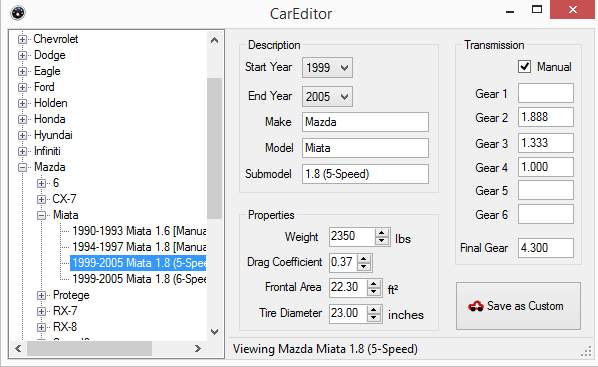
Top down drag coefficient is .46, which means that 50mph takes 10.9 hp
Top up drag coefficient of .38 means 50mph takes 9.69 hp
Reply
0
0

That algorithm relies on acceleration. You can get the drag force empirically by doing a cost down test from 80 to 60mph and then get the rolling friction force by doing a coast down test from below 40 to like 10 mph. And thats just some math. And once you have that you can do your calculations on the horsepower required.
Reply
0
0


That algorithm relies on acceleration. You can get the drag force empirically by doing a cost down test from 80 to 60mph and then get the rolling friction force by doing a coast down test from below 40 to like 10 mph. And thats just some math. And once you have that you can do your calculations on the horsepower required.
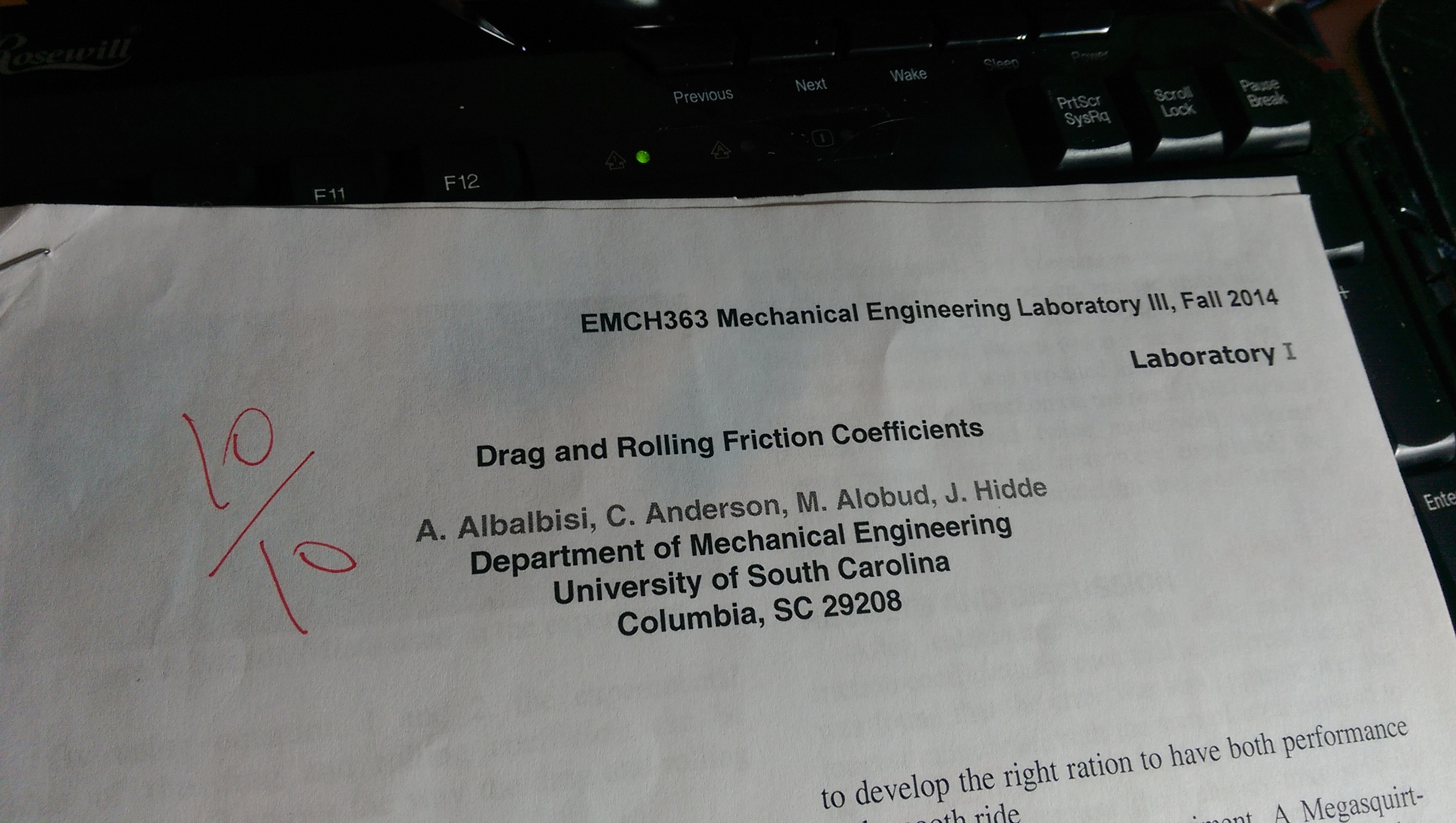
EDIT: For the record, I did not write the paragraph seen there using the word "ration"
Reply
0
0




That algorithm relies on acceleration. You can get the drag force empirically by doing a cost down test from 80 to 60mph and then get the rolling friction force by doing a coast down test from below 40 to like 10 mph. And thats just some math. And once you have that you can do your calculations on the horsepower required.
The TL;DR process is in red.
For the rolling resistance, hook a force gauge up to a strap that is connected to the front tie down hooks. Pull the car from a stop using the force gauge, as close to parallel to the ground as possible. This has to be done on a smooth surface that is level. At a steady 1mph or so, record the steady state force reading, just make sure that you are not accelerating or slowing down, this will greatly affect the readings. This is your rolling resistance in Lbs.
Perform a coast down test at a relatively high speed, such as 70-40mph. Knowing the weight of the car as well as the frontal area and other parameters, subtract the rolling resistance from the resistance calculated from the high speed tests, this will tell you the aero drag force, and from this you can find the coefficient of drag.
Using the information above with the calculations you guys posted, you can find out approximately how much HP is needed to go a certain speed.
Keep in mind, when you find this HP rating, this is the raw HP needed to accomplish this speed, it does not take any driveline or other losses into account. So if you are doing some project like trying to do a EV conversion and want to know how powerful the motor needs to be to achieve a certain speed, take a conservative estimate of the losses and go from there.
Long winded, but hope this helps.
Reply
0
0

Reply
0
0


Reply
0
0


