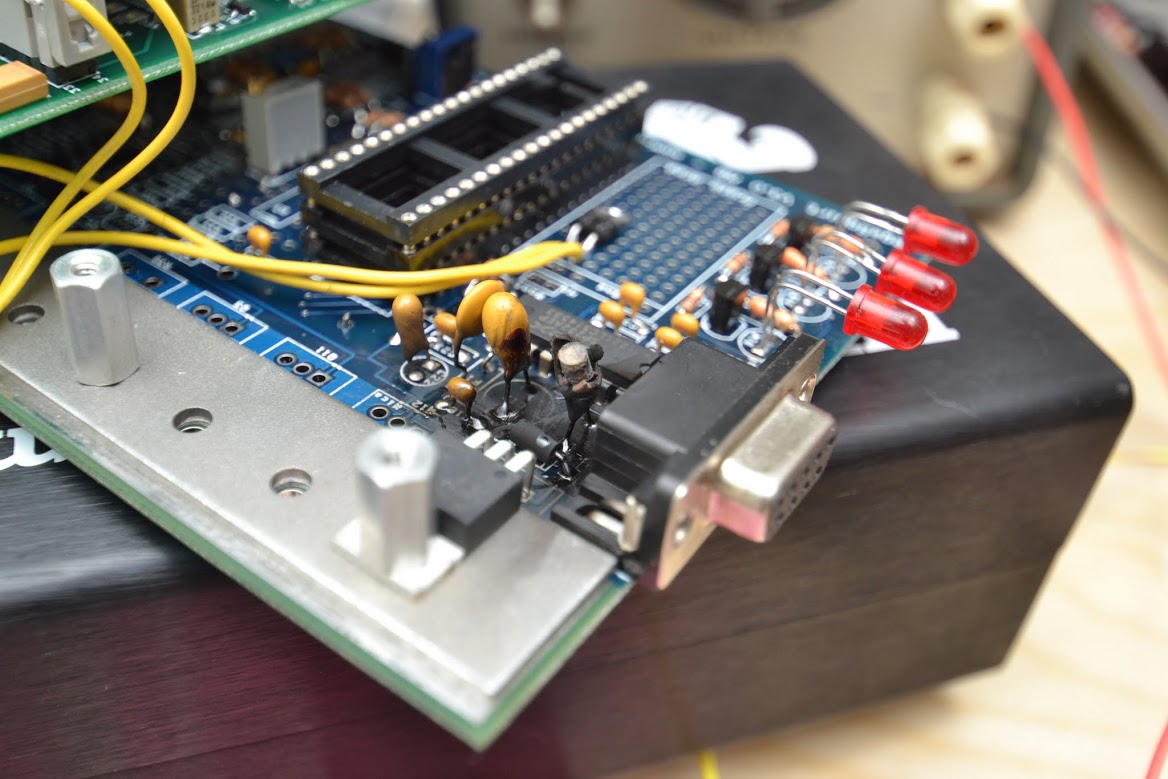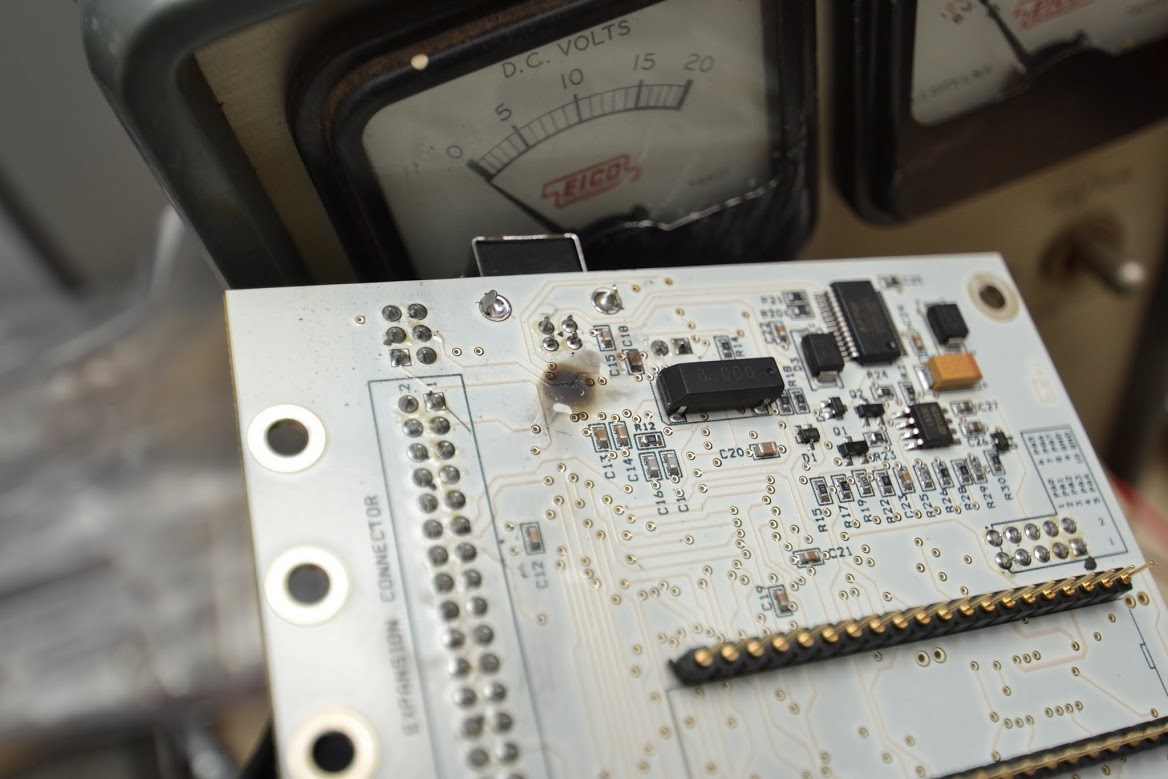


C16 exploded, carnage inside


Thread Starter
Senior Member
iTrader: (1)
Joined: Dec 2007
Posts: 1,036
Total Cats: 495
From: San Jose

Looked over the MS3 board a little more carefully.
Should these pins be bridged like this? There are some other pins on the opposite side that aren't quite bridged, but that definitely have solder trails that are nearly touching.

Should these pins be bridged like this? There are some other pins on the opposite side that aren't quite bridged, but that definitely have solder trails that are nearly touching.
Reply
 0
0

0


Reply
0
0



I can look again, but it appears one goes to JP2 on the FLEX pin and the other to the CPU.
If it was a power and a ground I could see c16 blowing up from it.
the CPU pins are supossed to be like that, those are grounds.
If it was a power and a ground I could see c16 blowing up from it.
the CPU pins are supossed to be like that, those are grounds.
Reply
0
0

Elite Member
Joined: Jul 2005
Posts: 6,420
Total Cats: 84
A backwards-inserted 'lytic cap can see reverse voltage and will heat up, stew, and finally vent and/or explode, often leaving behind telltale capacitor confetti and the unmistakable stench of disemboweled electrolytic guts.
I've had cans rocket past my scalp more than once. (Rocketing was more common in the old days) I've since learned to power up a new circuit for just a few seconds, power down, then check for hot parts with a thermal camera. Before the advent of the latter I'd use a finger, carefully.
I've had cans rocket past my scalp more than once. (Rocketing was more common in the old days) I've since learned to power up a new circuit for just a few seconds, power down, then check for hot parts with a thermal camera. Before the advent of the latter I'd use a finger, carefully.
Reply
0
0
I like to run the MSes I build on the jimstim for a good long while if I cant test on my car, both units I've ever built that lost C16 only blew once installed on a car, and pretty much instantly roasted.
One happened on my car, I heard a pop during cranking (it would not quite catch) and smelled burning.
One happened on my car, I heard a pop during cranking (it would not quite catch) and smelled burning.
Reply
0
0
Thread Starter
Senior Member
iTrader: (1)
Joined: Dec 2007
Posts: 1,036
Total Cats: 495
From: San Jose
A backwards-inserted 'lytic cap can see reverse voltage and will heat up, stew, and finally vent and/or explode, often leaving behind telltale capacitor confetti and the unmistakable stench of disemboweled electrolytic guts.
I've had cans rocket past my scalp more than once. (Rocketing was more common in the old days) I've since learned to power up a new circuit for just a few seconds, power down, then check for hot parts with a thermal camera. Before the advent of the latter I'd use a finger, carefully.
I've had cans rocket past my scalp more than once. (Rocketing was more common in the old days) I've since learned to power up a new circuit for just a few seconds, power down, then check for hot parts with a thermal camera. Before the advent of the latter I'd use a finger, carefully.
This board ran perfectly on the JimStim, without CPU, for several minutes while I was checking voltages and adjusting pots. Then it ran again for quite a while with the MS3 + X board while I screwed with R11. Interestingly, no matter how I screwed with R11, the voltage on the lower leg of R17 refused to move. It was (IIRC) 2.6v, I wanted 2.75v to be in the middle of the 2.5-3v range, but after a while I gave up. Perhaps this was a result of the bridged vias? Hmm.
Then again, if one of the vias was an output and was suddenly configured, and the other represented a short to that configuration, that could have done it. Of course that would mean a bunch of current probably went through my CPU...ugh.
Reply
0
0
clean up the solder and you can power up on the jimstim without c16 inplace. if you cant connect, you know the CPU is fried.
but I have a feeling it's still okay; when the CPU fries, it's instant. Blowing up c16 takes some time for the circuit ot get hot and explode things.
but I have a feeling it's still okay; when the CPU fries, it's instant. Blowing up c16 takes some time for the circuit ot get hot and explode things.
Reply
0
0


Joined: Sep 2005
Posts: 34,402
Total Cats: 7,523
From: Chicago. (The less-murder part.)
I've had cans rocket past my scalp more than once. (Rocketing was more common in the old days)
Reply
0
0
Thread Starter
Senior Member
iTrader: (1)
Joined: Dec 2007
Posts: 1,036
Total Cats: 495
From: San Jose
clean up the solder and you can power up on the jimstim without c16 inplace. if you cant connect, you know the CPU is fried.
but I have a feeling it's still okay; when the CPU fries, it's instant. Blowing up c16 takes some time for the circuit ot get hot and explode things.
but I have a feeling it's still okay; when the CPU fries, it's instant. Blowing up c16 takes some time for the circuit ot get hot and explode things.
I don't think I've said it explicitly yet, but thanks to everyone who's chipped in here, even if I didn't reference you personally. Y'all are impressive electronics geeks.
Reply
0
0
Elite Member
Joined: Jul 2005
Posts: 6,420
Total Cats: 84
I don't like tantalums and will avoid using them when possible. They are also poor in the life and reliability department. If you need low ESR and some capacitance use a polymer cap (aka "solid electrolyte" formerly known as "OsCon"). If you don't need so much capacitance use a multilayer ceramic ("MLCC").
Reply
0
0
Elite Member
Joined: Jul 2005
Posts: 6,420
Total Cats: 84
I see the value is about 35 uF. You would use an X5R (MLCC) cap instead of a tant. They're available in a 1206 package:
C3216X5R1E476M160AC TDK Corporation | 445-8047-6-ND | DigiKey
Or you can get this through hole guy:
http://www.digikey.com/product-detai...108-ND/2603953
Ceramic caps can take brief overvoltages no prob.
C3216X5R1E476M160AC TDK Corporation | 445-8047-6-ND | DigiKey
Or you can get this through hole guy:
http://www.digikey.com/product-detai...108-ND/2603953
Ceramic caps can take brief overvoltages no prob.
Last edited by JasonC SBB; Jan 30, 2013 at 12:42 AM.
Reply
0
0
Joined: Sep 2005
Posts: 34,402
Total Cats: 7,523
From: Chicago. (The less-murder part.)
Tantalums are sensitive little bastards- they get butt-hurt real quick if you over-volt them or subject them to reverse polarity. So we blow a lot of 'em up in the lab while prototyping and bringing up new products for the first time.
But in normal operation, they have proven to be exceedingly reliable. I can't recall ever having any serious problems with them. We've been using 'em in our audio consoles and routers for at least 15 years. A lot of our stuff is now old enough that it's starting to come back in for repair with dried-out electrolytics, but I don't think we've ever seen a systemic issue with tantalums.
FWIW, I don't see any ESR spec on that unit you posted.
Reply
0
0
Elite Member
Joined: Jul 2005
Posts: 6,420
Total Cats: 84
Ceramics have no meaningful ESR (i.e. zero) for the majority of applications. (high current high frequency SMPS output stages are one exception, in some cases).
What you gotta watch out for is their capacitance changes hugely with voltage. For power supply bypassing, it's not a problem.
Tants need voltage derating to increase their life.
IIRC they are sensitive to overheating and like to explode, from ripple (AC) current.
CTTOI if the OP powered his board from a bench supply which for some reason was oscillating, that tant ate lots of ripple current and expressed its displeasure.
What you gotta watch out for is their capacitance changes hugely with voltage. For power supply bypassing, it's not a problem.
Tants need voltage derating to increase their life.
IIRC they are sensitive to overheating and like to explode, from ripple (AC) current.
CTTOI if the OP powered his board from a bench supply which for some reason was oscillating, that tant ate lots of ripple current and expressed its displeasure.
Reply
0
0
Elite Member
Joined: Jul 2005
Posts: 6,420
Total Cats: 84
For my own education I looked up some 100 uF / 16V tantalums. The low-ESR ones form Vishay can only take 1 A, with 100 mΩ ESR. In contrast the mid-perf polymer Nichicon caps are 14 mΩ and can take >3A, with their bigger hi-current ones, capable of 5.6A with 7 mΩ. These solid electrolyte polymer caps make the highest perfromance 'lytics look wimpy, and have much longer life to boot.
Reply
0
0
Thread Starter
Senior Member
iTrader: (1)
Joined: Dec 2007
Posts: 1,036
Total Cats: 495
From: San Jose
Success! Got my new caps from DigiKey today, got them installed and tested everything out very, very carefully. Worked perfectly! It took the firmware no problemo and I've loaded Frank's 01 base MSQ (thanks Frank!).
Only issue I have now is the endplate fit. Even though my MS3 board is fully seated in the layers of standoffs, the USB port is maybe 1/8" too high to fit through the endplate. Is this common? I figured I'd borrow a file at work tomorrow and trim it up, but that seems a shame.
Very relieved that this worked out, very unhappy that QC failed so miserably on this card.
Again, thanks to everyone!
Only issue I have now is the endplate fit. Even though my MS3 board is fully seated in the layers of standoffs, the USB port is maybe 1/8" too high to fit through the endplate. Is this common? I figured I'd borrow a file at work tomorrow and trim it up, but that seems a shame.
Very relieved that this worked out, very unhappy that QC failed so miserably on this card.
Again, thanks to everyone!
Reply
0
0

Actually I talked to Ben over the weekend, he said he'll push to get higher rated caps when their current supply run out. however, he also said they are really only seeing this in our community, because gaycar.
Reply
0
0