


Stock ECU VE table



Joined: Oct 2007
Posts: 6,029
Total Cats: 305
From: The coal ridden hills of Pennsylvania

I wondered about this a long time ago. I think in the early days of MiataTurbo.net, somebody (for some stupid reason I think maybe Joe Perez?) built a Megasquirt just for datalogging purposes and logged the stock ECU spark and fueling.
I do remember reading about it in 07 or 08 I think. I know somebody did this...
Why exactly would you want to know the stock ECU VE table though?
I do remember reading about it in 07 or 08 I think. I know somebody did this...
Why exactly would you want to know the stock ECU VE table though?
Reply
 0
0

0

Thread Starter
Junior Member
iTrader: (1)
Joined: Dec 2010
Posts: 279
Total Cats: 3
From: Knoxville, TN
I wondered about this a long time ago. I think in the early days of MiataTurbo.net, somebody (for some stupid reason I think maybe Joe Perez?) built a Megasquirt just for datalogging purposes and logged the stock ECU spark and fueling.
I do remember reading about it in 07 or 08 I think. I know somebody did this...
Why exactly would you want to know the stock ECU VE table though?
I do remember reading about it in 07 or 08 I think. I know somebody did this...
Why exactly would you want to know the stock ECU VE table though?
my thought was to duplicate the OEM VE table for the <100kPa part of my VE table to regain the benefit of that development; initial issues would be accommodating the change in exhaust back pressure, higher capacity fuel delivery, larger injectors, ... [so much for blindly duplicating the stock settings--lol]
I just think the stock settings would be a good starting reference
Reply
0
0

Something to keep in mind is that oem ecus often have multiple tables for both fuel and spark that they can switch between to optimize operation based on conditions (anyone know if the miata ecu is like this?). You may not have the hardware to replicate this functionality.
Aside from that it doesn't sound like a terrible place to start.
Aside from that it doesn't sound like a terrible place to start.
Reply
0
0

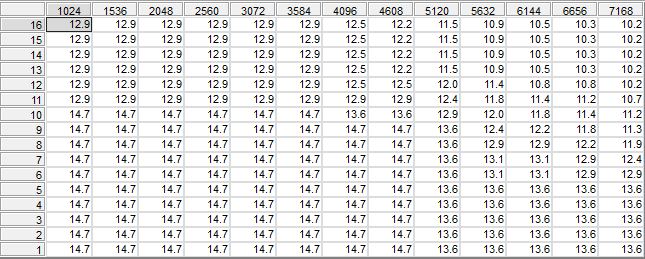

Stock ECU doesnt have a "VE" table, because its not speed density, its mass airflow.
Which means that the fuel table looks like what Sclippy posted, target AFRs which are referenced against the MAF curve to calculate how much fuel to deliver.
Which means that the fuel table looks like what Sclippy posted, target AFRs which are referenced against the MAF curve to calculate how much fuel to deliver.
Reply
0
0
Thread Starter
Junior Member
iTrader: (1)
Joined: Dec 2010
Posts: 279
Total Cats: 3
From: Knoxville, TN
yes looks like an AFR table with rpm across the top
now how to decode the vertical scale
interesting break between step 10 and 11
good point on the mass flow basis
means looking at the ECU code for calculating fuel quantity
I am thinking the mass flow system is more dynamic [continuous] than the speed density system with the required fuel being calculated based on a number of sensor values; whereas the speed density system determines fuel need by interpolating between fixed reference values from the VE table
think I will snoop some on the m.net postings
now how to decode the vertical scale
interesting break between step 10 and 11
good point on the mass flow basis
means looking at the ECU code for calculating fuel quantity
I am thinking the mass flow system is more dynamic [continuous] than the speed density system with the required fuel being calculated based on a number of sensor values; whereas the speed density system determines fuel need by interpolating between fixed reference values from the VE table
think I will snoop some on the m.net postings
Reply
0
0

I'm Miserable!
Joined: Jun 2009
Posts: 1,866
Total Cats: 0
From: albany, ga
a SD setup requires alot more inputs to do final fuel calucations then a MAF system.
You won't be able to really interpolate them because load on a maf system differs from that of a speed density setup.
The vertical scale is load based on engine output\tq
You can watch the load scale to see how efficient your engine is.
the maf itself is based on airflow\horse power
Unless of course you run megasquirt on a maf.
More then likely that table is more of a closed loop commanded afr table.
I wonder though what their power enrichment table looks like.
I also wonder how much spark timing they drop if any on shifting
You won't be able to really interpolate them because load on a maf system differs from that of a speed density setup.
The vertical scale is load based on engine output\tq
You can watch the load scale to see how efficient your engine is.
the maf itself is based on airflow\horse power
Unless of course you run megasquirt on a maf.
More then likely that table is more of a closed loop commanded afr table.
I wonder though what their power enrichment table looks like.
I also wonder how much spark timing they drop if any on shifting
Last edited by Techsalvager; Apr 12, 2012 at 08:21 AM.
Reply
0
0

I wonder how they could ever target anything other than 14.7 with a narrow band O2.
I doubt that table is a stock Mazda OEM table. Doesn't make sense given the sensors on the car.
I doubt that table is a stock Mazda OEM table. Doesn't make sense given the sensors on the car.
Reply
0
0

Joined: Jun 2006
Posts: 29,085
Total Cats: 375
From: Republic of Dallas
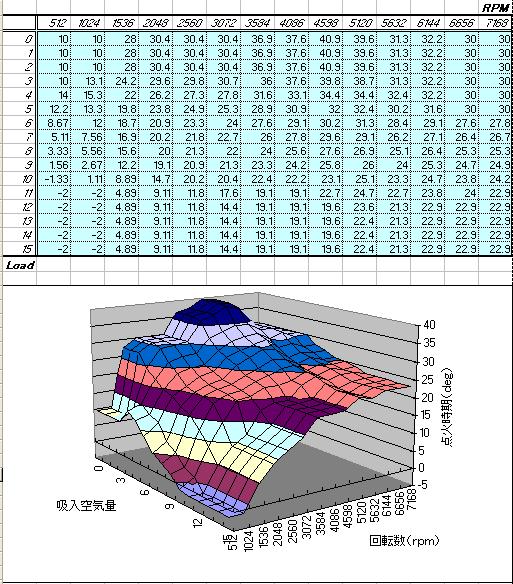
What I really want to see is the spark table.
Reply
0
0


Elite Member
Joined: Jul 2005
Posts: 6,420
Total Cats: 84
I doubt that table is a stock Mazda OEM table. Doesn't make sense given the sensors on the car.
It looks like this:
AFM voltage -> lookup table to output airflow -> divided by RPM to get VE (this is the Y axis)
Last edited by JasonC SBB; Apr 12, 2012 at 12:00 PM.
Reply
0
0
I'm Miserable!
Joined: Jun 2009
Posts: 1,866
Total Cats: 0
From: albany, ga
y axis is a load percentage on maf based systems if it was N\a engine you would probably see around 85-95 at max load depending on engine setup. like I said before at WOT with a maf based system it doesn't go to 100 on an N\A engine like it would on a SD setup. it follows tq output, so you can easily see when your tq has peaked and then just watch maf to see when the hp peaks out.
hustler that because its not geared for a SD setup.
on the highway I cruise at 20-30 load. light accel between 30-60, idle is around 14-18.
hustler that because its not geared for a SD setup.
on the highway I cruise at 20-30 load. light accel between 30-60, idle is around 14-18.
Reply
0
0
Joined: Jun 2006
Posts: 29,085
Total Cats: 375
From: Republic of Dallas
y axis is a load percentage on maf based systems if it was N\a engine you would probably see around 85-95 at max load depending on engine setup. like I said before at WOT with a maf based system it doesn't go to 100 on an N\A engine like it would on a SD setup. it follows tq output, so you can easily see when your tq has peaked and then just watch maf to see when the hp peaks out.
hustler that because its not geared for a SD setup.
on the highway I cruise at 20-30 load. light accel between 30-60, idle is around 14-18.
hustler that because its not geared for a SD setup.
on the highway I cruise at 20-30 load. light accel between 30-60, idle is around 14-18.
Reply
0
0
Elite Member
Joined: Jul 2005
Posts: 6,420
Total Cats: 84
MAF gives you airflow in lbs/min. "Load" and torque are proportional to air consumption in lbs per revolution, aka amount of air ingested per cycles, aka V.E. To go from MAF to VE, you need to divide by RPM. The resulting table will be very similar to a VE table driven by RPM and MAP.
Reply
0
0



at 5.5K where the timing drops, is due to the increase in fueling...so take that into account.
I'm sure Reverant already has all this data pulled from "stiming" the stock ECUs.
I'm sure Reverant already has all this data pulled from "stiming" the stock ECUs.
Reply
0
0


