


The AI-generated cat pictures thread






Joined: Sep 2005
Posts: 34,415
Total Cats: 7,531
From: Chicago. (The less-murder part.)

I didn't say there was no plot, I said they were shitty movies. And furthermore, I'm ashamed that I didn't burn (with fire) my DVD copies of them before out 4 year old could discover them. He now prefers II and III to ESB and ROTJ, much to my horror.
Reply
 0
0

0
Joined: Sep 2005
Posts: 34,415
Total Cats: 7,531
From: Chicago. (The less-murder part.)



Reply
0
0
Reply
0
0
Joined: Sep 2005
Posts: 34,415
Total Cats: 7,531
From: Chicago. (The less-murder part.)
Unrelated:

Reply
0
0

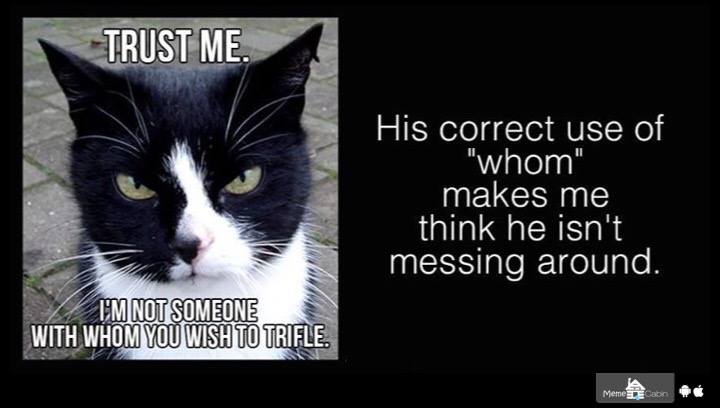
whom seems incorrect in this usage.
The cat--he--is someone you do not wish to trifle.
the whom is referring back to the cat, not you/he.
"I'm not someone who you wish to trifle." or "dont **** with me."
would be better.
The cat--he--is someone you do not wish to trifle.
the whom is referring back to the cat, not you/he.
"I'm not someone who you wish to trifle." or "dont **** with me."
would be better.
Reply
0
0

Reply
0
0

Since the structure is "I am not someone," that means that "whom" is referring to the object of the sentence, and is therefore correct.
Reply
0
0


Joined: Sep 2005
Posts: 34,415
Total Cats: 7,531
From: Chicago. (The less-murder part.)
The cat is correct.
The cat is not someone with whom you should trifle.
Reply
0
0





dunce cap.
but I am someone who still thinks that I am correct.
Last edited by Braineack; Apr 20, 2015 at 08:44 PM.
Reply
0
0

Well, it's actually the object of the preposition. "with", hence the objective case.
A reverse case is when you say something like, "He is cross with whoever gets in his way". In that case, "whoever gets" is a noun clause, in which, "whoever" is the subject, "gets" is the verb, respectively of that clause; so use the nominative case, "whoever" instead of "whomever". The clause is the object of the preposition "with" in that instance.
A reverse case is when you say something like, "He is cross with whoever gets in his way". In that case, "whoever gets" is a noun clause, in which, "whoever" is the subject, "gets" is the verb, respectively of that clause; so use the nominative case, "whoever" instead of "whomever". The clause is the object of the preposition "with" in that instance.
Reply
0
0