When you click on links to various merchants on this site and make a purchase, this can result in this site earning a commission. Affiliate programs and affiliations include, but are not limited to, the eBay Partner Network.
Interesting... I never really thought about shore power in the context of warships, but yeah, I guess you'd kind of need to have that available. I guess my experience base for such things only scales up as far as trucks and aircraft. What's the voltage / current on the shore-power hookup for a submarine? I assume each one of those cables is a single conductor.
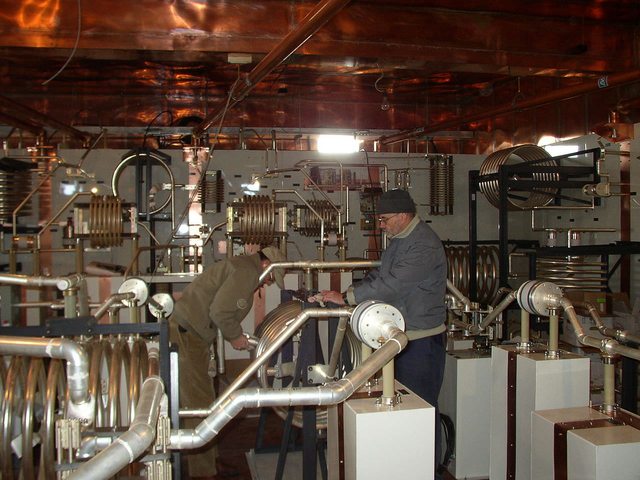
My first job was working at Puget Sound Navy Shipyard- doing lockout/tagout activities on submarine or aircraft carrier repairs. I remember seeing 4160v cabinets and giant scary looking switches/breakers like the ones you posted earlier. Shore power cables were 3-4" diameter (remember stepping over piles of them on my way to the bridge)- no clue what amperage but I'd assume it was allofit. I mostly did piping and valve stuff, not much electrical work- thank God I never killed anyone.
They had some procedure where part of the cabinet was live- electrician wearing shield, apron, standing on a rubber mat with a rope tied around him and a spotter holding the other end of the rope to drag them away if something happened. Scary.
They had some procedure where part of the cabinet was live- electrician wearing shield, apron, standing on a rubber mat with a rope tied around him and a spotter holding the other end of the rope to drag them away if something happened. Scary.
Sounds familiar. We had a similar procedure for doing work on the big panel down in the basement of the Empire State Building. The electrician wore a suit of chain mail with a metal helmet, all of which was bonded to ground, used a long wooden pole to operate the switch, and wore a nylon belt that extended to the other side of the room where the spotter was.
Unrelated, I think there's still space for me to cram a few more monitors into NewsCenter. What do you guys think?
I believe that Russian nuclear subs can provide power to on-shore military and civilian infrastructure in case of such need. I don't believe there is such design for US ones, but it was looked into for military and humanitarian purposes.
Although I'm sure it would be possible to engineer a solution for this, I don't think it is a current capability the US has built into it's ships. Plus, the infrastructure for connecting would have to be built into whatever shore location was already there. For humanitaian/disaster stuff, the best use of an aircraft carrier or ambhib is in the production of potable water pierside (plus delivery by rotary-wing) and as a mobile hospital. Delivering generators and fuel to areas in need is a far better solution than pulling a CVN pierside in a disaster zone and juicing to the local power grid. I've done humanitarian ops from a CVN. The ship will make something like 500,000 gallons a day... and we get no showers, and the food changes since they switch to a "water-minimal" menu.
Getting the water to the beach is interesting... if you're pierside, there usually aren't enough buffalo's or tanker trucks able to reach a pier in order to transport it all away. Plus, there are only so many ports in the world that Naval Reactors has certified to take a carrier. If you have to rely on air-delivery, you're kinda limited to bottled water, which doesn't realy on the ship to make.
Every time I open one of the Dejero boxes, I feel like Bruce Willis is going to show up and disarm it at the last second. (Or grab it and toss it into the lake.)
Im trying to figure out what this does exactly. Is it like a portable video processor and transmitter with a bunch of diversity (the 6+ antennas in the lid)?






 6
6