


How (and why) to Ramble on your goat sideways



Joined: Apr 2014
Posts: 18,643
Total Cats: 1,870
From: Beaverton, USA

What causes basilar skull fractures in motor sports incedents? All Google turns up is "a hard blow to the head". What movements stress the skull enough to break it?
Reply
 0
0

0
Elite Member

Joined: Mar 2007
Posts: 5,306
Total Cats: 887
From: Santa Clara, CA
Yes, you should buy a HANS.
--Ian
Reply
0
0

Elite Member
Joined: Oct 2011
Posts: 3,693
Total Cats: 222
From: OKC, OK
Because your torse remains stationary and your head does not. As has already been explained.
Go watch some IIHS (or whatever it's called) crash test videos if for some reason this still isn't making sense. Your head gets whipped about mightly in even low speed crashes.
Go watch some IIHS (or whatever it's called) crash test videos if for some reason this still isn't making sense. Your head gets whipped about mightly in even low speed crashes.
Reply
0
0

Since our shoulder harnesses cover both shoulders holding them firmly back into our seats, a sudden deceleration injury would allow our head to flex rapidly forward and down, thereby causing fractures to the base of the skull and/or the upper cervical vertebrae. This typically causes death by several means, including damage to the upper spinal cord and/or lower part of the brain resulting in the inability to move and breath.

Reply
0
0


Joined: Sep 2005
Posts: 34,433
Total Cats: 7,549
From: Chicago. (The less-murder part.)
A brief synposis from Race Drivers' Head Injuries Misunderstood - tribunedigital-chicagotribune
When a car crashes, usually against an immovable concrete retaining wall, the "rapid deceleration"--i.e., the sudden stop--creates surges of energy, many times the force of gravity, called "G-spikes."
Inertia, which is the physical tendency of mass to continue in motion at a sustained rate, tries to keep the human body moving forward inside the car. But the driver's safety "harness" (a system of lap and shoulder belts) stops the pelvis first, then the torso. That leaves the head, which at 10-12 pounds is the heaviest part of the human body, in motion--and in violent velocity relative to the car.
"The neck is now acting as the restraint, or the tether, for the head," Melvin says. And when the head reaches the end of its tether but strains to continue moving under tremendous "G-loading," the fatal damage occurs "right then and there," Melvin says.
The forces are trying to pull everything in the head and neck straight through the top of the skull. But the top is strong enough that when, literally, something has to give, the base--the weakest part of the skull--usually cracks. If it doesn't, then the neck usually breaks and/or severe brainstem stretching occurs.
Inertia, which is the physical tendency of mass to continue in motion at a sustained rate, tries to keep the human body moving forward inside the car. But the driver's safety "harness" (a system of lap and shoulder belts) stops the pelvis first, then the torso. That leaves the head, which at 10-12 pounds is the heaviest part of the human body, in motion--and in violent velocity relative to the car.
"The neck is now acting as the restraint, or the tether, for the head," Melvin says. And when the head reaches the end of its tether but strains to continue moving under tremendous "G-loading," the fatal damage occurs "right then and there," Melvin says.
The forces are trying to pull everything in the head and neck straight through the top of the skull. But the top is strong enough that when, literally, something has to give, the base--the weakest part of the skull--usually cracks. If it doesn't, then the neck usually breaks and/or severe brainstem stretching occurs.
Reply
0
0

...
When a car crashes, usually against an immovable concrete retaining wall, the "rapid deceleration"--i.e., the sudden stop--creates surges of energy, many times the force of gravity, called "G-spikes."
Inertia, which is the physical tendency of mass to continue in motion at a sustained rate, tries to keep the human body moving forward inside the car. But the driver's safety "harness" (a system of lap and shoulder belts) stops the pelvis first, then the torso. That leaves the head, which at 10-12 pounds is the heaviest part of the human body, in motion--and in violent velocity relative to the car.
"The neck is now acting as the restraint, or the tether, for the head," Melvin says. And when the head reaches the end of its tether but strains to continue moving under tremendous "G-loading," the fatal damage occurs "right then and there," Melvin says.
The forces are trying to pull everything in the head and neck straight through the top of the skull. But the top is strong enough that when, literally, something has to give, the base--the weakest part of the skull--usually cracks. If it doesn't, then the neck usually breaks and/or severe brainstem stretching occurs.
Inertia, which is the physical tendency of mass to continue in motion at a sustained rate, tries to keep the human body moving forward inside the car. But the driver's safety "harness" (a system of lap and shoulder belts) stops the pelvis first, then the torso. That leaves the head, which at 10-12 pounds is the heaviest part of the human body, in motion--and in violent velocity relative to the car.
"The neck is now acting as the restraint, or the tether, for the head," Melvin says. And when the head reaches the end of its tether but strains to continue moving under tremendous "G-loading," the fatal damage occurs "right then and there," Melvin says.
The forces are trying to pull everything in the head and neck straight through the top of the skull. But the top is strong enough that when, literally, something has to give, the base--the weakest part of the skull--usually cracks. If it doesn't, then the neck usually breaks and/or severe brainstem stretching occurs.
Also not mentioned, the added weight of a helmet only exacerbates the problem.
Reply
0
0

Feel the back of your head. Besides your face, which has no force acted on it in this case, it's the flatest part of your skull. Strength of flat< strength of curve.
I've seen some pretty impressive skull fractures, and the basal type is the most common.
I've seen some pretty impressive skull fractures, and the basal type is the most common.
Reply
0
0
Joined: Apr 2014
Posts: 18,643
Total Cats: 1,870
From: Beaverton, USA
I get that theres alot of force. And it's a weak part of your skull. But for something to break don't you need forces in opposite directions on it?
Reply
0
0

I'm not even sure what you aren't understanding at this point.
The force of the impact (eg, sudden deceleration) pulls your head forward. Your body cannot move with it because you're strapped to your seat.
The force of the impact (eg, sudden deceleration) pulls your head forward. Your body cannot move with it because you're strapped to your seat.
Reply
0
0
Elite Member
Joined: Mar 2007
Posts: 5,306
Total Cats: 887
From: Santa Clara, CA
Your head, OTOH, is only restrained by your neck. Basically it's like giant fingers come down and try to pull your head off.
--Ian
Reply
0
0
I think you might be confused about the nature of the fracture. In this case, it isn't caused by compression, but rather tension. Think of it as the base of your skull being torn apart.
Reply
0
0
Joined: Apr 2014
Posts: 18,643
Total Cats: 1,870
From: Beaverton, USA
Yes. That is physics. I understand this.
Tell me what makes the skull break.
What I've heard so far is:
You break your leg when you fall from a tall building.
Not: the force of your body impacts onto your leg which had met an imovable object.
Tell me what makes the skull break.
What I've heard so far is:
You break your leg when you fall from a tall building.
Not: the force of your body impacts onto your leg which had met an imovable object.
Reply
0
0
Joined: Sep 2005
Posts: 34,433
Total Cats: 7,549
From: Chicago. (The less-murder part.)
Once the torso stops moving, the head is still carrying significant momentum. It flexes forward across the neck, and wants to continue moving forward. The brain, the skull, the helmet, all that stuff is trying to pull the moving head forward against the stationary body.
The skull is anchored to the body by the tendons and ligaments of the neck, which attach to the skull at a point near the base. That's roughly where the fracture occurs.
I don't see why this is hard to understand.
Imagine that you have an elevator at the top floor of the World Trade Center. The elevator is your head, and the building is your body. The cable between the two is your neck.
You release the brakes and de-clutch the motor, which allows the elevator to start plummeting towards the ground. At about the 30th floor, you suddenly apply the brakes to the cable spool up on the roof. The elevator car has built up a lot of momentum during its fall, so it starts straining against the cable. The cable starts to stretch. If the part of the elevator car to which the cable attaches is weaker than the cable itself, then that section of the car will be ripped off and remain attached to the cable, while the rest of the car falls to the ground. That attachment point is the base of the skull.
Reply
0
0
Joined: Apr 2014
Posts: 18,643
Total Cats: 1,870
From: Beaverton, USA
So your neck muscles pull on your head? And pull a bit of skull off?
So the tendons are stronger than the bit of skull where it fractures?
Reply
0
0
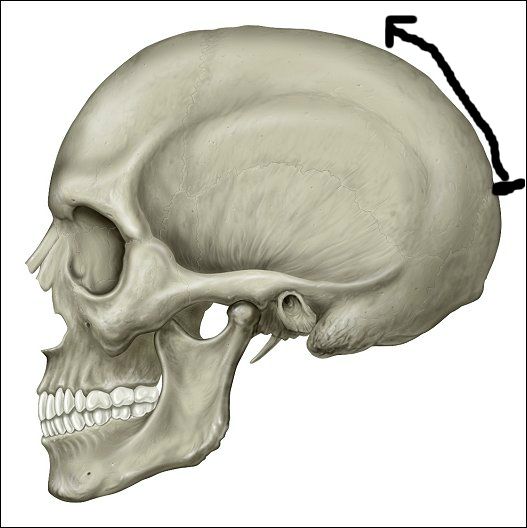
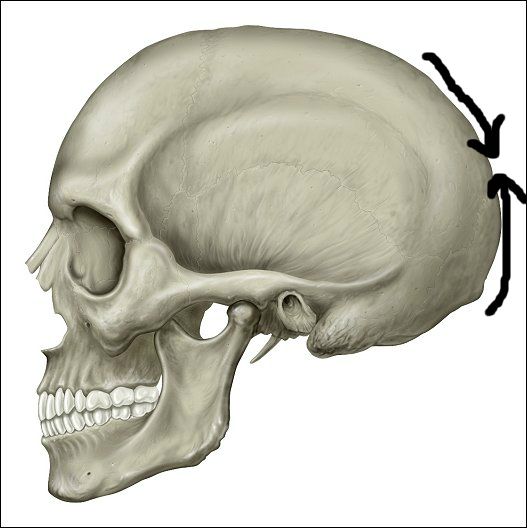
Your neck muscle are just holding the base of your skull stationary, which makes for a nice anchor.
Unfortunately, inertia tears the skull off at the anchor.
Like this:
Not like this:
Unfortunately, inertia tears the skull off at the anchor.
Like this:
Not like this:
Reply
0
0
Elite Member
Joined: Mar 2007
Posts: 5,306
Total Cats: 887
From: Santa Clara, CA
"Basically," Hubbard explains, "our heads are secured to our bodies by a series of tendons and ligaments. These tendon and ligament fibers penetrate into the base of the skull and anchor into the bone tissue.
"When a racing car goes headfirst into a tire wall," he continues, "the driver's body is fairly well secured to the car via the seatbelts, and as the car decelerates quickly, so does the body. The driver's head, which weighs about 10 pounds without a helmet, keeps moving. It's like a pendulum that's anchored at the shoulders and relies on the neck to hold it in place. The strain on those neck tendons and ligaments is enormous, and the weak link is the base of the skull, the anchor point for the head. If the accident is severe enough, the base of the skull breaks. Then you get stretching of the spinal cord and the breaking of major blood vessels that go to and from the brain. The skull fracture itself isn't deadly, but either the brain trauma or the loss of blood flow is."
--Ian
Reply
0
0
Joined: Apr 2014
Posts: 18,643
Total Cats: 1,870
From: Beaverton, USA
From http://www.caranddriver.com/features...-neck-feature:
"Basically," Hubbard explains, "our heads are secured to our bodies by a series of tendons and ligaments. These tendon and ligament fibers penetrate into the base of the skull and anchor into the bone tissue.
"When a racing car goes headfirst into a tire wall," he continues, "the driver's body is fairly well secured to the car via the seatbelts, and as the car decelerates quickly, so does the body. The driver's head, which weighs about 10 pounds without a helmet, keeps moving. It's like a pendulum that's anchored at the shoulders and relies on the neck to hold it in place. The strain on those neck tendons and ligaments is enormous, and the weak link is the base of the skull, the anchor point for the head. If the accident is severe enough, the base of the skull breaks. Then you get stretching of the spinal cord and the breaking of major blood vessels that go to and from the brain. The skull fracture itself isn't deadly, but either the brain trauma or the loss of blood flow is."
--Ian
"Basically," Hubbard explains, "our heads are secured to our bodies by a series of tendons and ligaments. These tendon and ligament fibers penetrate into the base of the skull and anchor into the bone tissue.
"When a racing car goes headfirst into a tire wall," he continues, "the driver's body is fairly well secured to the car via the seatbelts, and as the car decelerates quickly, so does the body. The driver's head, which weighs about 10 pounds without a helmet, keeps moving. It's like a pendulum that's anchored at the shoulders and relies on the neck to hold it in place. The strain on those neck tendons and ligaments is enormous, and the weak link is the base of the skull, the anchor point for the head. If the accident is severe enough, the base of the skull breaks. Then you get stretching of the spinal cord and the breaking of major blood vessels that go to and from the brain. The skull fracture itself isn't deadly, but either the brain trauma or the loss of blood flow is."
--Ian
Joe. You once again explained the physics of the crash. Not the anatomy of the injury.
Reply
0
0


