


Virtual Dyno




Joined: Oct 2011
Posts: 5,718
Total Cats: 830
From: Detroit (the part with no rules or laws)

Oh, never knew this thread was here. I used this and posted results in my progress log. (it's killing my self esteem) 
I think It's pretty cool the owner of this program represents it himself around forums like this. Props. Donated, it's not much but it's what i can do. Looking forward to future updates to the program.
I think It's pretty cool the owner of this program represents it himself around forums like this. Props. Donated, it's not much but it's what i can do. Looking forward to future updates to the program.
Reply
 0
0

0


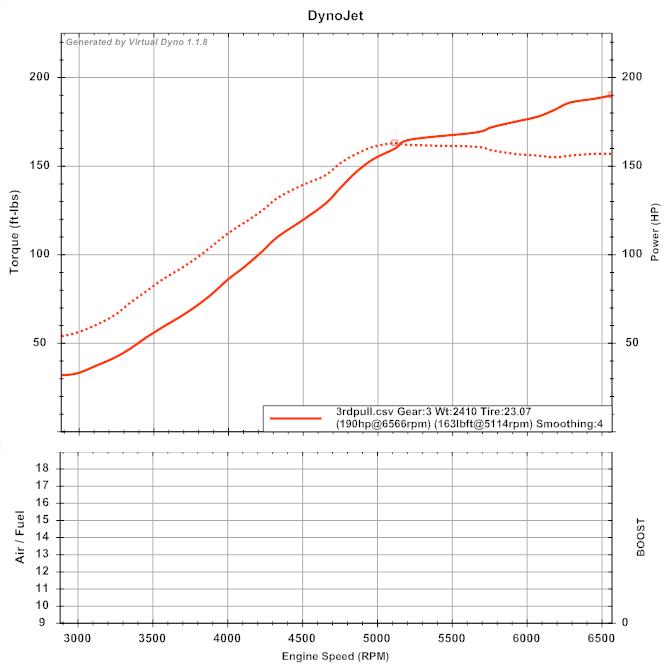
Hey! Since my first VD graph is in this thread I may as well update the new one for progress. Same boost level as the last one, new timing map thanks to brain. Mucho better.
Reply
0
0
That must feel much better. Making more TQ earlier, and 10% more at peak. Plus the extra 30 horses
I've been playing with my tune lately as I was dubious of the results shown a page or so ago in this thread. I also wanted to make sure that I was seeing consistency in the graphing of the logfiles as interpreted by Virtual Dyno from run to run. I made three 3rd gear pulls the other day in the span of 10min with as much control over any variables as possible and here's what I came up with.
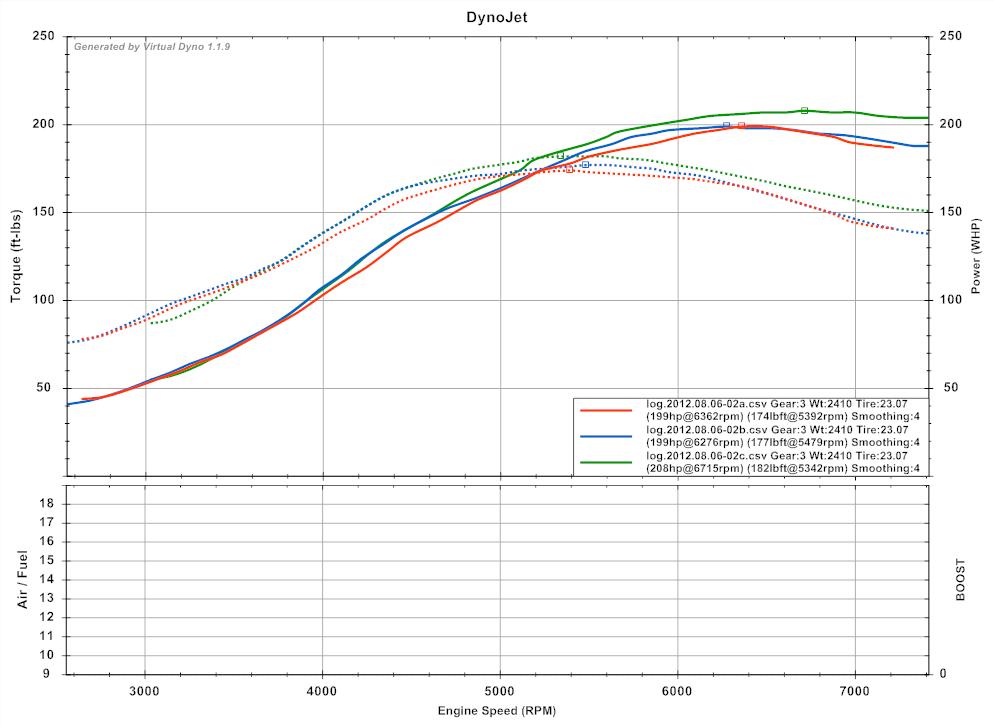
Looking at the logs after they were graphed, the green run log shows I had 1lb/min more airflow on that pull, which reflects the general idea that a change of 1lb/min = 10whp. Glad to see that line up as well. Eventually I'm going to hit the local DynoDynamics and see how it compares on the same tune, as I'm logging 23-24lb/min airflow but showing ~200hp in VD. I really don't want to leave that extra 30-40 "safe" hp on the table if I'm really only making 200 at the wheels.
Edit: I decided to search and see if there were any folks who had done any of this comparison testing before I drop coin on it. There are plenty of threads where favorable comparisons are made. Here's a link I found that shows me enough to be reasonably convinced of it's accuracy wrt actual dynos. Logs made during dyno runs are converted to VD graphs and compared.
Our Experiments With Virtual Dyno « Innovative Tuning
Brad you ought to drop that link every chance you get lol.
I've been playing with my tune lately as I was dubious of the results shown a page or so ago in this thread. I also wanted to make sure that I was seeing consistency in the graphing of the logfiles as interpreted by Virtual Dyno from run to run. I made three 3rd gear pulls the other day in the span of 10min with as much control over any variables as possible and here's what I came up with.
Looking at the logs after they were graphed, the green run log shows I had 1lb/min more airflow on that pull, which reflects the general idea that a change of 1lb/min = 10whp. Glad to see that line up as well. Eventually I'm going to hit the local DynoDynamics and see how it compares on the same tune, as I'm logging 23-24lb/min airflow but showing ~200hp in VD. I really don't want to leave that extra 30-40 "safe" hp on the table if I'm really only making 200 at the wheels.
Edit: I decided to search and see if there were any folks who had done any of this comparison testing before I drop coin on it. There are plenty of threads where favorable comparisons are made. Here's a link I found that shows me enough to be reasonably convinced of it's accuracy wrt actual dynos. Logs made during dyno runs are converted to VD graphs and compared.
Our Experiments With Virtual Dyno « Innovative Tuning
Brad you ought to drop that link every chance you get lol.
Reply
0
0

I'm Miserable!
Joined: Jun 2009
Posts: 1,866
Total Cats: 0
From: albany, ga
I say between 9.5 to 10.5hp per lb\min of air mass moved
so 23-24lb\min around 240hp~ then say 15% drive train loss around 200 whp.
One day I will test this myself on the dynojet dyno.
so 23-24lb\min around 240hp~ then say 15% drive train loss around 200 whp.
One day I will test this myself on the dynojet dyno.
Reply
0
0

Junior Member
Joined: Jan 2012
Posts: 66
Total Cats: 3
From: Kansas City, KS
Our Experiments With Virtual Dyno « Innovative Tuning
Brad you ought to drop that link every chance you get lol.
Brad you ought to drop that link every chance you get lol.

Reply
0
0

Joined: Oct 2011
Posts: 5,718
Total Cats: 830
From: Detroit (the part with no rules or laws)
Had a little hiccup with mine. On my desktop i think when it went to update to 1.1.9 something happened and every time i opened it the window would not come up. Only the icon on the task bar would come up.
Just had to reinstall and it works now. Not that big of a deal, just thought i should share. It updated fine on my laptop, so it's probably just me.
Just had to reinstall and it works now. Not that big of a deal, just thought i should share. It updated fine on my laptop, so it's probably just me.
Reply
0
0
Junior Member
Joined: Jan 2012
Posts: 66
Total Cats: 3
From: Kansas City, KS
Weird ... had one more user do something similar but I dont know what it was. His would fail to open after the update. Totally different symptoms but ... still worries me a little. Not that much as a reinstall is possible.
Reply
0
0


Finally got my exhaust comparison, I'll cross post this from my build thread.
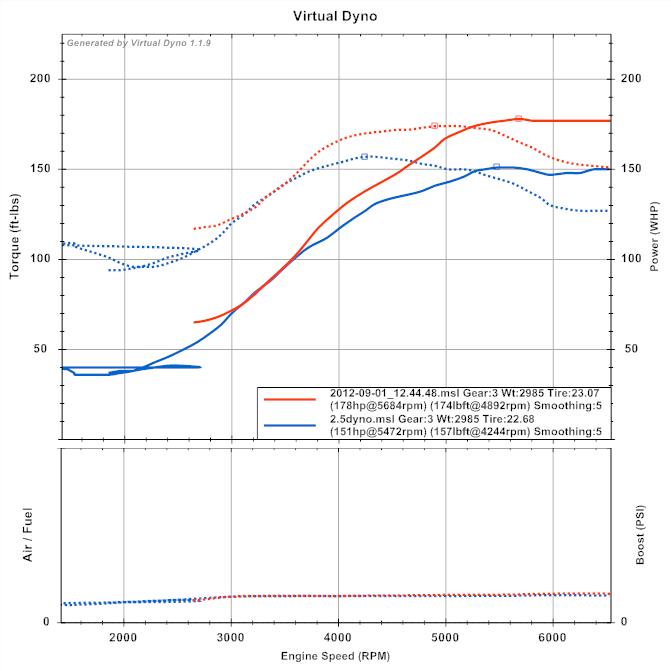
Only thing that changed was the exhaust. I altered the weight to get the same dyno results of 155 HP on the 2.5 graph, then used those numbers again.
Now I just need to figure out why my MBC isnt working.
Only thing that changed was the exhaust. I altered the weight to get the same dyno results of 155 HP on the 2.5 graph, then used those numbers again.
Now I just need to figure out why my MBC isnt working.
Reply
0
0
Curly, couple of things:
1. Best way to match VD output to your dyno is by setting the "Dyno Correction Factor." This is found under File=>Options=>Dyno. What you did (changing weight) "sort of" works but skews the curve. Here's why:
There are three components that go into VD's torque calculation. They are:
a. Newtonian physics (F = MA). Your car has mass (M) and it takes force (F) to accelerate at rate (A).
b. In addition, we need to add rolling resistance, which is a fudged value based upon mass (M) and speed.
c. In addition, we need to add wind resistance, which is calculated from speed and the Cd/frontal area of your car.
So, if you change weight rather than use the "Dyno Correction Factor," you are changed calculations 1 & 2 but not calculation 3. This changes the curve shape somewhat.
2. The new exhaust has altered your engine's volumetric efficiency at higher RPM. I'd recommend some fuel tuning to compensate.
That's it. Great results. I'm looking to mimic what you did (our starting points are remarkably similar).
1. Best way to match VD output to your dyno is by setting the "Dyno Correction Factor." This is found under File=>Options=>Dyno. What you did (changing weight) "sort of" works but skews the curve. Here's why:
There are three components that go into VD's torque calculation. They are:
a. Newtonian physics (F = MA). Your car has mass (M) and it takes force (F) to accelerate at rate (A).
b. In addition, we need to add rolling resistance, which is a fudged value based upon mass (M) and speed.
c. In addition, we need to add wind resistance, which is calculated from speed and the Cd/frontal area of your car.
So, if you change weight rather than use the "Dyno Correction Factor," you are changed calculations 1 & 2 but not calculation 3. This changes the curve shape somewhat.
2. The new exhaust has altered your engine's volumetric efficiency at higher RPM. I'd recommend some fuel tuning to compensate.
That's it. Great results. I'm looking to mimic what you did (our starting points are remarkably similar).
Reply
0
0


